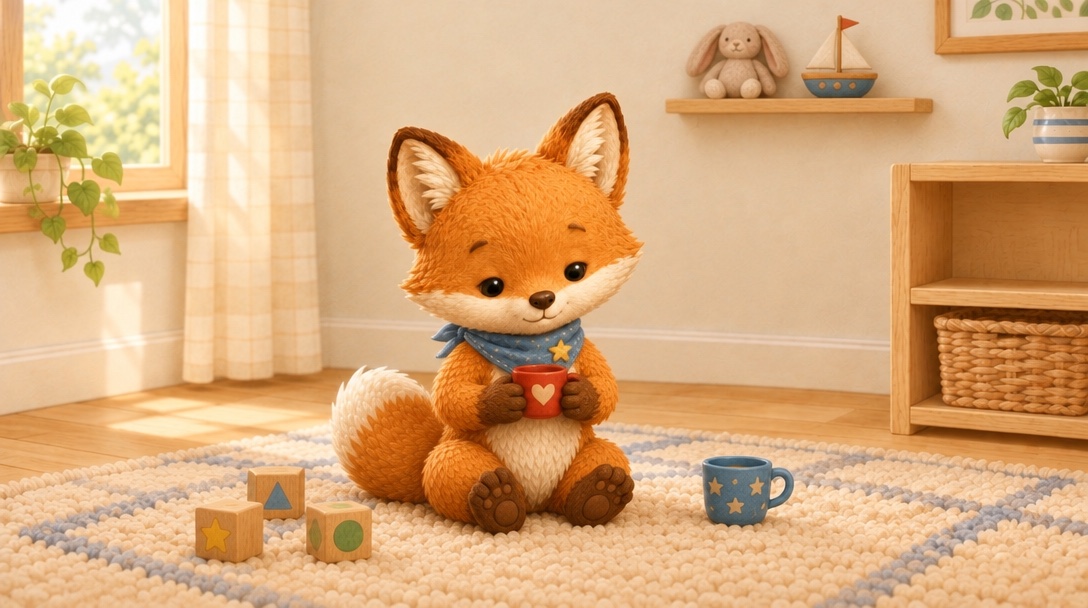
Before my friend comes, I pick two special things. They go up high, and they wait for me there.
Everything else is for both of us today.
Sometimes we both want the same thing at the same time. That happens to lots of kids.
When I am holding something, I am still using it.
I can say, "I'm still using it. You can have it when I'm done."
Waiting is hard. My friend might feel sad while they wait.
When I am the one waiting, my grown-up stays close to me. The waiting gets a little smaller.
When I am done, it goes to my friend. Then it is their turn.
Sometimes we use something together, like one big box we push all the way across the room.
Having a friend over is new, and I am learning. My grown-ups love me.
Finn
Still using it. Then it's yours.
Read it once a day at a calm time, never right after a hard moment. The marked line is the words your child can use in the moment. Say it the same way every time.
The same words, at home and at daycare
When two of them want the same thing
What we say, every time
To the one holding it
"You're still using it. Your friend can have it when you're done."
To the one waiting
"Waiting is hard. I'm right here."
1
Come close. Get down to their level. Nobody takes it back for anyone.
2
Say the line once. To both of them, same words, quiet voice. No lecture.
3
Stay with the one waiting. Offer something else to do while they wait.
We say it the same way every time. So does everyone who looks after Nia.
Tear here for the teacher
For the teacher
Nia's grown-ups use these words. It helps if you do too.
At home we let a child finish their turn, and we stay with the one who is waiting. Raising Children Network puts it simply: "It's unrealistic to expect your toddler to share consistently." We are not asking for anything new, just the same words.
The line we use at home
"You're still using it. You can have it when you're done."
And to the one waiting: "Waiting is hard. I'm right here."
Nia's own words: "I'm still using it."
Write back to us
Waited for a turn, with help
Handed something over when done
Hard to give up:
Dear Ms. Lee, thank you. Mom and Daddy, for Nia.
For the grown-ups
Sharing, on one page
What every pediatric body agrees on, and what the parents who got through it did. Most of it happens before the doorbell rings.
Before a friend comes
Let them pick two special things and put them up high. Everything else is for both kids.
Have two of the favourites. Two cups, two trucks, two of whatever they fight over.
Keep it to about an hour. End while it is still going well.
Read the story the day before, at a calm time.
In the moment
To the one holding it: "You're still using it. Their friend can have it when you're done."
To the one waiting: "Waiting is hard. I'm right here." Then offer something else.
A timer is fine if it helps your family. So is letting them finish.
No sticker for sharing. A warm word is enough: "You gave your friend the cup. Look at that face."
The other grown-up
Say your plan out loud: "We're doing turns here. Nia's finishing, then it's your little one's turn."
If they make their child hand it over: "It's okay, let them finish. I'll help Nia wait."
It's not a verdict on your parenting. Nearly every parent of a two-year-old has stood in this exact spot.
What to expect
"Mine" is normal, and it's a step forward: toddlers who say it tend to share more later.
At two, sharing comes now and then. Around three, it starts to show. It settles through four and five.
With a sibling, give each child a few things of their own that they never have to share.
What's behind this: the American Academy of Pediatrics, the Canadian Paediatric Society, Zero to Three, Raising Children Network, the CDC, and parents' own stories. The full guide is at fablefleet.com/sharing-social-story-printable.