
· Updated
Pacifier Weaning: When to Stop and How to Do It Without a Meltdown
Pacifier weaning is helping your child let go of the pacifier for good. For a toddler, the honest version of the advice is simple: sleep only now, gone by three, and done in a way your child owns. Three is the age the dentists agree on, because how long the habit lasts matters more than how often. Nobody has studied which way of stopping works best, so gradual and cold turkey are both fine. The parents who did it well all did the same things: a quiet two weeks, a short countdown, the child fills the bag, a comfort object already in the bed, and no giving it back on night two. Expect one to three hard nights, then a few weeks of asking now and then.
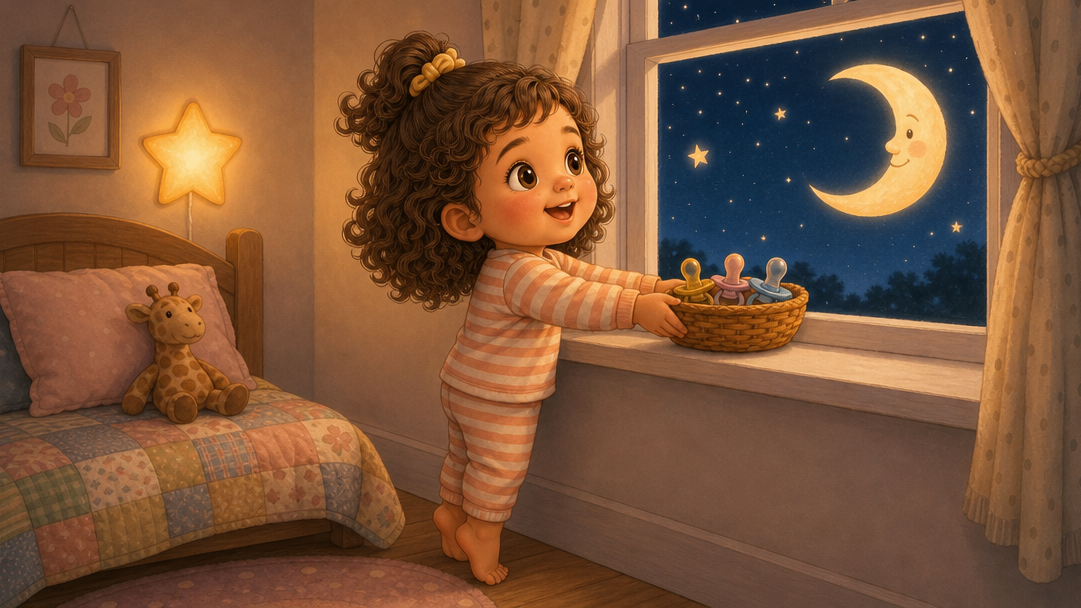
Sleep only now, gone by three, and a goodbye your child helps plan. That's the whole thing. The rest of this is where it comes from, which bits are real evidence and which bits are moms comparing notes, and what to do when it stalls.
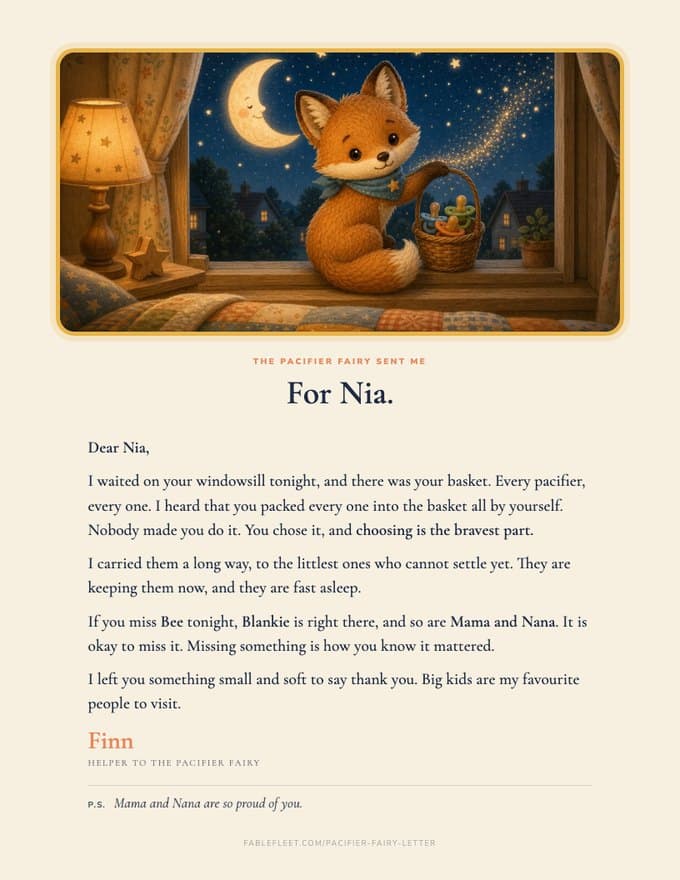
Free to print: a letter from Finn, the pacifier fairy's helper, with your child's name in it.
The giraffe
Neither of my kids ever took to a pacifier. We tried. What they loved was a little soother sewn onto a stuffed giraffe, and I can tell you the giraffe did all the work. The soother part got ignored within weeks; the giraffe went everywhere for two years. I didn't know it at the time, but that's the whole trick to this: the pacifier goes a lot easier when there's already something soft in its place.
So I never had the 2 a.m. night where the tiny hand pats the empty spot in the crib. But I've sat with a lot of moms who did, and when I started writing this I did what I always do: asked the friends who'd been through it, then read everything I could find at night, about seventy parents' stories of the week the paci left, plus what the pediatricians and dentists actually say. Here's what I'd tell you if we were at the park.
When to stop the pacifier: sleep only now, gone by three
Before my second baby, a friend with three kids told me the thing that stuck: the pacifier isn't the enemy, it just has an expiration date. Early on it has a real job. Babies need to suck, and the American Academy of Pediatrics says a pacifier at naps and bedtime lowers the risk of SIDS. If you started one on purpose, you did a sensible thing.
Here's the part that confused me when I went looking: the experts don't all say the same age, and it's because they're worried about different things. The ear infection advice is about babies. The AAP's own line is to wean in the second half of the first year for that reason. The teeth advice is about three. The American Academy of Pediatric Dentistry's policy says it in one line: "discontinuance of nonnutritive sucking habits by 36 months of age." The Canadian Paediatric Society says "plan to give it up by 3-4 years of age," and the Cleveland Clinic says it's "typically fine to let kids use a pacifier for bedtime and naps up to age 3."
So if you're reading this with a two year old, the baby advice is behind you, and the age that matters now is three. The Cleveland Clinic is the one that spells out the shape, and it's the shape I'd use: daytime goes first, somewhere between one and eighteen months, and the sleep pacifier stays a while longer. Sleep only now. Gone by three. Done in a way your child owns, because letting the child do the giving is the one thing every single expert agrees on.
Ready looks like this: the pacifier only comes out for sleep or big upsets, your child can be talked out of wanting it, and your child can follow a simple chat about saying goodbye, which most can around two and a half. If it's still in all day at that age, it isn't going to drift away on its own. And don't pile the goodbye on top of something else big: a new baby, a move, starting daycare, a cold. Pick a boring two weeks. The longer version of the timing question is in when to stop pacifier.
Teeth, ears, speech: what the pacifier actually risks
I'm not a dentist. My rule for anything medical is name it, show where it comes from, then send you to your own pediatrician. And I'll own this: the first version of this post had these three in the wrong order. Most pacifier articles do.
Teeth: real, and about time. The dentists' own words: "malocclusion was affected by duration more than frequency." How long the habit lasts matters more than how many hours a day. Kids still using one at three or later have a clearly higher rate of open bite, where the front teeth don't meet. The good news: it usually fixes itself if the habit stops before three. The first dental visit is recommended between one and two, and that's a natural moment to ask.
Ears: small, and mostly about babies. Pacifiers do raise the chance of ear infections a bit, which is why the first year advice exists. The effect is modest and the research isn't strong. For a toddler using one at sleep only, this isn't the reason to rush.
Speech: the weakest of the three. You'll read everywhere that pacifiers cause speech delay. The dentists, who have every reason to be against pacifiers, say the evidence "is limited," and that "a strong speech-related justification against pacifier use is not evident." A talking toddler with a binky in all day is worth fixing, because you can't babble around one. That's a reason for sleep only. It isn't a reason to panic.
None of that says rip it out tonight. It says aim for three, and the thing to protect is how long the habit runs, not how perfectly you pull off the goodbye.
How to wean off the pacifier: two roads, and what nobody has studied
Here's the sentence you won't find in most pacifier posts: nobody has studied which way works. The only proper review of how kids stop sucking habits, from Cochrane in 2015, pulled together six small studies, and in its own words: "Only finger or thumb sucking was studied. None of the trials looked at pacifiers." Nobody has tested gradual against cold turkey, or the fairy against a trade-in at the toy store. So when a post tells you one way is proven gentler, it's guessing. What you've actually got is the doctors' best judgment and what parents report. Both roads are fine.
Gradual is what the Cleveland Clinic suggests ("a gradual approach rather than making children quit cold turkey"): shrink the pacifier to one window, usually sleep, then close that one too. No single day is a cliff. It suits a younger toddler, and a parent who'd rather hold steady for two weeks than survive two awful nights.
Cold turkey is what most sleep consultants suggest when the pacifier is how your child falls asleep. Their logic: no option is easier than sometimes. Expect a few rough nights and hold the line, because caving on night two teaches that enough crying brings it back. Nearly every parent who went this way paired it with a goodbye, so their child had a story for where it went instead of waking up to it missing.
The thing that can actually backfire is on the other side of fast. The dentists point to research linking taking the pacifier away early, before the child is ready, to thumb sucking instead. Two moms I read described exactly that: the binky left, the thumb showed up, and you can't give a thumb to the fairy. So the lesson isn't slow versus fast. It's that your child has to be ready, and your child has to do the giving.
Whatever road, two things make it kinder. Have something soft ready a week or two before, so it's already a friend by the night. For a child over one, a small blanket or a stuffed animal. (Mine was a giraffe.) Make a fuss of the not sucking. Every expert lands here: praise, stickers, a proud phone call to Grandma. The AAP says "harsh words, teasing, and punishment" only upset a child, and the dentists say the same thing, that criticism risks "power struggles which could extend the duration of the habit." The step by step for both roads is in how to wean off pacifier.
What the moms who did it well all did
This is the part I read at night. About seventy families, the week the paci left. The smooth ones all did the same handful of things. It isn't research. It's the pattern.
- A quiet two weeks. No new baby, no move, no cold, no first week of daycare. Almost every story that dragged on for a week or more was a timing problem.
- Sleep only first. The daytime pacifier goes quietly, one place at a time, before the goodbye night.
- A countdown of a few days. "In three sleeps, the pacifiers go to the littlest ones." Nearly every smooth story had a warning like this.
- The soft thing is already in the bed. Introduced before, not handed over on the night.
- Every room, every bag, the car seat. A spare turning up on night two was the number one way this fell apart.
- Your child fills the bag. Every one. If they ask to keep one, wait. Most put it in.
- A small, soft gift and a letter. Big gifts didn't buy easier nights. The letter is what the kids kept.
- One to three hard nights, then a few weeks of asking now and then.
- Never give it back on night two. And never use the fairy, or teeth, as a threat. Not one mom said that worked.
When it stalls: the three things that actually happen
"The babies will be done with it soon." Toddlers negotiate. If the pacifiers went to the babies, your child will work out that the babies could give them back. Your story has to close that door: the littlest ones keep them, that's the whole point of giving. Say it once, warmly, and don't debate it.
Asking for it months later, when sick. This is the one parents don't see coming. A cold four months on, and the request is back. Hold firm, pile on the other comfort, and it passes in a few nights. Give it back here and you start over.
A sibling's or daycare's pacifier. It will end up in your child's mouth at some point. Expected, short, usually funny. "That one's the baby's. Yours went to the littlest ones." Move on.
If you've done all of it and your child genuinely can't let go, or the upset runs well past a week, stop and ask your pediatrician. There's no prize for white knuckling this alone.
The goodbye: the pacifier fairy, the paci party, the binky trade-in
This is the part that's genuinely mine. If a friend asked me, I'd say make it a little goodbye, when your child is ready, with a real conversation around it. The doctors agree as far as they go. The Cleveland Clinic suggests a goodbye party, a trade-in for a toy your child picks, or the binky fairy who collects them one night and leaves a small gift. The Canadian Paediatric Society suggests letting your child throw the soother away themselves, or leave it out for the soother fairy. The reason, in the doctors' words, is that it lets a child get involved and understand what's happening. Nobody has studied it. But a pacifier that just vanishes is a loss. A pacifier your child gathered up, talked about and handed over is something they did. Same missing pacifier, completely different feeling.
Two rules fell out of those seventy stories. Nobody spooky comes into the dark room: the bag goes on the windowsill and gets collected from outside. And sad is allowed. "It's okay to miss it" did more than any gift. How to set up the night, and the other goodbyes if the fairy isn't your thing, are in the pacifier fairy. We also made a free letter for the morning after, with your child's name, what they call it, the grown-ups who'll be there, and the soft thing that's right there if they miss it, plus a one page version of the checklist above for you.
Free printable
A letter from Finn, with your child's name in it
For the morning after the pacifiers go. Tap a few things about your family; nothing you type leaves your device.
Who will be there tonight (tap one or two)
The comfort object (what they hold instead)
Optional. Finishes the sentence “I heard that…”
Two pages: the letter from Finn, and a page for you with the night on it. Your answers go into the print page in the address after the #, which your browser never sends to us. How the fairy night works.
Keeping bedtime from falling apart
The fear under all of this is bedtime, and it's fair, because for a lot of kids the pacifier is how they fall asleep. Have a bedtime plan before you take it away, not after, and the soft thing in the bed. One safety line every expert repeats, here in the AAP's words: "Never tie a pacifier to the crib or around the child's neck or hand." Expect some waking for a few nights. A hand on the back, "it's okay to miss it," and nothing more. Hold steady, stay kind, and it settles. The night by night version is in how to wean pacifier at night.
None of this picks the perfect day or makes night three painless. That's still parenting. But going in with the real evidence sorted from the folklore, something soft already in the bed, and a goodbye your child helped plan is about as gentle as this gets.
How FableFleet fits
The goodbye is the part a story can carry. Our milestone films put your child in the story by name, in every scene, to watch the night before a big step so the day feels familiar. The pacifier goodbye is the film we're making next: your child fills the bag, Finn carries it to the littlest ones, the hard night is in there and gets through, and the morning brings the letter. Until it's ready, the free letter is the piece you can hold tonight, and Finn's Bedtime in the app is a calm routine to steady the nights while the pacifier leaves. I didn't have any of it for my daughter. FableFleet didn't exist yet.
More in Pacifier Weaning
- How to Wean Off Pacifier: Gradual, Cold Turkey, and What Makes It Kinder
How to wean off the pacifier: shrink it to sleep only first, then pick one of two roads. Gradual: close the sleep window over a week or two, no single hard night. Clean break: a countdown, your child fills the bag, the pacifiers go somewhere good, and you hold the line for one to three hard nights. Nobody has studied which road works better, so both are fine. What makes either one kinder is the same: a quiet two weeks, a comfort object already in the bed, every spare found, praise instead of shame, and never giving it back on night two.
- How to Wean Pacifier at Night Without Wrecking Sleep
How to wean the pacifier at night: it's the last piece and the hardest, because the pacifier is how your child falls asleep, not just a habit. Daytime goes first. Then either fade it (your child falls asleep with it, you take it out once they're under, and nobody puts it back) or make a clean break with a goodbye. Have a soft thing already in the bed and a bedtime routine that ends the same way every night. Expect one to three hard nights: night one is the worst, night two is less, by night three most children are sleeping fairly well. Never give it back on night two. If your child is under about two and a half and truly distressed, it's too early; put the sleep pacifier back and try again in a few months.
- The Pacifier Fairy: How the Goodbye Ritual Works (and Why It Helps)
The pacifier fairy is a goodbye ritual: your child fills a bag with every pacifier, leaves it on the windowsill, and in the morning the pacifiers are gone and a letter and a small, soft gift are in their place. The pacifiers went to the littlest ones who need them, and they keep them. It works from about two and a half, when a child can follow a three-day plan and do the giving themselves. Nobody has studied it, but pediatricians suggest it, and about seventy families' stories agree on the shape: a quiet two weeks, a countdown, the child fills the bag, every spare found, a soft thing already in the bed, a small gift, a letter, one to three hard nights, and never giving it back on night two.
- When to Stop Pacifier Use: Reading Your Child, Not the Calendar
When to stop the pacifier: sleep only now, gone by three. The experts give different ages because they are worried about different things. The ear infection advice (wean in the first year) is about babies. The teeth advice is about age three: the pediatric dentists say stop by 36 months, because how long the habit runs matters more than how often. The speech worry is the weakest of the three. For a toddler, that means shrink it to sleep only now, and plan the goodbye for somewhere between two and a half and three, when your child can understand it and do the giving. Taking it away earlier than your child is ready is the one thing that reliably backfires.
The story we are making next
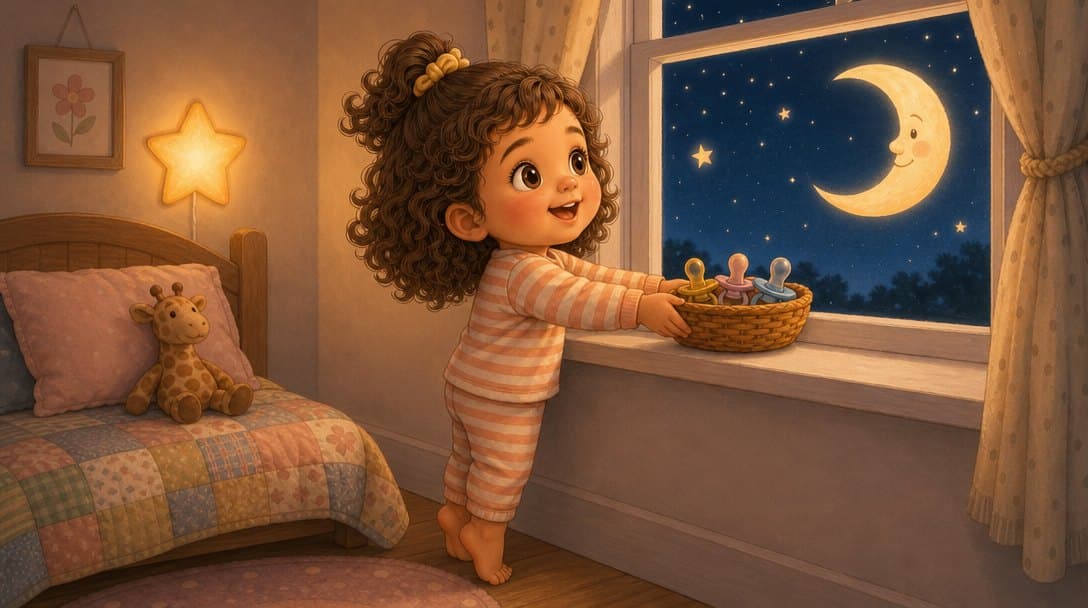
The Pacifier Fairy
Your child, by name, gathering up their pacifiers for the fairy: the brave night, and the morning after. Leave your email and we will tell you the day it is ready to make.
Frequently asked questions
- When should you get rid of the pacifier?
For a toddler: sleep only now, gone by three. Age three is the line the American Academy of Pediatric Dentistry (36 months) and the Canadian Paediatric Society (three to four) agree on for teeth, because how long the habit lasts matters more than how often. The ear infection advice (wean in the first year) is behind you once your child is a toddler. Daytime use goes first, somewhere between one and eighteen months; the sleep pacifier can stay a while longer.
- When should you stop using a pacifier at night?
Nighttime is usually the last and hardest piece, because the pacifier has become part of falling asleep. Aim to be done by three. Have a sleep plan and a comfort object in place before you take it away, not after, pick a quiet two weeks, and expect one to three hard nights with some waking before it settles.
- How do you take away a pacifier?
There is no research showing one method beats another, so both roads are legitimate: gradual (shrink it to sleep only, then close that window) or a clean break with a goodbye ritual such as the pacifier fairy. Either way, let your child do the giving (they fill the bag), have the comfort object already in the bed, sweep every room and the car seat for spares, praise rather than punish, and do not give it back on night two.
- How long does it take to wean off a pacifier?
Parents who did this well report one to three hard nights, then a tail of asking for it now and then for a few weeks. Longer struggles were almost always timing (a new sibling, a move, a cold, a child under two and a half) or a spare pacifier turning up. If the distress runs well past a week, pause and ask your pediatrician.
- What age should a pacifier be taken away according to the AAP?
The American Academy of Pediatrics sets no hard cutoff. It notes that strong, frequent sucking past about two to four years can affect the shape of the mouth and how the teeth line up, and that the bite usually corrects itself if the habit stops before the permanent front teeth come in. The dental body is more specific: stop by 36 months. For ear infections, the AAP's advice is to wean during the second six months of life.
Sources
- American Academy of Pediatrics (HealthyChildren.org), Pacifiers and Thumb Sucking
- American Academy of Pediatric Dentistry, Policy on Pacifiers (revised 2024)
- Canadian Paediatric Society, Pacifiers (soothers)
- Cleveland Clinic, Tips to Wean Your Baby From Pacifiers
- American Family Physician, Pacifiers: Common Questions and Answers (2025)
- Cochrane Review, Interventions for the cessation of non-nutritive sucking habits in children (2015)
FableFleet team
Founders & moms, FableFleet
We're a small team of moms building the personalized children's stories we wished existed for our own kids. Everything we publish is rooted in lived experience and cited research.