
Bedtime Routine Chart for Toddlers (Free Printable)
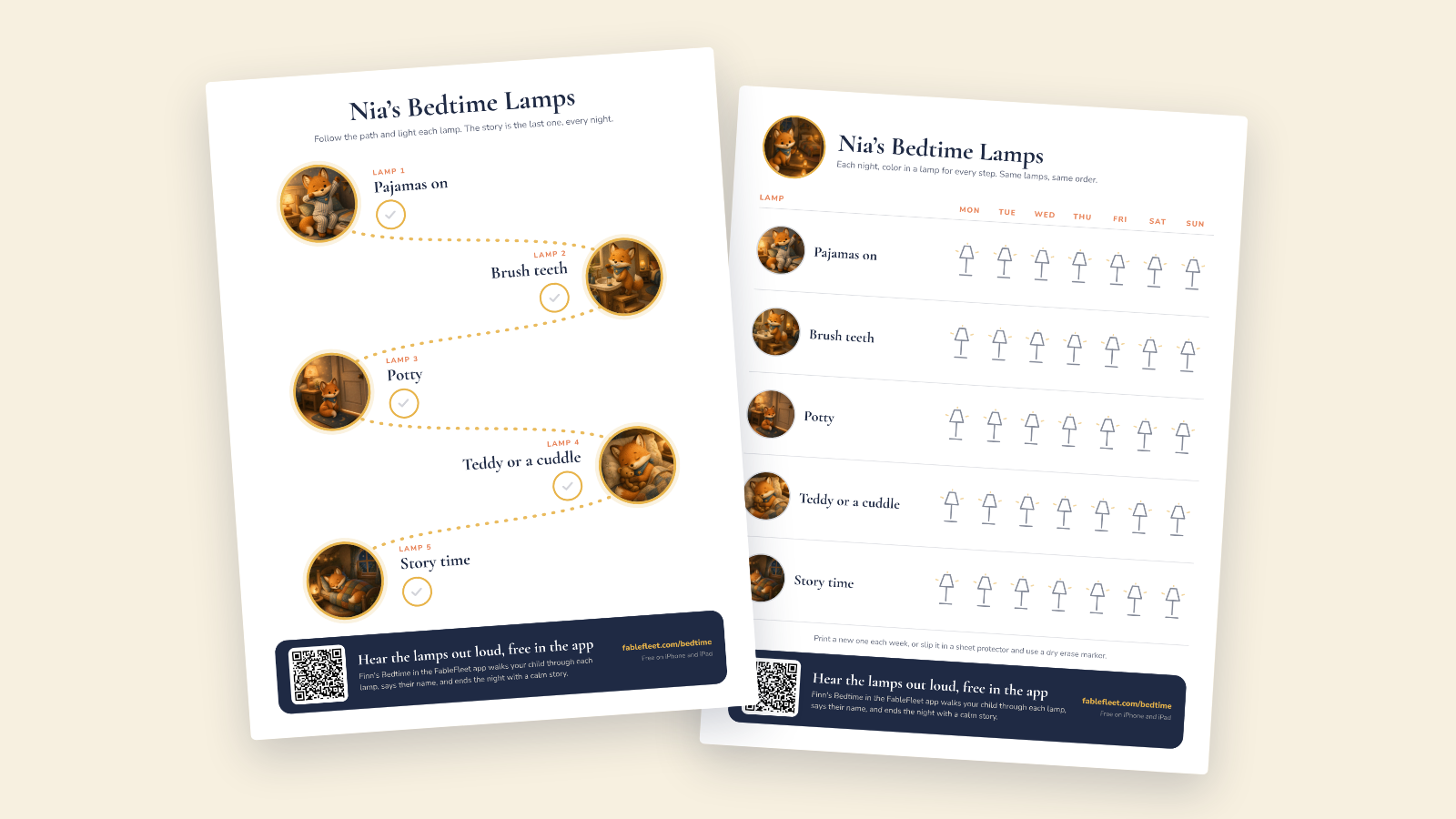
A bedtime routine chart works for a toddler when it is short, made of pictures, and done in the same order every night. Ours has five steps, each one a lamp: pajamas, teeth, potty, teddy or a cuddle, and a story last. Print it free in two styles, put your child's name on it, and let them light each lamp themselves. You can also customize your child's own bedtime routine in our free app.
Where the lamps came from
The lamps started with my co-founder, Amanda. Her son loves pressing the button, any button, and she wanted bedtime to have one for every step: pajamas, teeth, potty, teddy, then the story. We turned that into the bedtime routine in our app, where each step is a lamp on Finn the fox's walk home, and the story is the last lamp before bed.
This chart is the paper version. Same lamps, same order, on the fridge instead of a phone.
Print the chart
Free printable
Leave it blank to write the name in by hand. The name stays on your device and is only used to print your chart.
Finn's path
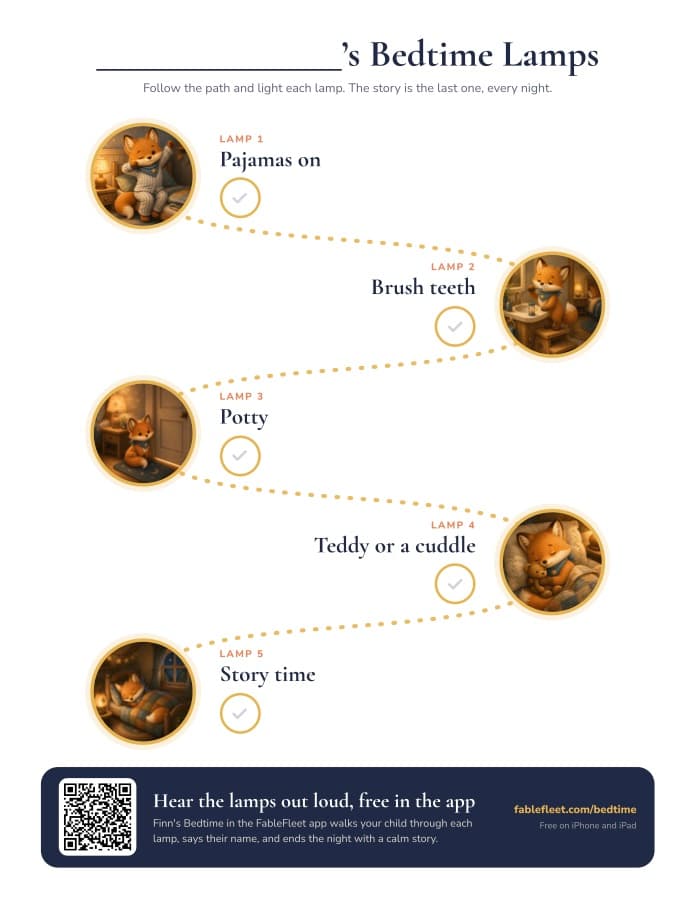
The lamps along a winding path, the way the app shows them. Tick each one.
Download the PDF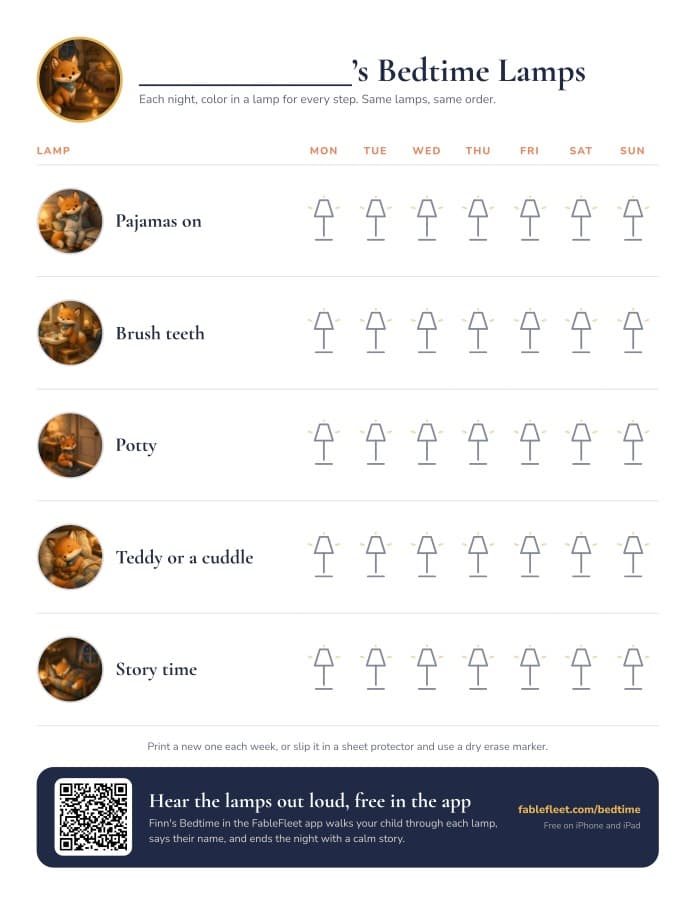
A week of lamps
One row per step. Color in a lamp each night, Monday to Sunday. Uses very little ink.
Download the PDFThere are two styles, both free, both one page:
- Finn's path: the lamps along a winding path, the way the app shows them, with a circle to tick at each one.
- A week of lamps: one row per step and a lamp to color in for each night, Monday to Sunday. Uses very little ink.
Type your child's name before you print and it goes at the top: "Nia's Bedtime Lamps." Or print it blank and write the name in together.
Why a picture chart helps a toddler
A two or three year old does not keep track of what comes next. You do, and every night you say it again: pajamas, now teeth, now potty. A chart moves that job onto the wall. Your child can look up, see Finn brushing his teeth, and know that is the next lamp.
The steps themselves are not magic. What matters is doing them the same way, in the same order, most nights. A 2015 study in the journal Sleep found that the more nights a week young children had a consistent bedtime routine, the better they slept, including falling asleep sooner and waking less in the night. The American Academy of Pediatrics puts the whole idea into three words for parents: Brush, Book, Bed.
A chart does not make a routine. It just makes the one you have easy to see, and easy to keep the same.
How to use it
- Walk through it together the first night. Point to each lamp and say what it is. Tick as you go.
- Let them hold the pen. Or the crayon. Ticking the circle or coloring in the lamp is their job, every night.
- Keep the order. If teeth come before potty on the chart, teeth come before potty in the bathroom. Changing the order is how a routine turns back into a debate.
- End on the story. Whatever happens earlier, the last lamp is the same quiet thing every night.
What to leave off
- Anything that does not happen every night. If bath is three nights a week, it does not belong in the fixed steps.
- Screens. The last half hour is for slowing down.
- Too many steps. If your chart needs a second column, it is a list, not a routine.
- Rewards for falling asleep. A toddler cannot fall asleep on purpose. If you want a reward, tie it to doing the steps.
Want Finn to say it out loud?
Amanda and I made Finn's Bedtime for our own kids, and it is free in the FableFleet app. It is the talking version of this chart: Finn walks your child through each step, says their name, and the routine ends with a calm story so the night winds down on its own.
If you would rather keep screens out of bedtime, you do not have to hand over the phone. You hold it and check off each step as you go, and your child just hears Finn guiding them from pajamas to the story.
Every family's evening is a bit different, so you can customize your child's own bedtime routine in the app. Put their name in, and tell Finn how to say it if it is one people often get wrong. Leave out the steps that do not happen in your house. Add a short step for sharing one worry before sleep if your child likes to talk through the day. Turn on a few affirmations to say together after the cuddle, like "I am safe. I am loved." Choose how many stories they hear before lights out.
Got more than one at bedtime? You can add up to four children, with one routine they do together or a routine each. We are adding more to it as we go.
It is free on iPhone and iPad, with no account needed to start. [Get Finn's Bedtime free](https://fablefleet.com/bedtime)
The chart and the app use the same steps in the same order, so a child who knows one already knows the other.
More in Toddler Bedtime
- Daylight Saving Time With a Toddler: How to Fall Back Gently on November 1
Daylight saving time with a toddler goes easiest when you move bedtime a little at a time in the days before the change, instead of switching all at once on Sunday morning. In 2026 the clocks go back one hour at 2 a.m. on Sunday, November 1, in most of the US and Canada. Here is a gradual plan from a pediatric sleep doctor, a simple timetable you can copy, what to expect the week after, and why keeping the bedtime routine exactly the same matters more than the clock.
For tonight
Finn’s Bedtime is free tonight
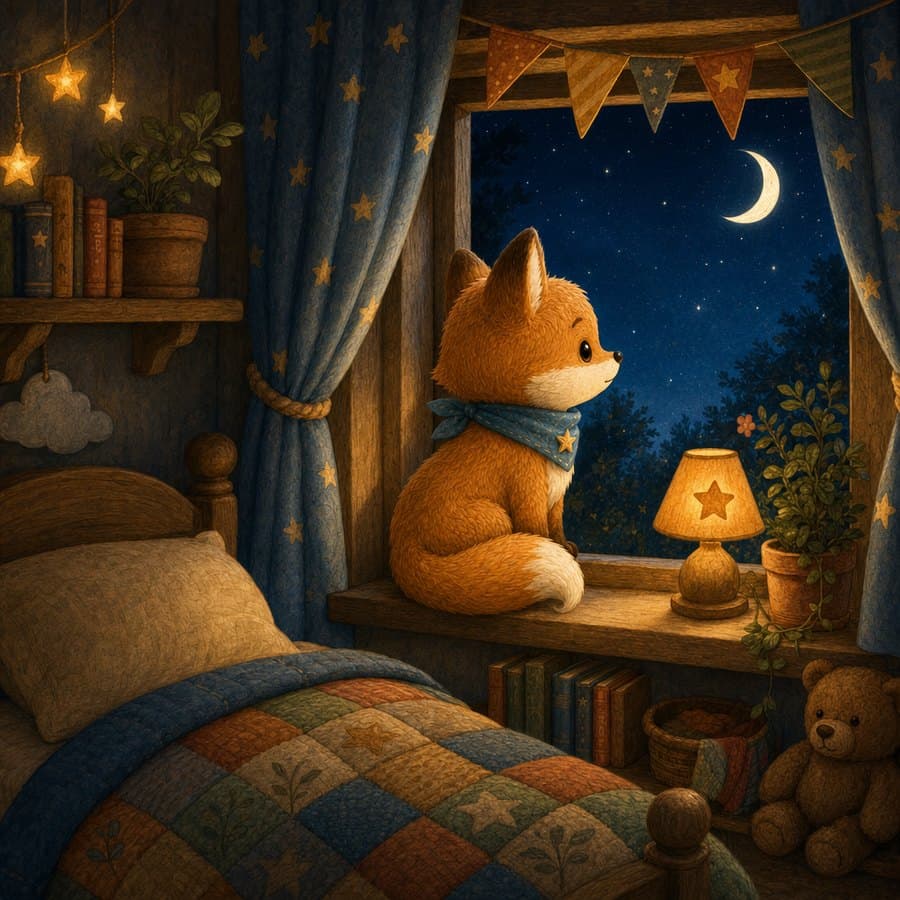
PJs, teeth, potty, one last cuddle, then a story that says your child’s name. Finn does the routine right alongside them. In the app, free, no account to make.
Frequently asked questions
- What should be on a toddler bedtime routine chart?
Four to six steps your child does every night, in the order you do them, each with a picture. Pajamas, brushing teeth, potty, a teddy or a cuddle, and a story is a good starting set. Leave off anything that does not happen every night, like a bath.
- At what age can a child use a bedtime routine chart?
Many children can follow a picture chart from around two, as long as every step has a picture and there are only a handful of steps. Before that, the chart is really for you: it keeps the order the same, which is what the routine needs.
- Should a bedtime chart have stickers or rewards?
It does not need them. The point of the chart is the same steps in the same order, so the night feels predictable. Ticking or coloring each step is satisfying on its own for most toddlers. If you add rewards, keep them small and about doing the steps, not about falling asleep.
- How long should a toddler bedtime routine take?
Around 20 to 30 minutes is a common target. Short enough that a tired toddler gets through it, long enough not to rush. If it is stretching well past that, look at which step is turning into a negotiation.
- Is there a bedtime routine app for toddlers?
Yes. Finn's Bedtime in the FableFleet app is the talking version of this chart. Finn guides your child through each step by name and the routine ends with a calm story. You can customize your child's own bedtime routine, add affirmations, and set up a routine for up to four children. It is free on iPhone and iPad.
- Can I use a bedtime routine app without giving my toddler screen time?
Yes. In Finn's Bedtime a grown-up can hold the phone and check off each step, so your child only hears Finn guiding them through the routine. The screen does not need to be in their hands at all.
Sources
- Mindell JA, Li AM, Sadeh A, Kwon R, Goh DYT. Bedtime Routines for Young Children: A Dose-Dependent Association with Sleep Outcomes. Sleep, 2015.. The more nights a week young children had a consistent bedtime routine, the better their sleep outcomes, including falling asleep sooner and waking less in the night.
- American Academy of Pediatrics (HealthyChildren.org), Brush, Book, Bed: How to Structure Your Child's Nighttime Routine. The AAP's simple three-step routine: brush teeth, read a book, go to bed, the same way every night.
- Sleep Foundation, Bedtime Routines for Children. Consistent routines with the same calm activities in the same order help children settle.
FableFleet team
Founders & moms, FableFleet
We're a small team of moms building the personalized children's stories we wished existed for our own kids. Everything we publish is rooted in lived experience and cited research.