
Books for Picky Eaters: What Actually Helps and What Does Not
Books for picky eaters can help modestly, mostly by giving families shared vocabulary for talking about brave eating outside of mealtimes. Classic titles include Bread and Jam for Frances, Green Eggs and Ham, I Will Never Not Ever Eat a Tomato, and D.W. the Picky Eater. Books are a supplement, not a fix; repeated low-pressure exposure and the Satter Division of Responsibility are the load-bearing work. Read the books outside of meals, model brave eating yourself, and skip the guilt if your child is not persuaded.

If your search history has "books to help my picky eater try new foods" in it, welcome. Here is the honest version of the roundup, because I would rather tell you what a book can and cannot do than sell you five hardcovers. The pediatric research is clear that modeling, low-pressure exposure, and involvement are what actually move the needle; a well-chosen book supports that work without replacing it. This guide is the shortlist that keeps showing up on librarian recommendations and parent forums, plus how to actually read them so they help.
What books for picky eaters actually do (and what they do not)
Let me start with the honest ceiling. A picture book about a kid who tries a new food will not, by itself, make your child eat broccoli. Pediatric sources are consistent about what actually shifts picky eating: repeated low-pressure exposure (UCSF says up to 15 tries), the Satter Division of Responsibility, modeling by adults, and involving kids in meal prep. A book contributes to two of those (modeling and shared vocabulary) in a small way.
What a book does well is give your child a character to identify with and give your family a phrase to use outside of meal times. The Child Mind Institute names modeling as one of the higher-leverage things you can do, and a book is a version of modeling aimed at your child's ear. When you and your kid have laughed at Frances trying jam on everything, "you're doing a Frances" becomes a warm reference in the calm hours between meals, which is when most useful eating conversations actually happen.
What a book will not do is replace exposure counts, take the pressure off the table by itself, or reach a child who is dealing with a sensory-driven or medical driver behind their picky eating. For the wider map of what picky eating in kids looks like and the tactics that actually help, the picky eating pillar walks through the calmer plan.
Classic titles worth keeping on the shelf
A few picture books have earned their place in the picky-eating conversation across decades. Here are the ones the parents and librarians I have talked to keep naming.
Bread and Jam for Frances by Russell Hoban. Frances only wants bread and jam, and her family lets her have it, at every meal, until the joy of bread and jam wears itself out and she comes back to variety on her own. The book is loved because it lets kids feel seen (Frances is not scolded) and quietly makes the point that a diet of only one thing eventually gets boring, without lecturing.
Green Eggs and Ham by Dr. Seuss. The oldest of the retry-a-food books. The narrator refuses green eggs and ham in every conceivable setting, and finally tries them and is surprised to like them. It is silly, it is repetitive in the best Dr. Seuss way, and the "you like it, you really like it" moment is a fine mini-model of the "try it, you might like it" idea kids hear from adults.
I Will Never Not Ever Eat a Tomato by Lauren Child. Charlie's little sister Lola refuses a long list of foods, and Charlie renames them into things she is willing to try (peas become "green drops from Greenland"). The book is charming, and it also (accidentally) illustrates how imagination and low pressure can nudge a picky kid toward a bite. Warning: some parent guides caution against the "trick her into eating it" reading of this book. The point is not deception, it is play; use it as a story, not a strategy.
D.W. the Picky Eater by Marc Brown. Arthur's little sister D.W. is a hardcore picky eater and refuses everything, until a family dinner at a restaurant where she accidentally eats spinach and loves it. Some pediatric sources are wary of the "she accidentally ate something she said she hated and now she loves it" arc because it can feed the trickery temptation, but read as a story about being surprised by your own taste, it is warm and useful.
Newer titles for the picky-eating stage
The picture-book landscape has expanded a lot in the last decade, and there are newer titles that align better with the low-pressure, Division-of-Responsibility approach pediatric sources endorse.
Books that treat food adventurously and celebrate variety (rather than framing picky eating as a problem to be fixed) tend to age well with kids. Look for titles that show a range of foods across cultures, feature kids trying things out of curiosity rather than under pressure, and treat the parents as calm and warm rather than desperate. Your local librarian is genuinely the best guide here; ask for their current shortlist for the age of your child, and mention that you want low-pressure titles rather than trickery arcs.
The AAP HealthyChildren tips guide names cooking together as one of the highest-value interactions you can have around food. Cookbook-picture-book hybrids for kids (with real, simple recipes and colorful illustrations) hit both notes at once and can turn a rainy afternoon into hands-on food practice without a table battle.
How to read them so they actually help
The parents I have asked who used books thoughtfully all said roughly the same thing. Read the food books at bedtime or on the couch, not at the table. Do not read a picky-eating book on the way to a meal where the target food is going to be served. That connects the story to pressure, which is the exact thing every pediatric source warns against. Instead, let the book live in the calm hours.
Read the book more than once. Kids soak in the arc slowly, and the vocabulary you both pick up ("Charlie and Lola foods," "green eggs and ham day") gets more useful the more times you have shared it. Do not narrate the moral. If your child says "I'm not going to eat the tomato either," that is fine, laugh with them, and let the story land on its own timeline.
Model the same behavior in real life. Kids notice the mismatch fast. If you love the book and then complain about vegetables at your own dinner, the book effect fades. UCSF's parent-modeling note is quiet but genuinely load-bearing.
Where an animated story fits differently
Books and animated stories do overlapping but distinct jobs. A book gives your child a character to identify with in the abstract; an animated story starring your own child (with their name spoken aloud, their family and friends woven in) hits the identification point directly. Both are supplements, not replacements for the exposure and low-pressure work at the table.
For families who lean on books already, adding an animated version does not replace the book collection, it slots next to it. For families whose kid does not connect with the classic picture books (some kids just do not), the personalized version is a different entry point at the same target. Neither one is magic. Both are ways of saying "here is a kid trying a new food, and it is okay to be brave and it is also okay to have a hard moment."
For the roundup of foods most picky eaters accept and how to expand from there, the picky eater food list spoke is the practical companion to any of these books.
How FableFleet fits
FableFleet is a personalized animated story video, not a book. I want to be really clear on that because "children's story" and "book" get used interchangeably in the picky-eating conversation, and we do not sell books. Our "Trying Something New / Feeling Brave" template has a character who looks like your child hesitate, try a new food, wobble a little, and come out proud, all with their real name.
Where it slots in the picky-eating toolkit is somewhere between the classic picture book and the parent-modeling piece. It gives your child the same identification-with-a-character experience a book does, and turns it up by using their own name and world. Same principle underneath: modeling brave eating outside of mealtime pressure. The parents I have asked who used story-based approaches said the outside-the-meal conversation was the thing that helped, whether that came from a book or a video.
Everything that is true of books is true here too. It is a warm supplement to the load-bearing work: repeated exposure, one family meal, Division of Responsibility, calm table. If your child is showing red flags (growth concerns, extreme sensory refusal, eating-related fear), a story is not the intervention; a pediatrician is.
More in Picky Eating
- Picky Eating: What Is Normal, When to Worry, and What Actually Helps
Picky eating is the toddler and preschooler stage where a child suddenly narrows the list of foods they will accept and pushes back on new tastes and textures. Pediatricians treat it as a common, usually temporary phase that often fades by around age 5. What helps most is repeated low-pressure exposure (kids may need 8 to 15 tries before liking a new food), a division of responsibility at the table, and skipping bribes and food fights. Red flags (weight loss, growth concerns, sensory extremes) mean a call to your pediatrician.
- Food Chaining: The Feeding-Therapy Method You Can Borrow at Home
Food chaining is a feeding-therapy method developed by Fraker, Fishbein, Cox, and Walbert (2007) that expands a picky eater's accepted-food list by bridging from an accepted food to adjacent foods with similar taste, temperature, and texture. Feeding specialists use it for complex cases; parents can use a lighter version at home, similar to the AAP's "food bridges" advice. Start with your child's list, pick one target food adjacent to an anchor, and offer it repeatedly with zero pressure.
- Picky Eater Food List: What Most Picky Kids Actually Eat (and How to Expand)
Picky eater food list: a snapshot of the foods your child currently accepts, useful as a baseline for expansion rather than a permanent menu. Foods most picky eaters accept cluster around soft carbs (bread, pasta, rice), mild dairy (cheese, yogurt), plain proteins (chicken nuggets, hot dogs, eggs), fruit, and sweet vegetables (carrots, sweet potato). Expand with food bridges (similar color, flavor, texture), one family meal, and low-pressure repeated exposure. Skip the short-order menu.
- Picky Eater Therapy: What It Is, Who It Is For, and How to Find a Provider
Picky eater therapy is a broad term for feeding therapy, a multidisciplinary treatment for children whose eating is restricted enough to affect growth, nutrition, or daily life. A feeding team typically includes a pediatrician, dietitian, therapist, and often a speech-language pathologist and occupational therapist. Common approaches include exposure-based cognitive-behavioral therapy for selective eaters and sensory-based feeding therapy for kids with texture or oral-motor issues. Referrals start with your pediatrician.
- Selective Eater: What the Term Means and What Actually Helps
Selective eater is the language pediatric and feeding-therapy sources use for a child whose accepted food list is small and stable, sitting on the spectrum between typical picky eating and clinical feeding disorders like ARFID. Most selective eaters are on the picky end (a phase, growing well, no medical worry) and respond to low-pressure exposure, division of responsibility, and a one-family-meal plan. A shrinking list, growth concerns, or extreme sensory refusal are a call-your-pediatrician signal.
- Signs of ARFID in Children: What to Look For and When to Call the Pediatrician
Signs of ARFID (Avoidant/Restrictive Food Intake Disorder) in children include an extremely narrow accepted-food list, weight loss or falling growth curve, nutritional deficiencies, extreme sensory refusal (gagging, panic, vomiting), and fear of choking, pain, or vomiting from eating. ARFID is a diagnosable eating disorder distinct from typical picky eating and is treated by a pediatric feeding team. If any of these signs sound like your child, the next step is a pediatrician appointment, not more tactics at home.
The story for this milestone
For the child who says no before they have touched it
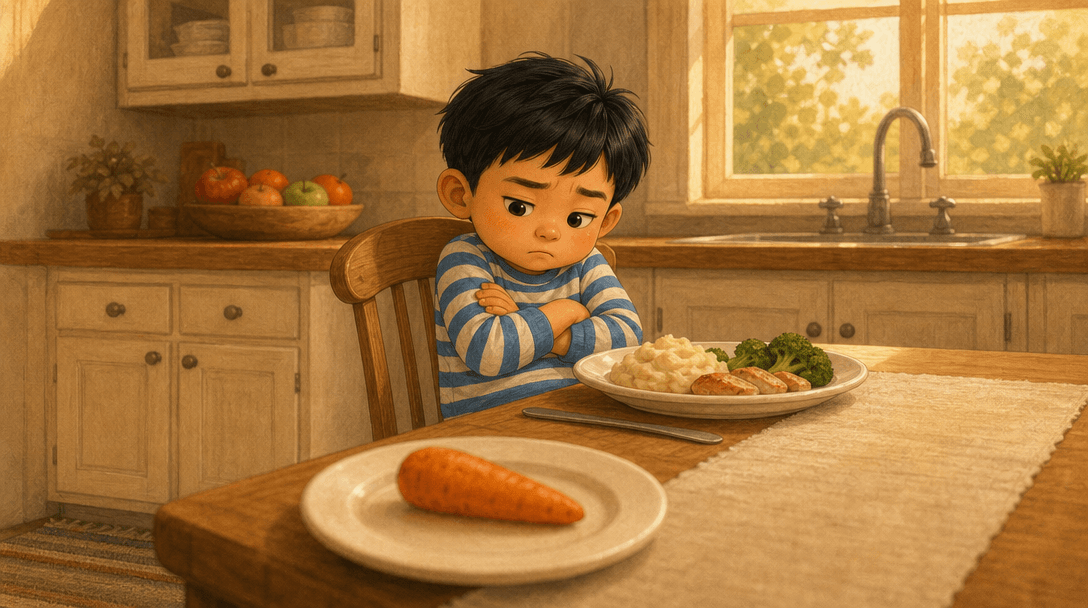
A personalized story for a picky eater: one new thing on a little plate, the same thing tomorrow, a finger, a lick, and a bite nobody made a fuss of. A 2.5 minute storybook film for ages 2 to 6.
We make it from the details you choose. Your child, by name, in every scene.
Frequently asked questions
- What is the best book for picky eaters?
There is no single best book. The picture books most often recommended by parents and educators are Bread and Jam for Frances by Russell Hoban, Green Eggs and Ham by Dr. Seuss, I Will Never Not Ever Eat a Tomato by Lauren Child, and D.W. the Picky Eater by Marc Brown. They work by giving your child a character to identify with and giving your family shared vocabulary for talking about trying new foods without pressure at the table.
- Do books actually help with picky eating?
Modestly. Books can support modeling and shared vocabulary, both of which pediatric sources cite as helpful, but they are not a fix for picky eating on their own. The load-bearing work is repeated low-pressure exposure, one family meal, and the Satter Division of Responsibility. Books are a warm supplement, not a replacement.
- At what age can books help with picky eating?
Picture books about eating can be enjoyed as early as toddlerhood, though most of the popular titles are pitched at ages 3 to 7 (when the intense picky phase peaks). Read them at bedtime or on the couch, not at the table, so the story is not mixed up with pressure. Younger toddlers may benefit more from you modeling brave eating in real life than from a book.
Sources
- Child Mind Institute, How to Help Kids Who Are Picky Eaters. Modeling, shared vocabulary, standard second option.
- AAP HealthyChildren.org, 10 Tips for Parents of Picky Eaters. Involving kids, food bridges, one family meal.
- UCSF Benioff Children's Hospitals, Picky Eaters. Parent-child roles, up to 15 exposures, no bribes.
- CDC, Picky Eaters and What to Do. Normal phase, exposure to variety, developmental framing.
FableFleet team
Founders & moms, FableFleet
We're a small team of moms building the personalized children's stories we wished existed for our own kids. Everything we publish is rooted in lived experience and cited research.