
Picture Books About Divorce: The Warm-Not-Sad Shelf
Picture books about divorce are one of the most useful tools you can put on a child's shelf when the family shape is changing, and pediatric authorities (Sesame Workshop, HealthyChildren.org) agree they help most when they are warm, kid-first, and free of blame. This piece walks the shortlist by age band from preschool to early elementary, names what to look for in a good one, flags the ones to read yourself first, and closes with where a personalized story fits alongside the picture book so your child sees themselves, by name, in the new family shape.

Here is the honest version from someone who was on the receiving end of the "here is a book about divorce" moment at six. The books that helped were the quiet ones, the ones that treated the shape as normal, and the ones where the kid on the page got to have a warm afternoon. The books that did not help were the ones that leaned into how sad it was, because I did not need somebody I had never met telling me how I was supposed to feel about my own week. I built FableFleet in part because I wanted your child to also have a story where their own name is in the new family shape, not just Alex's, and a warm picture book paired with a personalized animated story is a mirror plus a rehearsal. The rest of this walks the shelf.
Why picture books about divorce help kids (when they are chosen well)
Let me start with what the sources say and then get to the honest read. Sesame Workshop's Sesame Street in Communities module on divorce is direct: picture books help young children process big changes because they give the child a character to identify with, and the naming itself lowers the load. HealthyChildren.org from the AAP frames the same idea from the developmental side: children process change in loops, and a good picture book is a low-stakes surface that lets the child return to the topic on their own timeline.
The word "when they are chosen well" is doing the load-bearing work in that sentence. Not every book on this topic helps. A picture book that leans into loud fighting between parents on the page, or characterizes one parent as the bad guy, or lands the ending in sadness rather than warmth, can leave a child with the feeling they were reaching for a mirror and found a bruise instead. The best ones treat the shape as a shape a family can be, not a loss the child has to be walked through.
The rest of this piece is the shortlist of ones I would actually put on the shelf, plus the criteria I use to screen the others.
What the best picture books about divorce have in common
Five things. Once you see them, you can walk into any library and sort the shelf in about ten minutes.
Warm framing, not sad framing. The whole point of a good book here is to treat the family shape as normal. Both parents are drawn kindly. Both bedrooms are drawn warmly. The tone is calm. If the book opens with a fight and ends with a hug, it is doing it wrong. The best books open in a settled feeling and stay there.
Kid at the center. The story is about the child's experience, not about the adults' story of how they got here. AAP HealthyChildren.org guidance is direct that children do not need the adult version of the story. The picture book should not sneak it in either.
No blame, no bad guy. AACAP is explicit that children should not be pulled into adult conflict. A book that characterizes one parent (any parent, of any gender, in any configuration) as the bad guy is not a book to put on a preschooler's shelf.
Warm ending. The last page should feel like home. Sesame Workshop is clear that books work when they help the child arrive at a settled feeling; an ambiguous or sad ending leaves that feeling with the child.
Age-matched reading level. A book meant for a ten-year-old will feel heavy in a five-year-old's lap. HealthyChildren.org recommends matching the book to the child. Ask the librarian for age-band shelving; do not trust the marketing copy alone.
Picture books about divorce, by age band (preschool to early elementary)
Here is the shelf as I would build it, organized by age. Not exhaustive. Every title below has been in print for years, has warm framing, and does not pull the child into adult conflict.
Preschool, ages 3 to 5:
Two Homes by Claire Masurel, illustrated by Kady MacDonald Denton (Candlewick, 2001). Alex has two homes; both are warm; both parents are kind. Short text, generous illustrations. The anchor pick most librarians and pediatricians reach for. Also covered in the fuller two homes book piece.
Living with Mom and Living with Dad by Melanie Walsh (Candlewick, 2012). A lift-the-flap book with the same warm two-parent framing. The interactive flaps are especially useful for a preschooler who benefits from a physical beat of "and here is the other side."
Kindergarten to grade 2, ages 5 to 7:
I Have Two Homes by Marian De Smet, illustrated by Nynke Talsma (Clavis, 2011). A slightly longer picture book that follows Nina between homes. Sits well next to the Masurel title. For the just-a-bit-older child.
Was It the Chocolate Pudding? A Story for Little Kids About Divorce by Sandra Levins, illustrated by Bryan Langdo (Magination Press, 2005). Handles the "did I cause it" question gently and directly. Reach for this one if your child has hinted (or you sense they are thinking) that they might be to blame. Written by a Magination Press author, so it is aligned with the American Psychological Association's parenting imprint standards.
Grade 2 to 5, ages 7 to 10:
Standing on My Own Two Feet by Tamara Schmitz (Price Stern Sloan, 2008). Leans into the older kid's feelings about the shape. Best read with a parent so the child has someone to talk it through with.
Dinosaurs Divorce: A Guide for Changing Families by Marc Brown and Laurene Krasny Brown (Little, Brown, 1988). Older, still in print, and used widely by therapists. Uses dinosaur families to walk through the whole shape (why divorce happens, both parents' feelings, the child's feelings). Especially useful when the child is old enough for more information but still benefits from the picture-book format.
For the age-banded deep dive on the six-year-old moment specifically, our books about divorce for 6 year olds piece walks the shelf for that exact age.
The picture books about divorce to skip (or read carefully first)
I am not going to name titles here, because a book that is wrong for one family may be right for another. What I will name is the pattern.
Skip the ones that villainize a parent. Any book where one parent is drawn cold, small, or as a bad guy. A young child looking for a mirror does not need to be told their family has a bad guy.
Skip the ones that lean into loud fighting on the page. Some picture books try to normalize divorce by showing parents fighting first. That is not the mirror your child needs; it is a version of adult conflict rendered on the page, and it can be scarier than the actual house.
Skip the ones that end in ambiguity. A picture book for a young child needs a warm resolution. Ambiguous endings work in adult literature. They do not work at 4 or 6.
Skip the ones that are actually about adult grief. Some titles marketed as "picture books about divorce" are really books about a parent's sadness. Those are books for adults. Do not put them on a preschool shelf.
Read every book yourself first before reading it with your child. This is the rule the moms I have asked have said matters most. Ten minutes of screening saves an hour of trying to un-say something that landed wrong.
Where a personalized story fits alongside a picture book
The picture book is a mirror. Mirrors help. What a picture book cannot do is put your child's name in the story, put their comfort object in the picture, put their real bedtime routine into the bedtime scene, or name the specific words you use at your house.
This is the moment where I want to name what FableFleet does honestly. FableFleet makes personalized animated story videos, video-only, made just for your child. For a family navigating a family-shape change, the story that fits is one where a child with your kid's name is in a warm two-homes moment, both parents present kindly, both places treated as home. Your child sees themselves handle the shape on screen before they have to handle it again in a real room. That is a rehearsal beat.
The picture book and the personalized story do different work. The picture book is a mirror (they see a character who is a bit like them). The personalized story is a mirror and a rehearsal (the character is them). Together, both on the shelf, they do more than either alone. For the fuller pillar on how two homes actually works for a young child, and the pediatric-source playbook that grounds all of this, our pillar walks it through in depth.
What I wish had been on the shelf when I was six
I want to keep this section short because I am not going to invent a title I read at six or attribute a feeling to a book I did not read. What I remember is that some books helped and some did not, and the difference was almost always warmth. The ones that helped treated my family shape as normal. The ones that did not treated it as a loss I had to be walked through. What I wish had been on the shelf, on top of a good picture book, was a short story with my own name in the two-homes shape, both houses full of love, so I could see the shape from the inside and know it was a shape I could live in.
If your kid is at the beginning of this and you are picking the shelf, the version I would build for them is a warm picture book like Two Homes plus a short warm personalized story where they are the star. The rest is the routines, the traveling comfort object, the warm short words at the door, and the pediatrician if things do not ease. There is no formula. There is only the small handful of anchors and the parent who keeps showing up warmly.
More in Two Homes
- Two Homes: A Warm, Kid-First Guide for Parents
Two homes is a real, everyday shape for a lot of children after a separation, and pediatric authorities (AAP, KidsHealth, AACAP, Zero to Three) agree the same short list actually helps: keep routines consistent across houses, keep reassurance simple and repeated (this is not your fault, both parents love you), let one small comfort object travel with the child, and match the words to the child's age. This guide walks through what "two homes" looks like at 3, at 6, at 9, the language that actually lands at the door on transition day, how a personalized story can give a child a rehearsal moment in their own name, and the small signs that it is time to loop in your pediatrician or a family therapist.
- Blended Family Tips: The Slow, Kid-First Version That Actually Works
Blended family tips work best when they run slow, keep the kid at the center, and skip the "instant family" script. The American Psychological Association and AACAP both point at the same short list: introduce a new partner gradually, keep the child's existing relationships intact, preserve one-on-one time with the biological parent, keep routines consistent across houses, and do not push the child to call the step-parent a name they are not ready for. This piece walks the moves the moms who have done this well recommend, the ones to avoid in year one, and when a family therapist is worth bringing in early.
- Books About Divorce for 6 Year Olds: The Age-Matched Shelf That Actually Lands
Books about divorce for 6 year olds work best when the reading level matches a first-grader, both parents are drawn warmly, and the ending settles the child rather than leaving them unsettled. Pediatric authorities (AAP HealthyChildren.org, KidsHealth from Nemours) note that children 6 to 8 understand the concrete change but often fear abandonment, so books at this age need to answer the quiet questions with warmth: it is not your fault, both parents love you, you have a home at both places. This piece walks the shortlist worth handing a six-year-old, the one line they need to hear, and where a personalized story fits alongside the book.
- Evelyn Del Rey Is Moving Away: The Book (and What to Read Next)
Evelyn Del Rey Is Moving Away by Meg Medina, illustrated by Sonia Sanchez (Candlewick, 2020), is a Kirkus-starred picture book about two best friends and the day one of them moves. It lands the "I miss you and I still love you" beat gently, with a warm ending that lets a child hold both the goodbye and the friendship. Best for ages 4 to 8. This piece walks what the book is about, who it fits, how to read it with a child whose friend is moving, other picture books about moving worth having on the shelf, and how a personalized story fits when your child's world is changing shape.
- Mom's House Dad's House: The Transition-Day Playbook That Actually Lands
Mom's house dad's house is the moment every parent means when they say "transition day": the drive, the bag, the words at the door, the first hour on the other side. Pediatric sources (AACAP, KidsHealth, Zero to Three) all point at the same short list: keep the arrival ritual predictable, keep language warm and short, let one comfort object travel with the child every time, and keep the routines (bedtime, meals) roughly matched across places. This piece walks the exact words that land at the door, the traveling comfort object rule, the routine-consistency question, and when the meltdown pattern is worth naming to your pediatrician.
- Two Homes Book: The Warm Picks for Kids of Divorce (and What a Book Cannot Do)
Two homes book, the short version. Claire Masurel's Two Homes (Candlewick, 2001) is the anchor pick most librarians and pediatricians hand parents for a reason: warm, low-conflict, both houses are home, nobody is the bad guy. Melanie Walsh's Living with Mom and Living with Dad and Marian De Smet's I Have Two Homes are the two closest companions. What any two-homes book cannot do is put your child's name in the story or their comfort object in the picture, which is where a personalized story can sit alongside it. This piece walks the shelf and names what to look for.
The story for this milestone
Two homes, and a child who is loved in both
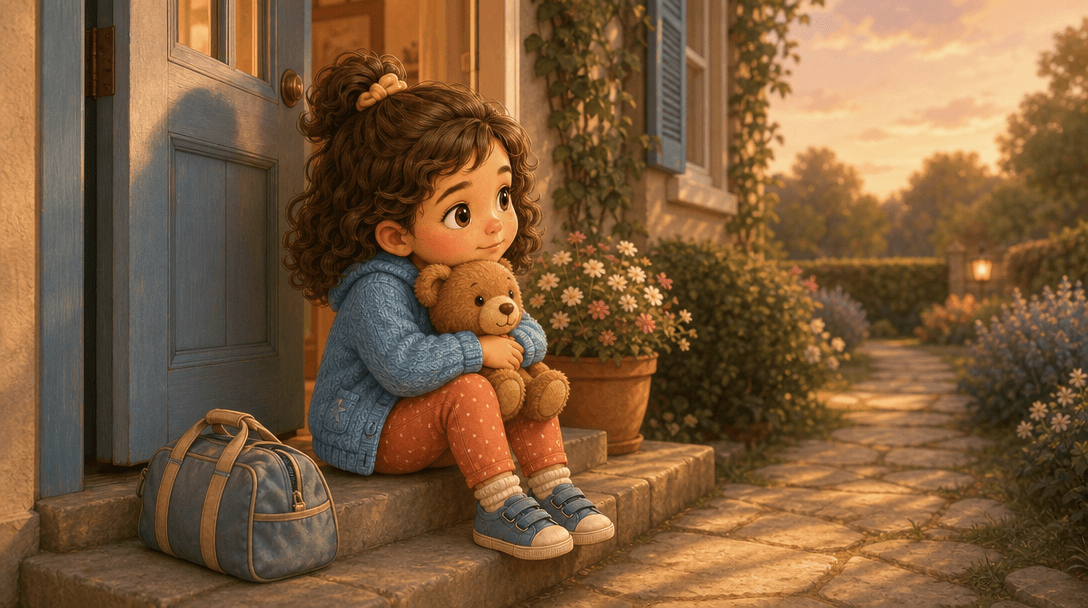
A personalized story for a child who lives in two homes: one ordinary switch day, a warm goodbye at one door and a warm hello at the other, both grown-ups named and shown. A 2 to 3 minute storybook film.
We make it from the details you choose. Your child, by name, in every scene.
Frequently asked questions
- What is the best picture book about divorce for preschoolers?
For most preschool families, Two Homes by Claire Masurel (Candlewick, 2001) is the anchor pick. It is short, warmly illustrated, low-conflict, and both parents are drawn kindly. Melanie Walsh's Living with Mom and Living with Dad is the closest companion. Both sit in the 3 to 5 sweet spot. Sesame Workshop and HealthyChildren.org both recommend age-matching a picture book, and these titles land squarely in the preschool range.
- At what age should you read a divorce book to your child?
Whenever the shape is entering their world. If a change is happening in the family, a warm age-matched book gives the child a mirror to hold what is happening. HealthyChildren.org from the AAP notes children process big changes in loops, so the same warm book will do different work at 4 than it does at 6 than it does at 8. Read it more than once. Read it at low-stakes moments, not on transition days.
- Are there personalized picture books about divorce?
Personalized static picture books focused on divorce are rare and the ones that exist are hard to find in-print. A personalized animated story is the more available shape today. It lets the child see themselves, by name, in the new family shape, both parents warm, both places treated as home. FableFleet is one option. It sits alongside a picture book like Two Homes rather than replacing it.
Sources
- Sesame Workshop, Sesame Street in Communities: Divorce. How books and stories help young children name what is happening.
- AAP HealthyChildren.org, Helping Children Understand Divorce. Age-matching guidance; developmental stages for processing divorce.
- Candlewick Press, Two Homes by Claire Masurel. Publisher page for the anchor picture book, first published 2001.
FableFleet team
Founders & moms, FableFleet
We're a small team of moms building the personalized children's stories we wished existed for our own kids. Everything we publish is rooted in lived experience and cited research.