
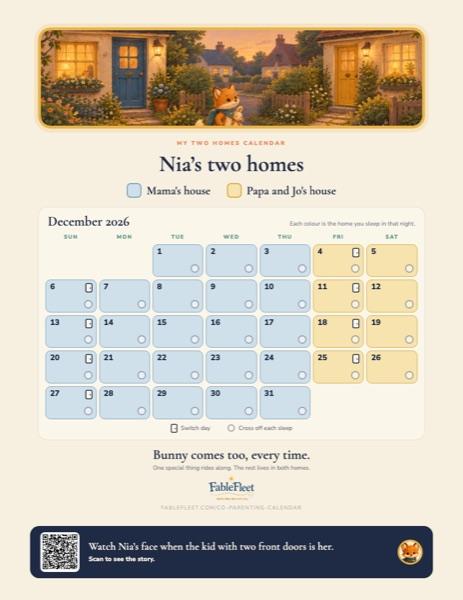
How the two homes calendar works
Print one for each home and put it where your child can reach it. Fill in the month here, or print it blank and colour the nights in together. Each night, they cross off a sleep. The night before a switch, look at it together and count what's left. A two year old will mostly love the colours. By four, most kids check it themselves.
Why a calendar helps little kids in two homes
Young children can't hold days and weeks in their heads yet, so the switch can feel like it comes out of nowhere. Zero to Three suggests a monthly calendar with “one color for one parent and a different color for the other.” Sesame Workshop and the Child Mind Institute say the same: a calendar on the wall, where your child can see it.
Their names for each home
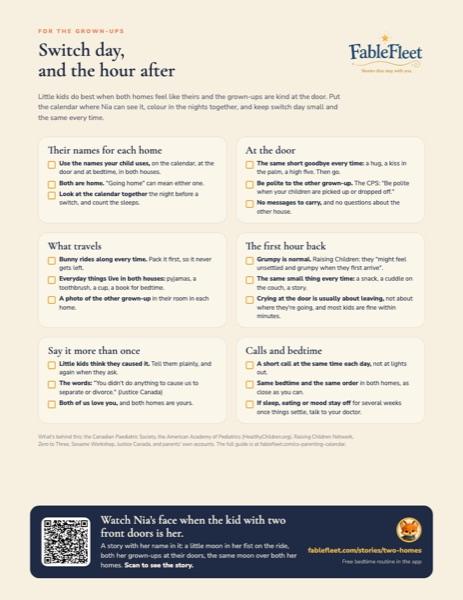
Every family is different. Some kids say Mama's and Daddy's, some say Nana's, some say Papa and Jo's. Use the names your child already uses, on the calendar, at the door and at bedtime, in both houses. Both are home.
Switch day, at the door
My brother and I grew up walking down the street between my mom's and my dad's with a bag of clothes. What I wish most is that our parents hadn't argued or talked badly about each other in front of us. It's the thing the pediatric groups put first, too: how the grown-ups are with each other matters more than how many homes there are. The Canadian Paediatric Society puts it simply: “Be polite when your children are picked up or dropped off.” Keep the goodbye short and the same every time, with no messages to carry and no questions about the other house.
The first hour back
Kids often hold it together at one house and let it all out in the other. Raising Children says they “might feel unsettled and grumpy when they first arrive.” Have the same small thing every time: a snack, a cuddle on the couch, a story. If sleep, eating or mood are still off several weeks after things settle, talk to your doctor.
Say it more than once
Little kids often think they caused it. Tell them plainly that they didn't, that both of you love them, and that both homes are theirs. Then say it again the next time they ask, and the time after that.
For the switch day itself, there's a story with your child in it, both of their grown-ups named the way they say them, and the same moon over both homes: Two Homes.
Questions parents ask
- How do you make a co-parenting calendar a child can understand?
- One month on one page, one colour for each home, and the homes named the way your child says them. Colour each night for the home they sleep in, mark the switch days, and count in sleeps, not days. Little kids can't hold a week in their heads yet, but they can count three sleeps on the fridge.
- What should we call each home?
- Whatever your child calls it: Mama's, Papa and Jo's, Nana's. Use the same names on the calendar, at the door and at bedtime, in both houses. Both are home, so "going home" can mean either one.
- Should their favourite toy go back and forth?
- One special thing can ride along every time: pack it first so it never gets left. The everyday things, like pyjamas, a toothbrush and a bedtime book, are easier kept in both homes. The pediatricians at HealthyChildren.org suggest keeping duplicates of favourite bedtime things at both homes.
- Is it normal for my child to cry at handover?
- Yes. The crying is usually about leaving the grown-up they're with, not about where they're going, and most kids are fine within minutes of the car pulling away. A short goodbye that's the same every time helps more than a long one.
- Why is my child grumpy after coming back?
- The first hour back is often the hardest. Kids hold it together at one house and let it out in the other. Keep that hour quiet and the same each time: a snack, a cuddle, a story, and no questions about the other house.
- What age is it for?
- About 2 to 6. A two year old will mostly like the colours and the door. By four or five they'll check the calendar themselves and tell you how many sleeps are left.
More for two homes
- The Two Homes story
- Two homes: helping a little one feel at home in both
- Mom's house, Dad's house: switch day
- Everything in Resources
Sources
- Zero to Three, “Divorce With an Under-3 in the House: What You Need to Know.” zerotothree.org
- Sesame Workshop, “Adjusting to Two Homes.” sesameworkshop.org
- Canadian Paediatric Society, Caring for Kids, “Helping children cope with separation and divorce.” caringforkids.cps.ca
- Raising Children Network, “Two homes after separation or divorce: helping children and teenagers adjust.” raisingchildren.net.au
- American Academy of Pediatrics, HealthyChildren.org, “Divorce and Separation: How to Help Your Child Adjust.” healthychildren.org
- Child Mind Institute, “Supporting Kids During a Divorce.” childmind.org
- Justice Canada, “Making plans: What your children may be feeling.” justice.gc.ca