
How the teacher thank you card works
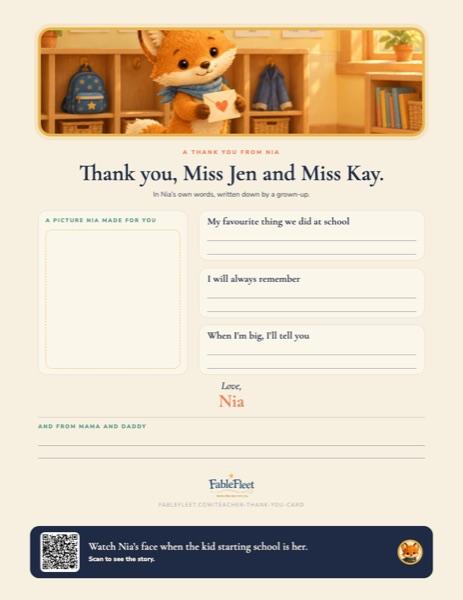
Print one card for each teacher. At a quiet time, ask your child the three questions, one at a time: their favourite thing they did together, something they'll always remember, and what they'll tell the teacher when they're big. Write down exactly what they say. Then they make a picture in the box, and you add a line of your own at the bottom if you want to. It goes in with a gift, or on its own.
Why their own words
Teachers ask for gift cards and keep the notes. The early childhood educators' association, NAEYC, puts goodbye messages and pictures for teachers on its list for the end of the year, and the staff who write about their last days say the same thing: the cards go in a box and get read again. Most thank you tags for teachers are puns. A line a three year old actually said is the one that gets kept.
The last month, on one page
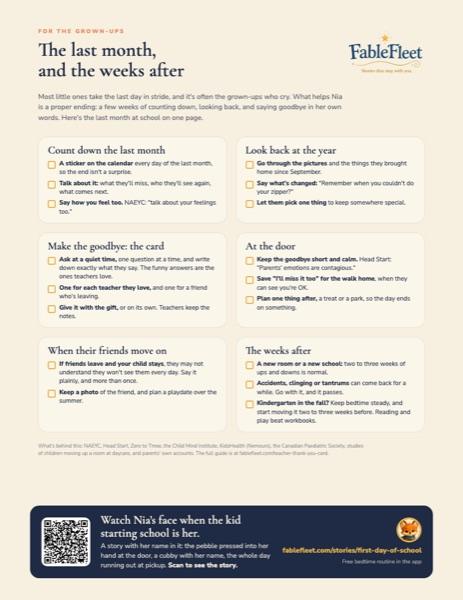
NAEYC's list for the end of the year is short and it works for daycare too: a sticker on the calendar every day of the last month, so the end isn't a surprise; a look back at the year's pictures and everything they learned; goodbye messages for friends and teachers; and a plan to keep in touch. It's all on the second sheet.
The goodbye at the door
The last day is often harder on the grown-ups than the kids, and that's fine. Head Start's guidance for teachers says it plainly: “Parents' emotions are contagious.” Keep the goodbye at the door short and calm, and save “I'll miss it too” for the walk home, when they can see you're OK.
When their friends move on
Sometimes your child is the one who stays. Our daughter has been at daycare since she was 18 months, and when most of her class left for kindergarten this August, she knew where they were going but didn't understand she wouldn't see them again. September was a rough month. Say it plainly, and more than once, keep a photo of the friend, and plan a playdate.
The weeks after
A new room or a new school unsettles most little ones for a while. In a study of toddlers moving up a room at daycare, the upset settled within about three weeks, and the Canadian Paediatric Society says it can take “a few days or weeks” to adjust. Potty accidents, clinging or tantrums can come back for a bit, and they pass. If kindergarten starts in the fall, keep bedtime steady over the summer and start moving it a few weeks before. Reading together and playing beat any summer workbook at this age.
For the first day after all of this, there's a story with your child in it: First Day of School.
Questions parents ask
- What should a child say in a thank you note to a teacher?
- Whatever they actually say. Ask one question at a time: their favourite thing they did together, something they'll always remember, and what they'll tell the teacher when they're big. Write it down word for word, even the funny bits. A teacher can tell a grown-up's sentence from a four year old's, and it's the four year old's they keep.
- Do teachers keep thank you notes?
- Yes. When teachers are asked what they want, gift cards come up first, and the note is what they keep. WeAreTeachers, after asking hundreds of teachers: "most teachers we surveyed say they appreciate a handwritten thank-you note over just about anything else." Daycare and preschool staff say the same in their own accounts: the cards go in a box and get read again.
- Should the card go with a gift?
- Either way. Put it in with a gift card or a class gift, or give it on its own. The card is the part that says what the year meant, and it costs nothing.
- What if my child won't answer the questions?
- Try another time: in the bath, in the car, at bedtime. Offer two choices if they're stuck ("the sandbox or the swings?"). One word is fine, and a picture with their name on it is a thank you too.
- Does it work for daycare teachers?
- Yes. Pick school, daycare, preschool or kindergarten and the card says it the way your family does. Print one for each teacher your child loves, and one for a friend who's leaving.
- What age is it for?
- About 2 to 6. A two year old might give you one word and a scribble, and that's a lovely card. By four or five they'll often surprise you.
More for the big moments
Sources
- NAEYC, “Saying Goodbye to Preschool and Hello to Kindergarten.” naeyc.org
- Head Start, “Transition to Kindergarten: Engaging Families.” headstart.gov
- Canadian Paediatric Society, Caring for Kids, “Child care: Making the best choice for your family.” caringforkids.cps.ca
- Cryer and others (2005), “Effects of transitions to new child care classes on infant/toddler distress and behavior,” Early Childhood Research Quarterly. doi.org
- Child Mind Institute, “Strategies for a Successful Summer Break.” childmind.org
- KidsHealth (Nemours), “Back to School.” kidshealth.org
- WeAreTeachers, “Best End-of-Year Gifts for Teachers.” weareteachers.com