
Big Sister Books for Toddlers: The Honest Ones, Sorted by Stage
Big sister books for a toddler work best when they match what she is facing right now: a simple book about waiting before the birth, a book about the busy lap in the first weeks, and a book that admits the baby can be annoying for the jealous stretch after that. Here are real, in-print picks sorted by stage and age, which ones are honest about the hard parts and which ones keep it all lovely, how to read them so they actually prepare a toddler, and when to start.

I have a three-year-old daughter and a baby son, so getting a toddler ready for a new baby is very recent in our house. One thing stands out about new baby books: most are written for the week the baby comes home, and very few for the month after, when the visitors have gone, the baby still cries, and the big sister has worked out that this is permanent. That second stretch is where a good book earns its place.
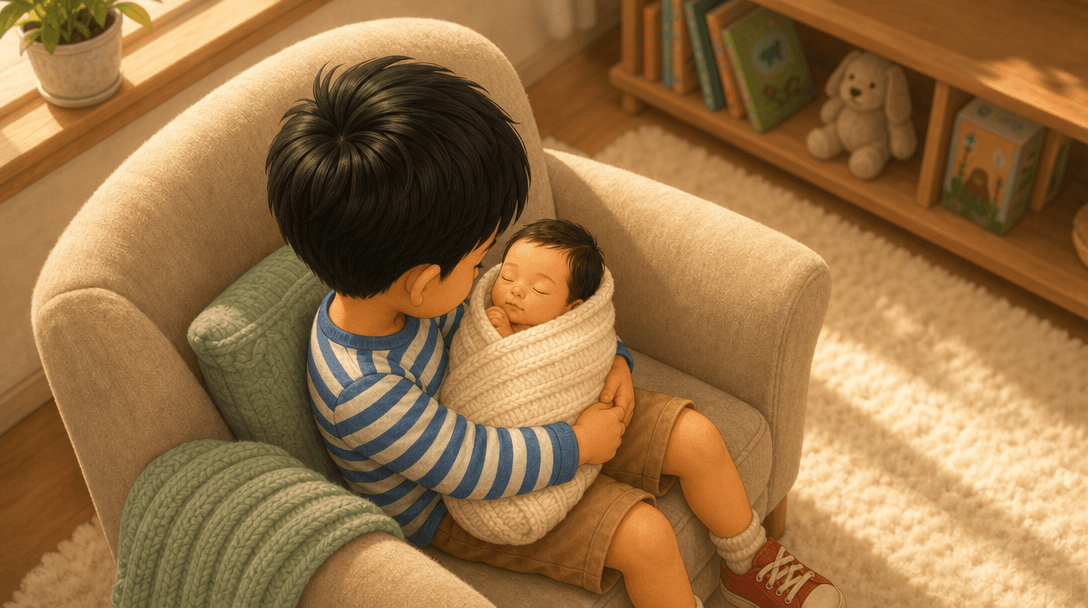 A story for thisBecoming a big sibling, hard parts includedYour child, by name, in every scene. See the New Baby story →
Which big sister book is best for a toddler?
There is not one, because a two year old before the birth and a two year old six weeks after it are dealing with completely different things. Before, the idea is abstract: there is a baby somewhere inside a belly and one day it will be here. After, it is concrete: there is a baby on the lap she used to have to herself.
So the short answer, by stage:
- Before the birth, under three: Waiting for Baby by Rachel Fuller.
- Before the birth, two to five: There's Going to Be a Baby by John Burningham and Helen Oxenbury.
- The first weeks: On Mother's Lap by Ann Herbert Scott.
- The jealous stretch, two to five: Peter's Chair by Ezra Jack Keats.
- The jealous stretch, four and up: Julius, the Baby of the World by Kevin Henkes.
The rest of the picks are below, with what each one does well.
Big sister books for before the birth
Waiting for Baby by Rachel Fuller (board book, about 1 to 3). Part of a four book series from Child's Play. It has no words, just pictures of a family getting ready: the scan, choosing new toys, getting a room ready, visiting in the hospital. That sounds like a weakness and is the opposite. You tell it in your own words, with your own plans, so it fits your family instead of someone else's.
There's Going to Be a Baby by John Burningham, illustrated by Helen Oxenbury (about 2 to 5). A small boy and his mother talk through the pregnancy season by season, and he imagines what the baby might grow up to be. It is the most honest of the before books, because the boy is not simply thrilled. He has questions and a little doubt, and the book lets him have them. Good for a child who asks "but why".
Hello in There! A Big Sister's Book of Waiting by Jo Witek, illustrated by Christine Roussey (publisher says 4 to 6, works younger). A sister-to-be sings to the bump and tells the baby about everything waiting outside. It has flaps that show the baby tucked inside. This one is pure excitement and does not touch the hard parts. That is fine as long as it is not the only book you read.
Little Miss, Big Sis by Amy Krouse Rosenthal, illustrated by Peter H. Reynolds (board book, short enough for 2 and up). Very few words per page and a family celebrating. Lovely, quick, and entirely sunny. Treat it as the happy one in the pile.
Big sister books for the first weeks
My New Baby by Rachel Fuller (board book, about 1 to 3). The same series as Waiting for Baby, now with the baby home. The toddler watches the new baby and asks about everything it needs. Under threes like seeing the ordinary baby jobs, because those are exactly the jobs taking their parent away.
On Mother's Lap by Ann Herbert Scott, illustrated by Glo Coalson (about 1 to 4). A small boy keeps adding things to his mother's lap, his doll, his boat, his reindeer blanket, and she always makes room. Then the baby cries, and he says there is no room. There is. This is the book I would reach for first after the birth, because the busy lap is the real loss for a toddler, and this book names it without any lecture.
Lola Reads to Leo by Anna McQuinn, illustrated by Rosalind Beardshaw (about 2 to 4). Lola loves books and shares them with her new brother Leo, helping around the house and telling him stories when he cries. It gives a big sister a real job, which many children love. One honest note: in the book, Lola's stories help when Leo cries. Some babies cannot be calmed by anyone for a while, so be ready to say out loud that if the baby keeps crying, that is not her fault.
I'm a Big Sister by Joanna Cole, illustrated by Rosalinda Kightley (publisher says 4 to 8, fine from about 3). Clear and reassuring: what the baby cannot do yet, what the big sister can, and that the parents love her as much as ever. Upbeat rather than honest about the hard bits, but very good at the "you are still you" message.
Big sister books for the jealous stretch
This is the section most lists skip, and the one that matters most a month in.
Peter's Chair by Ezra Jack Keats (picture book and board book, about 2 to 5). Peter watches his old crib and high chair being turned pink for his baby sister, so he rescues his little chair and runs away with it, only to find he no longer fits in it. It is the classic for a reason: the child gets to be cross, nobody scolds him, and he reaches the next step himself. Peter is a big brother, so it works for both.
Julius, the Baby of the World by Kevin Henkes (about 4 to 8, some threes). Lilly thinks her baby brother is disgusting and says so, often. Then a cousin insults Julius, and Lilly finds out she is on his side after all. It is funny, and it tells a child that loud dislike is allowed. Better from four, when the joke lands.
The New Small Person by Lauren Child (about 4 to 8). Elmore Green has his own room and his own precious things lined up just so, until a baby arrives who knocks them over and even licks his jelly beans. He is told he cannot be angry because the baby is only small. The book is honest that this is hard, and lets the relationship come round slowly. A boy main character again, so it doubles as a big brother book.
When should I tell my toddler about the new baby?
The American Academy of Pediatrics suggests starting early in the pregnancy and bringing the baby up in everyday moments: buying things for the nursery, a growing belly, a friend's newborn. For a two year old, "in March" means nothing. Linking it to something they can feel coming, after the snow, after their birthday, works better than a month.
Two timing points from the same AAP guidance are worth knowing before you reach for any book. If you can, finish toilet training or the move from a crib to a bed before the baby arrives. If you cannot, wait until things have settled afterwards. A toddler asked to give up the crib in the same month a baby takes over the house will often connect the two.
How do I use a book to prepare my 2 year old for a sibling?
Zero to Three recommends two kinds of books, ones about how babies grow and are born, and ones about becoming a sibling, including what will be fun and what might be hard. That last part is the useful bit. A book is a safe place to say the hard things before they happen, so they are not a surprise when they do.
A few things make the reading do more:
- Use your words, not the book's. Swap in the baby's name or the name you use for the bump, and your child's name for the big sister.
- Read the honest ones as often as the happy ones. If every book says a baby is wonderful, a toddler who finds the real baby boring or loud may think she is getting it wrong.
- Ask, do not test. "How do you think Peter feels?" works. "You won't be like Peter, will you?" does not.
- Keep reading after the birth. The AAP suggests reading these books before and after the baby comes. The after is when they matter most.
- Do not ask her to love the baby. Zero to Three is clear on this: pressure to love a newborn, who mostly sleeps and cries, tends to backfire. Liking can come later.
Is it normal for a toddler to regress after a new baby?
Yes, and it is one of the most common worries. The AAP says to expect a little regression, like accidents in a child who was dry, and to meet it with attention rather than criticism. Zero to Three adds clinginess, wanting to be carried, waking at night, and pulling away or acting out aggressively. It usually passes faster when it is treated as ordinary rather than as a problem. If it is the potty in particular, there is more on that in our post on potty training regression.
The other thing both sources come back to is time alone. The AAP suggests some time with the older child every day, even a short stretch, doing something she chooses. No book replaces that, but a book read in that time, just the two of you, is a good use of it.
Big brother books
Big brother is searched for even more than big sister, and the good news is that several of the strongest books above already have a boy as the older sibling:
- Peter's Chair by Ezra Jack Keats, for 2 to 5.
- There's Going to Be a Baby by John Burningham and Helen Oxenbury, for 2 to 5.
- On Mother's Lap by Ann Herbert Scott, for 1 to 4.
- The New Small Person by Lauren Child, for 4 and up.
- I'm a Big Brother by Joanna Cole, the companion to I'm a Big Sister, for about 3 and up.
- Big Brother Daniel by Angela C. Santomero, a Daniel Tiger book, for children who already know the show.
We are writing a separate guide to big brother books with more picks, sorted the same way.
A story where your child is the big sibling
The books above are about other children becoming a big sister or brother. We make one where it is your child. FableFleet is made by two moms, Ashley and Amanda, and our New Baby story is a personalized storybook film, about two and a half minutes, for ages two to six. Your child is in every scene and the narrator says their name, and you can give us the baby's real name, or whatever you call the bump for now, and the narrator says that too. It does not pretend a new baby is easy: the quiet house, the busy lap, the first hold and the crying nobody can fix are all in it, and it tells your child plainly that the crying is not their fault and not their job to fix. Every film is checked by a person and is ready within 24 hours. Before the birth is good; the weeks after, when the newness has worn off and the crying has not, are better. It sits well next to the books, not instead of them.
The story for this milestone
Becoming a big sibling, hard parts included
A personalized new baby story: your child by name, the shared drawer, the first hold, the crying nobody can fix, and the baby turning toward their voice. A 2.5 minute storybook film. Ready within 24 hours.
We make it from the details you choose. Your child, by name, in every scene.
Frequently asked questions
- What is the best book to prepare a toddler for a new baby?
There is no single best one, because a toddler needs different things at different points. Before the birth, a simple book about waiting works well for under threes, such as Waiting for Baby by Rachel Fuller, or There's Going to Be a Baby by John Burningham and Helen Oxenbury for two to five year olds. After the baby comes, On Mother's Lap by Ann Herbert Scott is the gentlest book about sharing a parent. For the jealous stretch, Peter's Chair by Ezra Jack Keats is the classic for younger children and Julius, the Baby of the World by Kevin Henkes for four and up.
- When should I tell my toddler about the new baby?
The American Academy of Pediatrics suggests starting to talk about the baby early in the pregnancy and using everyday moments, like buying baby things or noticing a growing belly, to bring it up. For a two year old, months are hard to picture, so many parents link the arrival to something the child can feel coming, like a season or a holiday. Telling them yourself, before they overhear it, matters more than the exact week.
- Is it normal for a toddler to regress after a new baby?
Yes. The American Academy of Pediatrics says to expect some regression, such as potty accidents in a child who was trained, and to answer it with attention rather than criticism. Zero to Three lists clinginess, wanting to be carried, night waking, accidents, and pulling away or acting out aggressively as common. Treating it calmly and matter of factly usually lets it pass on its own.
- Should the baby bring the big sister a gift?
Many families do it, and the American Academy of Pediatrics suggests giving the older child a special gift when the newborn arrives so they are not left out of the attention. It does not need to be from the baby. A small thing that is about them, chosen for them, does the job. What matters more over the following weeks is a little time alone with you each day.
- What age are big sister books for?
Board books like Rachel Fuller's New Baby series work from about one to three. Most picture books about becoming a sibling suit two to five, and the funnier, more complicated ones, like The New Small Person by Lauren Child or Julius, the Baby of the World, land best from about four. A two year old will still enjoy the older ones if you shorten the text and talk about the pictures.
Sources
- American Academy of Pediatrics, HealthyChildren.org, Preparing Your Older Child for a New Baby. Read books about newborns and siblings before and after; talk about the baby early; expect a little regression; special gift on arrival; finish toilet training or the move to a bed before the baby comes, or wait; time alone with the older child each day.
- Zero to Three, Preparing Your Older Child for the Arrival of a New Baby. Books about how babies grow and about becoming a sibling, including what will be fun and what might be hard; common behavior changes; respond with empathy while still setting limits.
- Zero to Three, Becoming a Big Sister/Brother: Stories to Share. Book list sorted by topic, including a section of books about the not so fun parts (Peter's Chair, Julius, the Baby of the World, The New Small Person).
- Zero to Three, How to Help Older Siblings Adjust to the New Baby. Do not pressure the older child to love the baby; mixed feelings are normal; carve out one to one time; treat regression matter of factly.
FableFleet team
Founders & moms, FableFleet
We're a small team of moms building the personalized children's stories we wished existed for our own kids. Everything we publish is rooted in lived experience and cited research.