
How to Explain Christmas to a 2 Year Old (And What They Will Actually Get)
You explain Christmas to a two year old the way you explain anything at that age: not as an idea, but as a few things that happen, said the same way every time. Most two year olds will not understand the holiday, but they will understand the lights, the tree, the waiting and the presents, and that is enough. Here is a short script in their words, a Santa approach for families who do Santa and families who do not, how to pick one or two traditions worth repeating, and how to keep December from overwhelming a toddler.

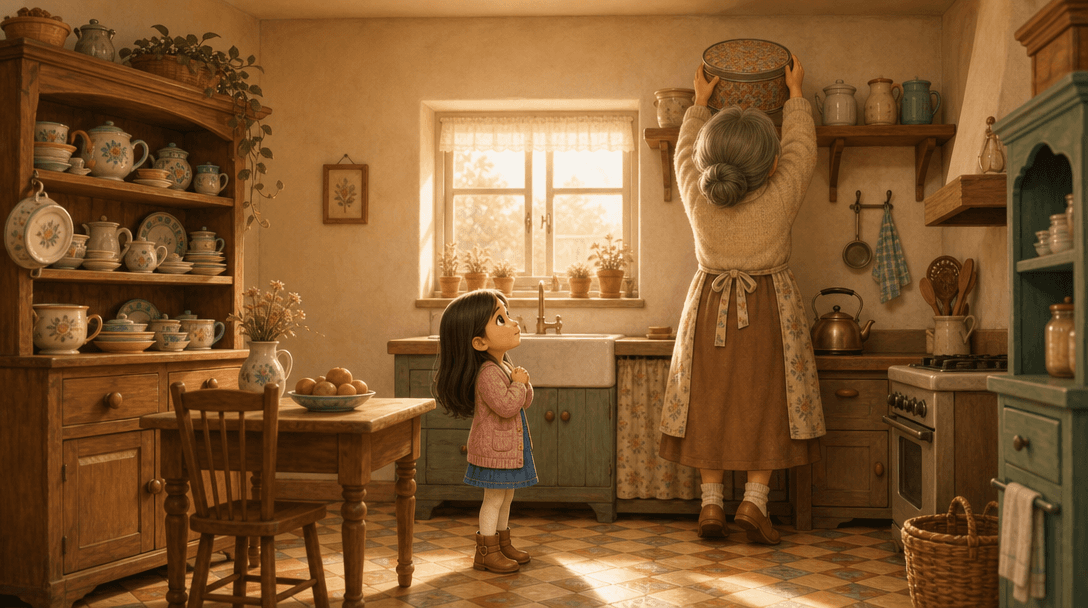 A story for thisA weekend at Grandma's, and the grandparent your child gets to knowYour child, by name, in every scene. See the Weekend at Grandma's story →
Does a 2 year old understand Christmas?
Not as a holiday. If you have read the forum threads, the usual answer is "they will not remember it, do not stress", and the first half is mostly true. ZERO TO THREE puts it gently: little ones will not remember much about their first few holiday seasons, but they carry with them the way those seasons felt.
That is the honest answer, and it is also a freeing one. A two year old does not need to understand Christmas to love it. What they take in is concrete:
- The lights. Nothing in a toddler's year is as exciting as a house that glows.
- The tree, which is inside, which is wonderful and unreasonable.
- The waiting, which they feel even if they cannot count it.
- The people, who are more than usual and louder than usual.
- The presents, which are mostly about paper.
If your toddler gets those five things in a calm, warm way, they have had a good Christmas, whether or not they could tell you what it was.
At what age do kids understand Christmas?
It builds over a few years, and every child moves at their own pace. As a rough guide:
- Around two: they enjoy the pieces (lights, tree, wrapping paper) without connecting them to one day.
- Around three: many start to anticipate it, ask when it is coming, and remember small bits from last year once you remind them.
- Around four to five: most understand that Christmas comes once a year, know what happens and in what order, and have firm opinions about how it should go.
None of these stages needs the full story yet. Each one needs the next small piece.
A short explanation, in their words
Toddlers learn through short, repeated phrases. Pick a version that fits your family and say it the same way every time it comes up. For example:
Christmas is a special day. We put lights on a tree. We give presents to people we love, and they give presents to us. We see family. It comes after lots of sleeps.
If your family celebrates Christmas as a religious holiday, the birthday frame works beautifully, because toddlers already understand birthdays:
Christmas is when we celebrate baby Jesus being born. It is a bit like a birthday. We sing songs, we hear the story, and we give presents.
Then let the season fill in the rest. When the tree goes up, say "This is our Christmas tree." When a card arrives, "This is a Christmas card from Auntie." You are not explaining Christmas once. You are labelling it, a little every day, until it makes sense.
How do I explain Santa to a 2 year old?
Decide first what your family is doing, because many families do Santa and many do not, and both are good choices. Here are options for each, all short enough for a two year old.
If your family does Santa. Keep it simple and kind: "Santa is a kind man in a red suit. On Christmas night, he brings presents." That is all a two year old needs. If you are worried about the honesty of it, Christian Hart, a psychology professor who studies deception, notes that most children work out the truth by around seven, and that research has found no link between how many Santa stories parents told and how good the adult relationship with those parents turned out to be.
If your family does not do Santa. Frame him like any other storybook character: "Santa is a pretend person from Christmas stories. Some families play a Santa game, and that is their game, so we let them enjoy it." That last part matters, because your toddler will meet children who believe, and "we let them enjoy it" is a kind rule they can actually follow.
If you want something in between. "Santa is a story people tell at Christmas, and it is a fun one." It lets a toddler enjoy the songs, the books and the red suit without anyone saying more than they are comfortable with. You can add more as they get older and ask more.
Whichever you choose, two things help at this age:
- Skip the "he is watching you" and naughty list talk. A stranger who watches you sleep and judges you is a frightening idea for a two year old, and it tends to backfire as a behaviour tool.
- Never force a lap. A large bearded stranger in a costume is scary for the same reason masks are: the face is wrong. Let them wave from your arms, stand next to him, or skip the visit. Next year might be different.
Pick one or two traditions and repeat them
Toddlers love the same thing again. That is exactly what a tradition is, so you do not need many. One or two, done the same way every year, will be what your child remembers first. Some ideas that suit two to four year olds:
- A lights walk or drive after dinner on the same evening each year, in pyjamas.
- One ornament a year that your child chooses and hangs themselves, low on the tree.
- The same Christmas book, brought out on the first of December and read until you can recite it.
- Making something for the birds or the neighbours, with your child carrying it to the door.
- A Christmas Eve box opened after dinner. We wrote a full guide on what to put in a toddler's Christmas Eve box.
Make the waiting visible
"Christmas is in three weeks" means nothing to a two year old. "Seven more sleeps" means a little more. Something they can see and touch means the most: a paper chain with a link torn off each morning, or a row of stickers on the fridge to cross off. Start short. A countdown of a week or two is easier for a toddler to follow than one that begins on the first of December.
How do I keep Christmas from overwhelming my toddler?
December is a lot: more people, more noise, more sugar, later nights, different beds. A few things make the biggest difference.
- Protect sleep. The American Academy of Pediatrics' holiday advice is to stick to the sleep habits that work at home, and to build quiet time in between activities so children can decompress. A slightly later bedtime on a special night is fine. A week of them is a meltdown.
- Ask for a quiet room. The Child Mind Institute suggests asking hosts in advance for a calm space your child can retreat to, and giving children time to warm up before they are expected to join in.
- Expect less socially. A wave hello and goodbye is plenty from a two year old. Hugging relatives they barely know is optional.
- Practise opening presents. Wrap a few things they already own and take turns opening them and saying thank you. The Child Mind Institute recommends role-playing this, and toddlers find it hilarious.
- Spread the presents out. A toddler often wants to play with the first present for an hour. Let them. The rest can wait until after lunch, or tomorrow.
- Let go of perfect. The AAP's own holiday advice admits there is no perfect when it comes to the holidays with small children. If your two year old spends Christmas morning in the box, that counts.
Gifts from grandparents who live far away can get lost in all of this, so we wrote a separate guide on Christmas gifts for grandchildren who live far away for the grown-ups who will not be in the room.
Keep bedtime the same when everything else changes
If you only protect one thing in December, make it the bedtime routine. When the house is full of new things, the same steps in the same order every night are what tell a toddler that the day is ending and everything is still all right.
If you would like help holding that routine together on the busy nights, Finn's Bedtime is a free guided bedtime routine in the FableFleet app for ages two to four, with no account needed. Finn walks your child through pyjamas, teeth with a two minute song, potty, Teddy and a cuddle, and a few lines you say together, then finishes with a calm story that says your child's name. It is the same every night, which in December is the whole point.
More in Christmas for Toddlers
- A Christmas Eve Box for a Toddler: What Is Worth Putting In It
A Christmas Eve box for a toddler works best with four things in it: new pyjamas, one book, something calm to do together, and a snack to leave out. Keep it small, open it straight after dinner, and let it start the bedtime routine instead of adding to the excitement. Here is what to put in, what to leave out, how to pick something calm to watch, how many presents a two year old actually needs, and how to keep Christmas Eve from tipping over.
- Christmas Gifts for Grandchildren Who Live Far Away (That Still Feel Like You)
The Christmas gift that works best from far away is one with you in it: your voice, your face, the name your grandchild calls you, something they can play again in January when you are not there. For a toddler that matters more than the size of the box. Here are the ideas that hold up at a distance, what to ask the parents before you buy, how to make the Christmas video call work, and what still arrives on time when the post office has stopped promising anything.
The story for this milestone
A weekend at Grandma's, and the grandparent your child gets to know
A personalized story about a weekend at a grandparent's house: the tin on the high shelf, the slow Saturday, the story about their own parent as a child, and three buttons carried home. A 2.5 minute storybook film.
We make it from the details you choose. Your child, by name, in every scene.
Frequently asked questions
- Does a 2 year old understand Christmas?
Not as a holiday, and that is fine. A two year old can understand the things that happen: lights go up, a tree comes inside, people visit, there are presents, and there is a lot of waiting. The idea of a special day with a meaning comes later, usually somewhere between three and five. Teach the events, in order, in short words.
- At what age do kids understand Christmas?
It builds gradually. Many two year olds enjoy the lights and the presents without connecting them to a day. Many three year olds start to anticipate it and remember bits from the year before. By four or five, most children understand that Christmas comes once a year and can tell you what happens. Every child is different, so follow what yours asks about.
- How do I explain Santa to a 2 year old?
Keep it short and kind, and decide first what your family is doing. If you do Santa: Santa is a kind man in a red suit who brings presents on Christmas night. If you do not: Santa is a pretend person from Christmas stories, and some families play a Santa game, so we let them enjoy it. Either way, skip the watching and naughty list talk, which can make a small child anxious.
- Should I make my toddler sit on Santa's lap?
No. Plenty of toddlers find a large bearded stranger in a costume frightening, for the same reason masks scare them. Let them wave from your arms, stand next to him, or skip it altogether. A photo of a crying child is not worth a memory of being handed to a stranger.
- How do I keep Christmas from overwhelming my toddler?
Protect sleep and routines, build quiet time between busy events, ask hosts for a calm room your child can retreat to, and spread presents out rather than opening everything at once. Expect less of them socially: a wave hello and goodbye is plenty from a two year old.
- How do I explain Christmas to a toddler if we are religious?
The birthday frame works well: Christmas is when we celebrate Jesus being born, so it is a bit like a birthday, with a special story, songs and presents. Toddlers already understand birthdays, which makes this one of the easiest explanations to land. Keep it to one or two sentences and repeat it.
Sources
- ZERO TO THREE, 12 Days of Holiday Reads: Keeping It Shiny and Bright with Babies and Toddlers. Little ones will not remember much about the first few holiday seasons, but they carry the way they felt; quiet, cozy celebrations and reading together.
- Child Mind Institute, 24 Ways to Make the Holidays Kid-Friendly. Visual schedules, age-appropriate social expectations (hi and bye is enough), role-playing opening presents and saying thank you, asking hosts for a quiet space, warm-up time.
- American Academy of Pediatrics, HealthyChildren.org, Holiday Travel Tips. Stick to the sleep habits that work at home; quiet time between activities helps children decompress; there is no perfect holiday.
- Christian L. Hart, Ph.D., Psychology Today, Should You Lie to Kids About Santa?. Most children work out the truth about Santa by around seven; no link found between the number of Santa lies and the quality of the adult relationship with parents.
FableFleet team
Founders & moms, FableFleet
We're a small team of moms building the personalized children's stories we wished existed for our own kids. Everything we publish is rooted in lived experience and cited research.