
Why a placemat, and why no sticker
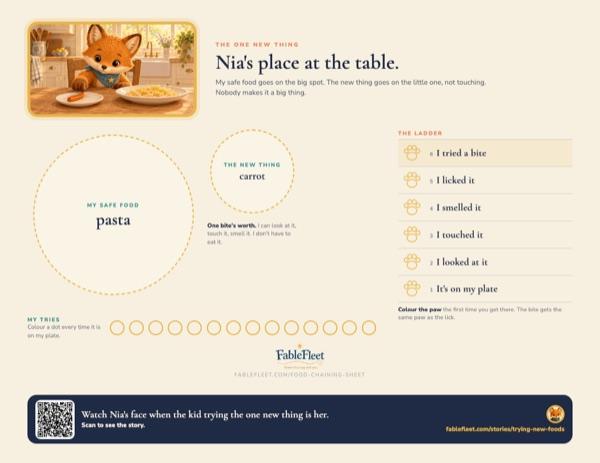
Every try-new-foods chart you can buy is a grid with a sticker column, and most of them pay for the swallow. The pediatricians are plain about why that backfires. The American Academy of Pediatrics: “This can make the ‘prize’ food even more exciting, and the food you want them to try an unpleasant chore.” So the placemat has no sticker and nothing to earn. It credits the steps a feeding clinic credits, looking, touching, smelling, licking, because the CDC says to “allow kids to touch and smell their food,” and because a finger that reaches out and comes straight back is the biggest moment in the whole two weeks.
How to use it
It goes under the plate at every meal. The safe food on the big spot, every time; the Canadian Paediatric Society says to “offer at least one food at every meal that you know your child likes.” One bite's worth of the new thing on the little spot, not touching. You eat yours. If they say no, “you don't have to eat it,” and that is the whole conversation. When the meal ends, the NHS: “Just take the food away without saying anything.” The paws are for the first time they reach a rung. The dots are for every try.
Picking the one new thing
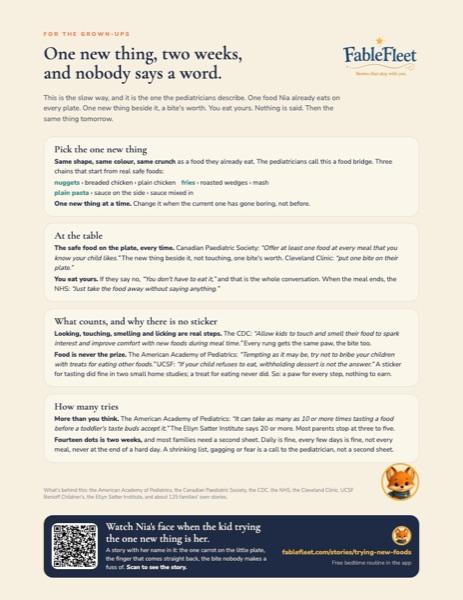
Same shape, same colour, same crunch as a food they already eat. The American Academy of Pediatrics calls this a food bridge; the feeding clinics call it food chaining. Nuggets to breaded chicken to plain chicken. Fries to roasted wedges to mash. Plain pasta to pasta with the sauce on the side to sauce mixed in. One new thing at a time, for as long as it takes to go boring. Then the next link. The food chaining guide has the longer version.
The page for you
The second sheet has the four things to hold onto for two weeks, in the pediatricians' own words: how to pick the new thing, what happens at the table, why there is no sticker, and how many tries it really takes (the bodies say anywhere from eight to twenty, and most parents stop at three to five). The last line matters most: a list of foods that is shrinking, gagging, or fear at the sight of new food is a call to the pediatrician, not a second sheet. The signs worth a call are in their own guide.
Questions parents ask
- Why is there no sticker for eating it?
- Because food earned by eating another food gets liked less, and every pediatric body says the same: the American Academy of Pediatrics says "try not to bribe your children with treats for eating other foods," and UCSF says "withholding dessert is not the answer." A sticker for a tiny taste did fine in two small home studies, so colouring a paw for each step is as far as the placemat goes. The bite gets the same paw as the lick.
- How many tries does a new food take?
- More than you think. The American Academy of Pediatrics says "10 or more times," the CDC says 8 to 10, UCSF says up to 15, and the Ellyn Satter Institute says 20 or more. Most parents stop at three to five. The placemat has fourteen dots, which is two weeks, and most families need a second one.
- What goes on the little spot?
- One bite's worth of one new thing, as close as you can get to a food they already eat: same shape, same colour, same crunch. Nuggets to breaded chicken to plain chicken. Fries to roasted wedges to mash. Plain pasta to pasta with the sauce on the side. One new thing at a time, and change it only when it has gone boring.
- What if they only ever eat the safe food?
- That is the point. The Canadian Paediatric Society says to "offer at least one food at every meal that you know your child likes," so nobody goes hungry and nobody has to fight. The new thing is there to be looked at, touched and smelled for as long as that takes. When the meal ends, the NHS line is the whole method: "Just take the food away without saying anything."
More for a picky eater
- Picky eating at 2, 3 and 4: what is normal and what helps
- The picky eater food list: the safe foods most kids accept
- Everything for picky eating
- The One New Thing story, with your child's name in it
What's behind this
- American Academy of Pediatrics, “10 Tips for Parents of Picky Eaters.” healthychildren.org
- Canadian Paediatric Society, “When your child is a picky eater.” caringforkids.cps.ca
- CDC, “Picky Eaters and What to Do.” cdc.gov
- NHS, “Fussy eaters.” nhs.uk
- Cleveland Clinic, “How To Deal With a Picky Eater Toddler.” health.clevelandclinic.org
- UCSF Benioff Children's Hospitals, “Picky Eaters.” ucsfbenioffchildrens.org
- Ellyn Satter Institute, “Introducing New Foods.” ellynsatterinstitute.org