
Growing up · ages 2 to 5
For the child who is not ready to share, which is most of them
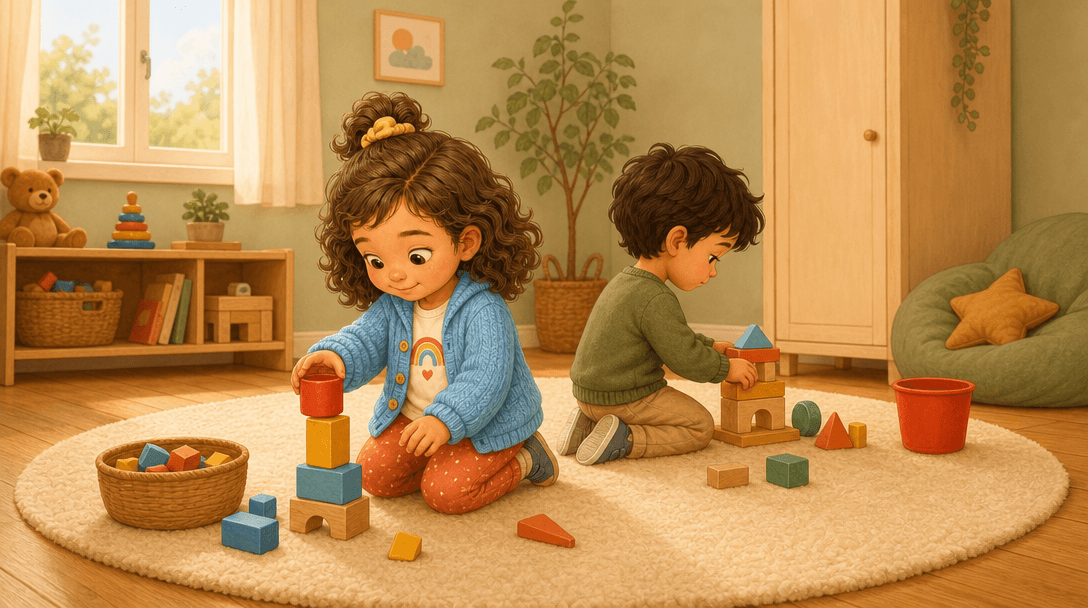
Sharing is hard at two, three and four, and a first playdate is where that shows. In this story your child, by name, chooses two precious things to put safely away before the doorbell, plays side by side, and lands on the same red cup as their friend, with nobody made to hand anything over. Watch it the week before a first playdate, and the hard moment has already been rehearsed.
- Your child in every scene, made from the details you choose
- Two precious things put safely away, chosen by them
- Nobody is forced to share
- The waiting shown at its real, difficult length
- Finn hides three times, with a question at the end
Coming soon
We're still making this one. See what's ready to make today
Why we made this one
What adults mean by sharing, giving up something you still want, is a lot to ask between two and five. In one national survey of parents, more than four in ten thought children could share and take turns before age two; the survey's answer is three to four. The usable version at this age is taking turns, and the hard part of taking turns is the waiting.
One study sits underneath this whole story. Preschoolers who chose to give up something they could have kept shared more the next time than children who were simply told to. So the handover here is the child's own choice, unhurried, because a story where an adult makes it happen would be arguing against itself.
There is also an uncomfortable finding about us. Parents tend to push their own child to share when the toy is theirs, which makes the host child's turn the one most likely to be cut short. That is the engine of this story, which is why the grown-up in it crouches down, says one sentence naming the hard part, and then lets the turn finish.
What finally ends it is not a lecture. It is a job too big for one person, because three-year-olds who have just worked together tend to split the reward evenly, much more often than when the same things simply land in their laps.
Three moments from the story
Every scene is made from scratch for your child, so these are written here rather than shown.
Two go up high
Before anybody arrives, your child chooses two things to go up in the cupboard. Everything else out here is for today.
The waiting
Turning a block over and over. Looking sideways about nine times. Waiting is the hardest thing there is at three, and nobody makes it shorter.
Nobody asked
The cup goes across when your child is finished with it. Nobody asked them to. It was their own choice, and that is what makes it stick.
How it works
Step 1
Tell us about your child
Their name, age, hair, skin and eyes, and the grown-up hosting, who names the hard bit and then does nothing. You see your child's character before you pay. About five minutes.
Step 2
We make the story
Every scene is made just for your child, and the narrator reads their name.
Step 3
Watch it together
It lands in the FableFleet app and in your email within 24 hours, usually much sooner. Yours to keep and download.
Coming soon
We're still making this one. See what's ready to make today
Questions parents ask
- Should I be making my child share?
- Not by telling them to. Preschoolers who chose to give up something they valued shared more afterwards than children who were told to. At this age, child development experts talk about taking turns instead, and that is what the story shows, with the waiting named out loud.
- Is it wrong to put favourite toys away before a friend comes?
- No. It is common advice before a playdate, and this story opens on it. Two or three things, chosen by your child, put up high.
- There is no sand timer in it?
- Deliberately not. Most guidance allows a timer and no study has tested one, so the story leaves it to your family and shows a turn ending when it naturally ends.
- Does it work for siblings rather than a friend?
- Yes. The visitor can be a cousin or a friend, and the beats are the same. The job that takes two people works especially well between siblings.
- Who is Finn?
- Finn is our little fox. He hides three times in this story, and at the end the story asks how many times you spotted him, then shows where he was.
- How long is it and when does it arrive?
- About two and a half minutes. It is ready within 24 hours, usually much sooner, and you get an email the moment it is done.
- What does it cost?
- $9.99 USD, one time, or $12.99 CAD in Canada. Anywhere else, checkout shows it in your own currency.
Guides for this moment
- The sharing social story: free, in your child's voice, with their name and a friend's, for the days before a friend comes over.
FableFleet stories are designed to provide gentle, age-appropriate storytelling support. They are not a substitute for professional medical, mental-health, legal, or therapeutic advice.
What was yours stayed yours, Nia. And the other thing, you handed over all by yourself.