
What the sharing social story says
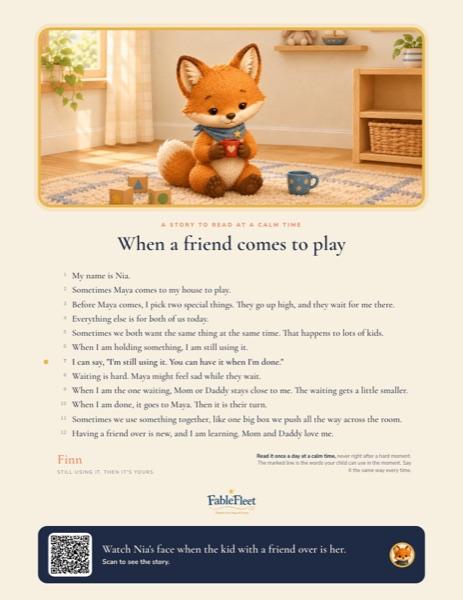
Eleven of the twelve lines describe. A friend comes over. Before they arrive, your child picks two special things, and those go up high to wait. Everything else is for both of them today. Sometimes they both want the same thing at once, and that happens to lots of kids. When your child is holding something, they are still using it. Waiting is hard, and when your child is the one waiting, their grown-up stays close. When they are done, it goes to the friend. One line gives your child the words to say: “I'm still using it. You can have it when I'm done.”
That shape comes from Carol Gray, who created social stories: mostly describing, with one line, at most, that tells the child what to do. No sticker at the end and no “good sharing” prize. A warm word when they hand something over is plenty.
How to use a sharing social story before a playdate
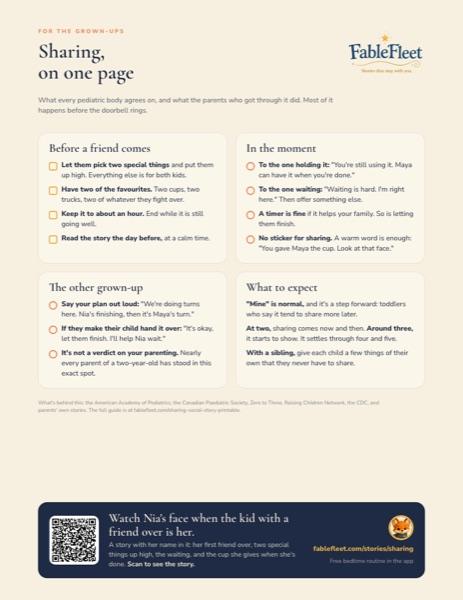
Read it once a day at a quiet time for a few days before a friend comes, the same way each time. Never straight after a grab, when it would feel like a telling-off. The day of the playdate, let your child choose their two special things and put them up high together. Every pediatric body that speaks to it says the same thing, and the American Academy of Pediatrics says it plainly: “Let your child put away a few things that are off limits.” Then have two of the favourites out, two cups or two trucks, and keep it to about an hour.
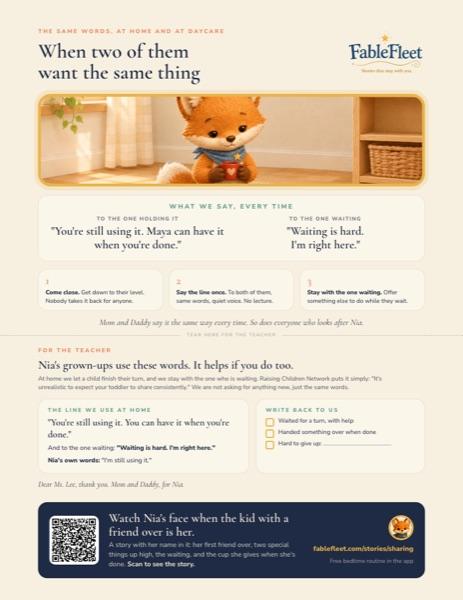
The same words card for sharing at daycare
The card gives everyone the same two lines. To the child holding it: “You're still using it. Your friend can have it when you're done.” To the child waiting: “Waiting is hard. I'm right here.” Under them go three steps: come close, say the line once, and stay with the one who is waiting. The bottom half tears off for the teacher, with a place to write back how turns went. If your daycare already has a line for turns, put theirs on the card. Which line matters less than everyone saying the same one.
Questions parents ask about sharing
- What is a sharing social story?
- A short story in your child's own voice about something that is hard for them, read at a calm time so the words are already familiar when the hard moment comes. This one is about a friend coming over: two special things go up high, the rest is for both of them, and the one holding something gets to finish.
- What age is a sharing social story for?
- About two to five. Two-year-olds share now and then, mostly when asked. Around three it starts to show, and it settles through four and five. For a two-year-old, read it slowly and point to Finn and the red cup.
- Should I make my toddler share?
- Not by taking the toy out of their hands. Let them finish their turn, and stay with the child who is waiting. The Canadian Paediatric Society lists asking toddlers to share as an example of expecting something beyond a child's level.
- What do I say when two kids want the same toy?
- To the one holding it: "You're still using it. Your friend can have it when you're done." To the one waiting: "Waiting is hard. I'm right here." Then offer the waiting child something else to do. Say it the same way every time, at home and at daycare.
- Is a timer a good idea for taking turns?
- If it helps your family, yes. Most guidance for parents allows one, and none of it is against. Letting a child finish their turn works too.
Sources
- Carol Gray, “Social Stories 10.4 Criteria.” carolgraysocialstories.com
- American Academy of Pediatrics, “Young Children Learn a Lot When They Play.” healthychildren.org
- Canadian Paediatric Society, “Positive discipline for young children.” caringforkids.cps.ca
- Raising Children Network, “Teaching children to share: an age-by-age guide.” raisingchildren.net.au
- Zero to Three, “Helping Young Children With Sharing.” zerotothree.org