
· Updated
50/50 Custody Schedule for Toddlers and Preschoolers: What Works by Age
By Amanda and Ashley, two moms with four kids between us
There's no single best 50/50 custody schedule for a toddler or preschooler. Little ones count in sleeps, not days, so for under threes keep each stretch away from either parent short, two or three days, which is what a 2-2-3 does. From about three, longer stretches get easier, and studies of three to five year olds sharing time equally find no harm from the split itself. What matters more is a pattern that stays the same, a calendar they can read, and grown-ups who are kind to each other at the door.
You're looking at a blank month and two homes, trying to work out a 50/50 custody schedule a three year old can actually live with. Every page you find is written for the grown-ups: which days, which weekends, who drives. This one is written from the child's side of the door.
The short version: how long your child is away from each of you matters more the younger they are, a pattern they can predict matters at every age, and how the two of you are with each other matters most of all. For the bigger picture of helping a little one feel at home in both places, start with our co-parenting tips for toddlers and preschoolers.
Coming soon, the story for this moment: Your child's Two Homes, with your child in every scene.
What a 50/50 custody schedule means to a three year old
To you, a schedule is days and weeks. To a two or three year old, it's sleeps. The AFCC's planning guide for parents puts it simply: three to five year olds are beginning to understand days and weeks, but not time. Wednesday means nothing. Two more sleeps, then Papa's means something.
They also see themselves at the centre of everything. A preschooler may quietly decide the two homes are their fault, or worry that a parent who isn't here tonight is gone for good. So the best 50/50 custody schedule for a young child is one they can feel coming: the same order, the same kind of goodbye, and someone telling them in sleeps when they'll see the other grown-up again.
Under about two, words do even less. What a toddler takes in is the routine: the same faces, the same bedtime, the same cuddly. Keep those steady in both homes and they'll follow the shape of the week long before they could explain it. A bedtime story that plays the same in both homes helps: we made Finn the Sleepy Fox, a calming one on our YouTube channel, to listen to with the screen turned away.
Is a 50/50 custody schedule good for a toddler?
For children from three to six, the research lines up more than you'd think. In Sweden, where equal time is common, preschoolers living equally in both homes had fewer emotional and behavioural problems than children living mostly with one parent. An Australian study found no link between shared overnights and unsettled behaviour at four and five. A US study that followed young children for a year and a half found that the ones already sleeping over in both homes at four to six had fewer problems later than younger children did, and that a steady schedule mattered more than the overnights themselves.
For babies, researchers still disagree, and that argument isn't ours to settle. The joint position from both sides says there's no reason to ban overnights under three, but some caution about very frequent ones, especially when the baby doesn't yet know the second parent well or sees the parents fight.
What every guide agrees on is that the number of days isn't the point. The AFCC's guide says it plainly: "no research supports a given number of hours or days that children should spend with each parent."
Canada says the same thing in its own words. Since March 1, 2021, the Divorce Act talks about parenting time, not custody, and Justice Canada's planning tool says "there is no presumption or starting point that parenting time is to be split 50-50 between parents." Equal time is one good answer, not the only one.
The 2-2-3 custody schedule and other 50/50 patterns
These are the four you'll see on every schedule site. Here's how each one feels from a small child's side.
- 2-2-3. Two days in one home, two in the other, then three back in the first, and the next week it flips. No stretch is longer than three sleeps, which suits a toddler. The cost is lots of switch days, so the goodbye has to be easy.
- 2-2-5-5. The same two weekdays in each home every week, and the weekends alternate, so each home gets a five-day stretch every other week. Fewer switches, and the weekdays never change, which helps a child who likes to know.
- 3-4-4-3. Three days in one home and four in the other, then it swaps. Fewer switches than 2-2-3, but some stretches are four sleeps.
- Week on, week off. One switch a week. Seven sleeps is a long way off for a child who counts in sleeps, so it usually fits better as they get older.
By age, the AFCC guide gives a rough shape:
- Nine to 18 months. Separations of more than three or four days from either parent get in the way of the bond with that parent.
- Toddlers, about 18 months to three. If both of you did the hands-on care before the separation, your child should be able to be away from either of you for two or three days. That's the stretch a 2-2-3 custody schedule keeps to. Start with overnights spread through the week rather than bunched together.
- Three to five. The guide says reasonably equal time may be considered. Some parents find every other weekend, with time midweek, works well too.
Whatever you start with can change as your child grows.
Fixed days or rotating: which 50/50 schedule is easier?
Parents who share time say fixed days are easier for a little one to follow than a rotation. One family with a daughter of nearly four chose four nights and three nights on the same weekdays every week, so she always knew which days she went home with which parent. Another family's six year old has fixed weekdays and alternate weekends, and the days cause no confusion at all. When they do swap one, something always gets left at school.
That fits the research. The steadiness of the pattern mattered more for young children than the overnights did. If your work won't allow fixed days, a calendar does the same job.
What matters more than any 50/50 custody schedule
When I was about eight, my brother and I lived in two homes on the same street. We were usually at my mom's during the week and more at my dad's on the weekends, and plenty of weeks bent around whatever worked for their schedules. We walked down the street with a bag, mostly clothes.
My parents didn't get along. Looking back, what would have made it so much better was them getting along, not arguing, and not talking badly about each other in front of us.
The research says the same thing. A Swedish study of three year olds found that once the parents' teamwork was counted, the differences between living arrangements almost vanished. Its authors put it this way: "coparenting quality is a key determinant of mental health in preschool children."
So whichever 50/50 custody schedule you pick, the parts that protect your child are the same:
- Be polite at pickup and drop-off. Save the hard conversations for a text or a call your child can't hear.
- Carry no messages. Your child is not the go-between, even for a pickup time.
- Ask nothing about the other house. Let them tell you if they want to.
- Let them love both of you out loud. Missing the other grown-up is allowed.
Switch days on a 2-2-3 custody schedule
A 2-2-3 means a lot of doors. That's fine if each one is short and the same. One warm goodbye, a small ritual you always do, and go. Crying at the door is common, and it's usually about leaving the grown-up they're with, not about where they're going.
If the door is hard, let the swap happen somewhere ordinary. Justice Canada suggests a natural point in the day: one of you drops off at daycare or school, and the other picks up. No doorstep, no goodbye to stage.
Expect a grumpy first hour back. Keep it quiet: a snack, a cuddle, a story, no questions. There's more on the goodbye and the hello in Mom's house, Dad's house: switch day for little kids.
A 50/50 schedule calendar your preschooler can read
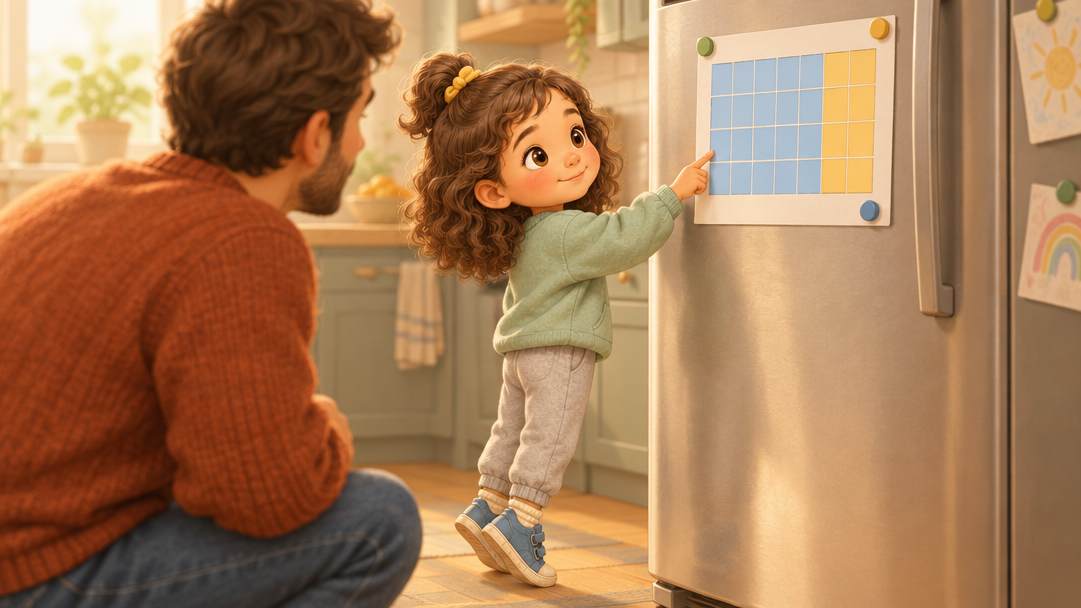
Whatever the pattern, put it where your child can see it. A month on the fridge, a colour for each home, and a way to count the sleeps.
We made one you can print free: the two homes calendar. Each home is named the way your child says it, in its own colour. You tap in the nights, the switch days get a small door, and the one thing that always comes along has its own line. Print one for each home and cross off the sleeps together at bedtime.
When to call the doctor, or change the schedule
Some sleep trouble, clinginess, potty accidents and big feelings are normal for a while after any new schedule. If they're still there several weeks after things have settled, or they're getting worse, talk to your doctor.
A schedule that suits your child at two may not suit them at five, so look at it again as they grow. And if one home isn't safe, the schedule changes. Justice Canada notes that people are often at higher risk of family violence soon after a separation. If you or your child are in danger, call 911 or your local police.
Two Homes: a story for switch days
We made Two Homes for the child living a schedule like this. It's one ordinary switch day, with your child in every scene and both of their grown-ups named the way your child says them. The coloured squares on the wall show whose day it is. Only Bear rides along. At the first door there's one warm, short hug and a little wooden moon pressed into their hand. At the second door, someone is waiting. There's a grumbly hour nobody minds, everything right where they left it, and the same moon over both homes at bedtime. It's for ages three to six.
Watch it together before a switch day, then watch it in the other home too. For books to read alongside it, start with the Two Homes book and our shelf of books about divorce for preschoolers.
More in Two Homes
- Co-Parenting Tips for Toddlers and Preschoolers: Helping Your Child Feel at Home in Two Homes
Little kids can do well in two homes. The co-parenting tip that matters most is how the grown-ups are with each other at the door: kind, short, and the same every time. Tell your child it isn't their fault, and say it more than once. Keep bedtime and meals close to the same in both houses, let one special thing ride along, and use the names your child already has for each home. Expect a grumpy first hour after a switch. Most kids settle as the new pattern becomes ordinary.
- Books About Divorce for Preschoolers and Young Kids, by Age
The best books about divorce for preschoolers are calm ones, where a child lives in two homes and is loved in both. Start with Two Homes by Claire Masurel. Add a book where something travels between the homes, like Fred Stays With Me! If your child thinks it's their fault, read It's Not Your Fault, Koko Bear. Read each one yourself first, then read it together more than once.
- Evelyn Del Rey Is Moving Away, and Moving House With a Little One
Evelyn Del Rey Is Moving Away is a picture book by Meg Medina about two best friends on the day one of them moves. It's for ages five to seven, and it lets a child hold the goodbye and the friendship at the same time. If your own family is the one moving, tell your little one simply, let them pack one box of their own, set up their room first, and keep other big changes for another month.
- Mom's House, Dad's House: Switch Day for Toddlers and Preschoolers
Mom's house, Dad's house, or whatever your child calls them: switch day goes best when the goodbye is short and the same every time. Crying at the door is usually about leaving the grown-up they're with, not about where they're going, and most kids are fine within minutes. If the door is hard every time, move the swap to daycare or school. Keep the first hour back quiet, and put goodnight calls at a set time before bed.
- Two Homes Book by Claire Masurel, and What to Read Next
Start with Two Homes by Claire Masurel. It's the two homes book we'd hand any parent of a two to five year old. Alex has a home with Mommy and a home with Daddy, is loved in both, and nobody argues on the page. Read it on an ordinary day, say the names your child uses for each home, and keep a copy in both houses. When you want more, read Living with Mom and Living with Dad, Always Mom, Forever Dad, and Fred Stays With Me!

Coming soon
Two homes, and a child who is loved in both
A personalized story for a child who lives in two homes: one ordinary switch day, a warm goodbye at one door and a warm hello at the other, both grown-ups named and shown. A 2 to 3 minute story.
We’re still making this one. Your child, by name, in every scene.
Frequently asked questions
- What is the best 50/50 custody schedule for a 3 year old?
There's no single best one, and no research supports a set number of days. What helps a three year old is a pattern that stays the same, stretches they can count in sleeps, and a calendar on the fridge. A 2-2-3 and fixed weekdays in each home both give a little one a pattern to hold. Pick the one your child can predict.
- Is a 2-2-3 custody schedule good for a toddler?
It can be. A 2-2-3 keeps every stretch to three sleeps or fewer, which fits a family court guide's advice that a toddler whose parents both did the hands-on care can be away from either parent for two or three days. The cost is lots of switch days, so keep each goodbye short, warm and the same every time.
- Is week on, week off too long for a preschooler?
Seven sleeps is a long way off for a child who counts in sleeps, so it usually fits better as children get older. For three to five year olds the family court guides say reasonably equal time may be considered, but they don't set a length. Watch your child: if a week apart brings big feelings every time, a shorter pattern may suit them for now.
- Is 50/50 custody good for toddlers and preschoolers?
For children from three to six, the studies line up: preschoolers sharing time equally did as well as, or better than, children living mostly with one parent. For babies, researchers still disagree. At every age, how the grown-ups get along matters more than the split.
- How do I help my preschooler understand a 50/50 schedule?
Count in sleeps, not days. Put a month on the fridge with a colour for each home and a small mark on switch days, and cross off the sleeps together at bedtime. Use the names your child already has for each home, and say the same short goodbye every time.
- Does Canada still say custody?
Not under the federal Divorce Act. Since March 1, 2021, it says parenting time and decision-making responsibility instead of custody and access. Justice Canada also says there's no starting point that parenting time has to be split 50-50. Some provinces still use the older words.
Sources
- AFCC Massachusetts Chapter, Planning for Shared Parenting: A Guide for Parents Living Apart
- Justice Canada, Parenting arrangements after separation or divorce
- Justice Canada, Parenting Plan Tool
- Justice Canada, Making plans, Section 4: What is the best parenting arrangement for my child?
- Justice Canada, How children react at different ages and stages
- Justice Canada, Fact Sheet: Divorce and Family Violence
- American Academy of Pediatrics, HealthyChildren.org, Sleep Problems After Separation or Divorce
- Bergström and others (2018), Preschool children living in joint physical custody arrangements show less psychological symptoms, Acta Paediatrica
- Bergström and others (2021), Importance of living arrangements and coparenting quality for young children's mental health after parental divorce, BMJ Paediatrics Open
- Pruett, Ebling and Insabella (2004), Critical aspects of parenting plans for young children, Family Court Review
- McIntosh, Smyth and Kelaher (2013), Overnight care patterns following parental separation, Journal of Family Studies
- Pruett, McIntosh and Kelly (2014), Parental separation and overnight care of young children, Part I, Family Court Review
Co-founders and moms, FableFleet
Two moms, four kids between us. We write about the moments we are living through, and we made the bedtime routine and stories our own kids use.