
· Updated
First Lost Tooth: What to Expect, What to Say, and How to Mark It
Most children lose their first baby tooth between ages five and seven, usually a lower front tooth, after a wiggle that lasts longer than they expect. Let it come out on its own. Answer the two bedtime worries honestly: it rarely hurts much, and if it gets swallowed, the tooth fairy still comes. A little bleeding is normal; rinse and press for a few minutes. Then mark the morning with a photo, a note and someone to tell.
Most children lose their first baby tooth between ages five and seven, and it is usually one of the two lower front teeth, according to the American Academy of Pediatric Dentistry. It starts with a wiggle that tends to last longer than your child expects, and it usually ends quietly, often during a meal or while brushing.
If you are reading this during the wiggly weeks, here is what to expect, what to say at bedtime, and how to mark the morning after.
The short version:
- First teeth usually go between five and seven. Earlier or later is often fine.
- Let the tooth come out on its own. Nothing needs to be pulled.
- The two big bedtime worries are "will it hurt?" and "what if I swallow it?" Both have honest, calm answers.
- A little blood is normal. Rinse with cool water and press gently for a few minutes.
- The morning after is the part children remember. A photo, a note and someone to tell are plenty.
When does the first tooth fall out?
The usual window is ages five to seven, with the lower front teeth going first, per the AAPD. The whole set of baby teeth is usually gone by around age twelve, and there is plenty of normal variation along the way.
If your child is at the early or late end of that window, that is usually fine. The flags worth raising with your dentist are a child who reaches seven with no loose teeth at all, or a grown-up tooth coming in behind a baby tooth that is not budging (more on that below).
The story for this moment: Your child's Wiggly Tooth, with your child in every scene.
The wiggle: what the lead-up looks like
The first sign is usually your child noticing it. A tongue keeps going to the same spot, an apple gets bitten on the side, and there is an announcement at breakfast that "this one is moving."
Then comes the long wait. A loose tooth can stay loose for longer than seems possible, and for a five-year-old that wait is a big part of the experience. Some children wiggle it constantly. Some refuse to touch it. Both are normal.
A few things that help during the wait:
- Do not pull it. Loose teeth come out on their own, often while eating or brushing. Nobody needs to rush it.
- Let your child set the pace. If they want to wiggle it, clean hands are all that matter. If they do not, leave it alone.
- Offer softer food if biting hurts. Cut apples into slices rather than skipping them.
- If it is hanging by a thread and bothering them, a clean tissue and a gentle twist can help, but only if your child wants that.
The bedtime worries, answered
Bedtime is when a loose tooth gets big. In a quiet room, children tend to arrive at two specific fears, and it helps to answer them out loud before they come up.
"Will it hurt?"
Usually not much. By the time a baby tooth is very loose there is very little holding it in, which is why so many come out without anyone noticing until it is in their hand. You can say it plainly: "It might feel a little funny, and there might be a tiny bit of blood. It will be quick, and I will be right there."
Avoid promising it will not hurt at all. A small, honest answer is easier to trust than a big reassuring one.
"What if I swallow it in my sleep?"
This is a real worry for a lot of children, and the answer can be calm: a baby tooth is small, and the ritual does not depend on having it. If your child ever coughs, chokes or has trouble breathing, call your pediatrician.
It also helps to say what happens next: "If it ever gets swallowed, we just write a note, and the tooth fairy still comes." (Or the mouse, or whatever your family's version is.) Knowing the ritual does not depend on the tooth takes a lot of the pressure off.
After both questions are answered, the most settling thing you can do is the simplest: nobody rushes the tooth. It will come out when it is ready.
When the tooth comes out
The first half minute is what your child will remember, so match their energy. If they are thrilled, be thrilled. If they are nervous, be calm and matter-of-fact.
A few lines that work:
- "That is your first lost tooth. That is a big deal."
- "Let me see. A little blood is normal. Let's rinse."
- "Where do you want to put it tonight?"
For bleeding, the ADA's MouthHealthy guidance is simple: rinse with cool water, press a clean cloth or gauze gently on the spot for a few minutes, and offer soft food for the rest of the day. Bleeding that has not stopped after about ten minutes of gentle pressure is worth a call.
If your child is nervous about the blood, narrate what you are doing in a steady voice: "We are just rinsing, and now I am pressing gently. That is all." Then give them something to look forward to, like choosing where the tooth goes.
Where the tooth goes tonight
The tooth goes wherever your family's tradition says, and there are more options than the pillow. Some families have a tooth fairy, some have la petite souris or Ratoncito Pérez, some keep the tooth in a keepsake box, and some have no ritual at all. All of these are fine.
If your child chooses the spot, they are more likely to feel settled at bedtime. A small bag or envelope keeps a tiny tooth from getting lost under a pillow. For the practical side of the night itself, including what to leave and how much, see our first tooth fairy visit guide. For the bigger questions children ask about the fairy, our tooth fairy guide has the answers.
The morning after
The morning is half the memory. Whatever your ritual, a few small things make it land:
- Be nearby when your child wakes up. The first reaction is the part you will want to see.
- Take one photo. The gap, the grin, the tooth or the note in their hand.
- Let them tell someone. A grandparent on the phone, a sibling, a teacher. Telling the story is how it becomes theirs.
- Save the tooth if you want to. A small envelope with the date and which tooth it was is enough. The AAPD has no medical position on keeping baby teeth, so this is purely your choice.
Family rituals like this matter more than they seem. Research by Marshall Duke at Emory, described by Bruce Feiler in The Stories That Bind Us, links small family stories and rituals to children's sense of belonging. A first lost tooth is one of the easiest ones to mark.
If your child feels sad about it
Some children are thrilled. Some feel strange about losing a piece of themselves and cannot say why. Some feel both in the same morning. All of it is normal.
Name the feeling rather than fixing it: "It was part of you, and now it is not. That can feel strange." Then point to what comes next: "A grown-up tooth is on its way, and that one stays." Skip "don't be sad, this is exciting." Both can be true at once.
A child who wants to keep the tooth can do that too. Many families let the visitor borrow the tooth for the night and leave it beside the gift in the morning.
Caring for the gap
The gap may be tender for a day or two, and soft food helps. Keep brushing gently around it with a soft brush.
The grown-up tooth can show up within weeks, but per the ADA it can take up to about six months to come in fully, and that is within the normal range.
When to call the dentist
Call your pediatric dentist if:
- Bleeding has not stopped after about ten minutes of gentle pressure.
- Your child has pain that does not settle with soft food and rest.
- A grown-up tooth is coming in behind a baby tooth that is not loosening (sometimes called "shark teeth"). This is common and often resolves, but your dentist should take a look.
- Your child is seven and none of the lower front teeth have loosened.
A story for the long wait
We are Ashley and Amanda, two moms who started FableFleet, and we make personalized storybook films. The Wiggly Tooth story, titled with your child's name, was written for exactly the weeks this post is about. It is about two and a half minutes, for ages 5 to 7, with your child in every scene and the narrator saying their name. It follows the wiggle, the long wait, the bedtime worry answered and the morning after. The two fears get said out loud, that it might hurt and that it might be swallowed in the night, and a grown-up answers both honestly. Nothing is pulled and no blood appears: the tooth comes out on its own, on the tip of a toothbrush, and your child is surprised by how small the moment is. Nobody is named as the visitor, so it fits a family with a fairy, a mouse, a keepsake box or no ritual at all. A person checks every film, and it is ready within 24 hours. See the Wiggly Tooth story.
More in Tooth Fairy
- Tooth Fairy: The Whole Guide for Parents (What She Does, What She Looks Like, and the Traditions Worth Keeping)
The tooth fairy comes at night after a child loses a baby tooth, takes the tooth and leaves a small gift, usually money and often a short note. There is no official version: she first appeared in print in 1908, so what she looks like, what she does with the teeth and how much she leaves is up to your family. Pick a few details, keep them consistent, and the ritual does the rest.
- First Tooth Fairy Visit: What to Leave, How Much, and How to Pull It Off
For a first tooth fairy visit, most families leave their usual amount of money plus a short note, sometimes with one small extra for the first tooth. Delta Dental's poll puts the recent U.S. average at four to six dollars per tooth. Get the gift and note ready before bedtime, know where the tooth is, wait until your child is deeply asleep, swap quietly, and be nearby in the morning.
- Personalized Tooth Fairy Gifts: Ideas That Feel Made for Your Child (Plus Boxes, First-Tooth Gifts and a DIY Door)
The most personal tooth fairy gift is also the cheapest: a short handwritten note that uses your child's name and one true thing about them. Pair it with one small keepsake, such as a special coin, a charm, a named tooth bag or a small book. For a first tooth, add a keepsake box with labeled envelopes. A tiny door at the baseboard, made together, can be part of the gift too.
- What If the Tooth Fairy Doesn't Come? What to Say in the Morning, and Notes You Can Copy
If the tooth fairy doesn't come, stay calm and treat it as a delay, not a failure: \"She must have had a very busy night. Let's leave the tooth out again tonight.\" Then make sure the visit happens the next night, with the planned gift, a short note giving a gentle reason, and one small extra. Set an alarm so it does not happen twice. Handled warmly, the repair often becomes a favorite family story.
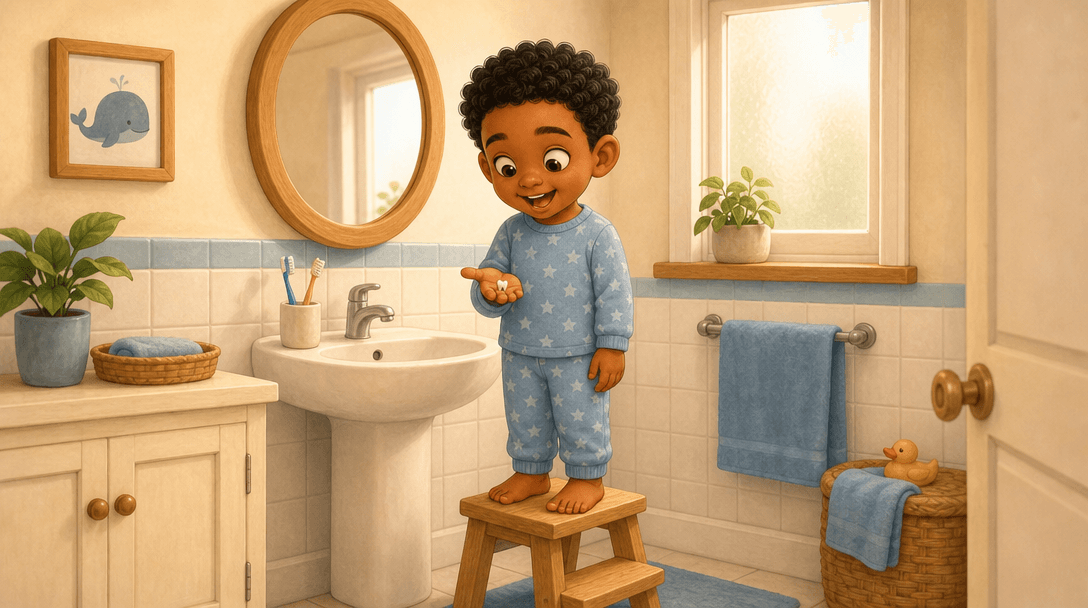
The story for this milestone
A first wobbly tooth, and the long wait for it to fall out
A personalized first lost tooth story: the wiggle, the long wait, the bedtime worry answered, and the morning after. A 2.5 minute storybook film for ages 5 to 7. Ready within 24 hours.
We make it from the details you choose. Your child, by name, in every scene.
Frequently asked questions
- At what age do kids lose their first tooth?
Most children lose their first baby tooth between five and seven, according to the American Academy of Pediatric Dentistry. The lower front teeth usually go first. A little earlier or later is generally normal.
- Should I pull my child's loose tooth?
No. Loose baby teeth come out on their own, often while eating or brushing. If a tooth is hanging by a thread and bothering your child, a clean tissue and a gentle twist can help, but only if they want it.
- What if my child swallows their tooth?
If you are worried, or your child coughs, chokes or has trouble breathing, call your pediatrician. For the ritual, a short note explaining what happened is all the visitor needs.
- Is bleeding normal when a baby tooth falls out?
A little bleeding is common. Rinse with cool water and press a clean cloth or gauze on the spot for a few minutes. Bleeding that has not stopped after about ten minutes is worth a call to your dentist.
- How long does it take for the new tooth to come in?
It often starts to show within a few weeks, but up to about six months is within the normal range, per the ADA. If you are unsure, ask at your next dental visit.
Sources
- American Academy of Pediatric Dentistry (AAPD), Tooth Eruption Charts. Cited for the typical age window and tooth-by-tooth order of loss.
- American Dental Association (ADA), MouthHealthy, Babies and Kids. Cited for clinical guidance on bleeding, care for the gap, and first-dental-visit norms.
FableFleet team
Founders & moms, FableFleet
We're a small team of moms building the personalized children's stories we wished existed for our own kids. Everything we publish is rooted in lived experience and cited research.