
· Updated
First Tooth Fairy Visit: What to Leave, How Much, and How to Pull It Off
For a first tooth fairy visit, most families leave their usual amount of money plus a short note, sometimes with one small extra for the first tooth. Delta Dental's poll puts the recent U.S. average at four to six dollars per tooth. Get the gift and note ready before bedtime, know where the tooth is, wait until your child is deeply asleep, swap quietly, and be nearby in the morning.
For a first tooth fairy visit, most families leave money plus a short note with their child's name on it, and some add one small extra to mark the first tooth. Get everything ready before bedtime, wait until your child is deeply asleep, swap the tooth for the gift, and be close by in the morning, because the discovery is the part they remember.
The short version:
- Recent U.S. averages are four to six dollars per tooth. Pick an amount you can repeat for every tooth and every child.
- The note is what children keep. Three or four sentences with one true thing about your child.
- One small extra is enough for a first tooth. Not five.
- Have it all ready before the bedtime routine starts, and set an alarm.
How to be a tooth fairy
Being the tooth fairy comes down to preparation before bedtime and patience after it. Almost everything that goes wrong on the night goes wrong because something was left until later.
Before bedtime
- Find out where the tooth is. Ask casually: "Where are you keeping your tooth tonight?" Under the pillow is the hardest spot to reach. A small bag on the nightstand or a tooth pillow with a pocket is much easier.
- Get the gift ready. Money, note and any extra, together in one place in your room.
- Write the note now, while you are still awake enough to make it specific.
- Set a phone alarm and label it "tooth fairy." A labeled alarm is harder to snooze without thinking. If two grown-ups are home, agree on who is doing it.
The visit
- Wait until your child is deeply asleep. A good rule of thumb is at least forty-five minutes after they stop moving, because children often stir and half-wake early in the night.
- Go in slowly. Leave the light off. Slow, even breathing is your signal.
- Take the tooth. From a pocket or bag, just swap. From under a pillow, slide two fingers in along the near edge and feel for the bag. Do not lift the pillow.
- Leave the gift where the tooth was, or where your child will see it first.
- Add any flourish on the way out, then close the door slowly.
If something goes wrong
- Your child stirs: stand still. If they see you, you were "checking on them." Try again later.
- You cannot find the tooth: leave the gift anyway with a line in the note: "I could not find your tooth, so you can keep it safe for me."
- A sibling catches you: "Back to bed, she is shy." Then let them in on the fun in the morning if they are old enough.
- You fell asleep: it happens. Our guide to when the tooth fairy doesn't come has the repair.
The story for this moment: Your child's Wiggly Tooth, with your child in every scene.
What to put under the pillow
Put a short note and one small thing under the pillow: usually money, sometimes a special coin, a small book, a charm or a sticker sheet. The note is what lasts. The object is the treasure that goes with it.
Combinations that work well:
- Note plus money. The standard visit, easy to repeat for all the teeth to come.
- Note plus a special coin. A foreign coin or one from the year your child was born.
- Note plus a small book. Good for a first or last tooth. Books do not fit under a pillow, so leave the book on the nightstand and the note under the pillow.
- Note plus a charm for a keepsake box or bracelet. The charms add up over the years.
- Note plus a handwritten coupon for time with a grown-up: a walk for ice cream, an extra bedtime book.
Things to leave out: anything fragile, anything that needs batteries or assembly, and loose glitter in a house with children under three.
How much does the tooth fairy leave?
The Delta Dental Original Tooth Fairy Poll, which has tracked U.S. averages since 1998, has lately put the average at four to six dollars per tooth, with first teeth getting a little more. Amounts vary a lot by region and by family, and there is no wrong number.
The more useful question is what you can repeat. Children lose around twenty baby teeth, according to the American Academy of Pediatric Dentistry, so whatever you leave for the first one is the start of a pattern. A few things to decide up front:
- Will the first tooth get more? Many families keep the amount the same and let the note and one small extra make the first tooth special.
- What about siblings? Whatever the oldest gets, the youngest will hear about, even years later. Same amount for everyone is simplest.
- What should it teach? A small amount that goes into a savings jar says one thing. A bill to spend says another. Pick the one that matches how money already works in your house.
- What will you say about classmates? Children compare. A calm line helps: "Every tooth fairy is a little different, and ours leaves what feels right for our family."
What does the tooth fairy bring besides money?
Money is the most common gift, but plenty of families add or swap in something else: a handwritten note, a small book, a special coin, a charm, stickers or a coupon for time together. The note is the one thing worth including every time.
Non-money gifts make the most sense when:
- It is the first tooth or the last one, and you want it to feel different.
- Your child already has more money than they know what to do with.
- You would rather the gift lasted longer than a trip to the store.
A good middle path is money for most teeth and a small keepsake for the first and the last. For more keepsake ideas, see our personalized tooth fairy gifts guide.
Glitter tooth fairy money
Glitter tooth fairy money is a coin with a little sparkle set onto it, so a few flecks come off on your child's fingers when they pick it up. It takes ten minutes to make, but it needs time to dry, so do it the day the tooth gets loose, not the night it comes out.
- Put a coin on a paper towel.
- Brush a thin coat of clear nail polish on one face, keeping it off the edges.
- Sprinkle a small pinch of biodegradable, cosmetic-grade glitter onto the wet polish and press it in lightly with a fingertip.
- Let it dry for at least four hours, ideally overnight.
- Tap off any loose glitter before it goes under the pillow.
Follow the ADA's MouthHealthy guidance on small objects around young children: skip loose glitter entirely if there is a child under three in the house, and keep the dusting light. Change the pillowcase in the morning.
No glitter in the house? Wrap the coin in foil and twist the ends, or polish it until it shines and let the note say the fairy chose it specially.
How to write a tooth fairy letter
A tooth fairy letter needs four things: your child's name, one true thing you noticed about them, a word about the tooth, and the same sign-off every time. Three or four sentences is plenty. A fairy in a hurry is more believable than one who wrote a page.
The specific sentence matters most. "I saw you help your sister find her shoe yesterday" works. "You are so special" does not, because it could be about any child.
Write small, in a slightly different hand from your own, on a little piece of paper sealed with a sticker. Put the date on the back for the keepsake folder.
First tooth:
Dear Sam, congratulations on your very first lost tooth. I saw how patient you were with all that wiggling, and I am so proud of you. First teeth are the most special ones of all. With love, the Tooth Fairy.
A tooth that took forever:
Dear Ben, you did it. I have been watching that wiggly tooth for a long time, and I knew it would come out when it was ready. Thank you for waiting so patiently. Your friend, the Tooth Fairy.
A tooth lost at school or swallowed:
Dear Ava, I heard your tooth went missing today. Don't worry, I do not need the tooth to celebrate. I am so proud of how grown-up you are getting. Love, the Tooth Fairy.
Keep the letters in a folder with your child's name on it. They are often the thing a grown child is gladdest to find.
The morning after
The discovery is half the visit. Be near the room when your child wakes up, act surprised, read the note out loud slowly, and take one photo of the grin with the note in hand. Then let them tell someone who will make a fuss, like a grandparent on the phone.
For the rest of the first-tooth experience, including what to say at bedtime during the wiggly weeks, see our first lost tooth guide. For the bigger questions about who she is and what she does with the teeth, see our tooth fairy guide.
If the tooth came out with no warning
Most first teeth come out on an ordinary weeknight with no plan in place. A note on paper torn from a notebook, whatever cash is in your wallet, and a deep breath is a complete visit. Perfectly planned does not beat happened at all.
A story for the weeks before
We are Ashley and Amanda, two moms who started FableFleet, and we make personalized storybook films. The Wiggly Tooth story, titled with your child's name, is about two and a half minutes for ages 5 to 7, with your child in every scene and the narrator saying their name. It follows the wiggle, the long wait, the bedtime worry answered and the morning after, and it was written for the weeks around the first wobble. The tooth goes wherever your child chooses to put it, the house goes quiet, and in the morning something has happened. Nobody is named as the visitor, so it sits alongside whatever your family does on the night itself. A person checks every film, and it is ready within 24 hours to watch in the FableFleet app or from the link in your email. See the Wiggly Tooth story.
More in Tooth Fairy
- Tooth Fairy: The Whole Guide for Parents (What She Does, What She Looks Like, and the Traditions Worth Keeping)
The tooth fairy comes at night after a child loses a baby tooth, takes the tooth and leaves a small gift, usually money and often a short note. There is no official version: she first appeared in print in 1908, so what she looks like, what she does with the teeth and how much she leaves is up to your family. Pick a few details, keep them consistent, and the ritual does the rest.
- First Lost Tooth: What to Expect, What to Say, and How to Mark It
Most children lose their first baby tooth between ages five and seven, usually a lower front tooth, after a wiggle that lasts longer than they expect. Let it come out on its own. Answer the two bedtime worries honestly: it rarely hurts much, and if it gets swallowed, the tooth fairy still comes. A little bleeding is normal; rinse and press for a few minutes. Then mark the morning with a photo, a note and someone to tell.
- Personalized Tooth Fairy Gifts: Ideas That Feel Made for Your Child (Plus Boxes, First-Tooth Gifts and a DIY Door)
The most personal tooth fairy gift is also the cheapest: a short handwritten note that uses your child's name and one true thing about them. Pair it with one small keepsake, such as a special coin, a charm, a named tooth bag or a small book. For a first tooth, add a keepsake box with labeled envelopes. A tiny door at the baseboard, made together, can be part of the gift too.
- What If the Tooth Fairy Doesn't Come? What to Say in the Morning, and Notes You Can Copy
If the tooth fairy doesn't come, stay calm and treat it as a delay, not a failure: \"She must have had a very busy night. Let's leave the tooth out again tonight.\" Then make sure the visit happens the next night, with the planned gift, a short note giving a gentle reason, and one small extra. Set an alarm so it does not happen twice. Handled warmly, the repair often becomes a favorite family story.
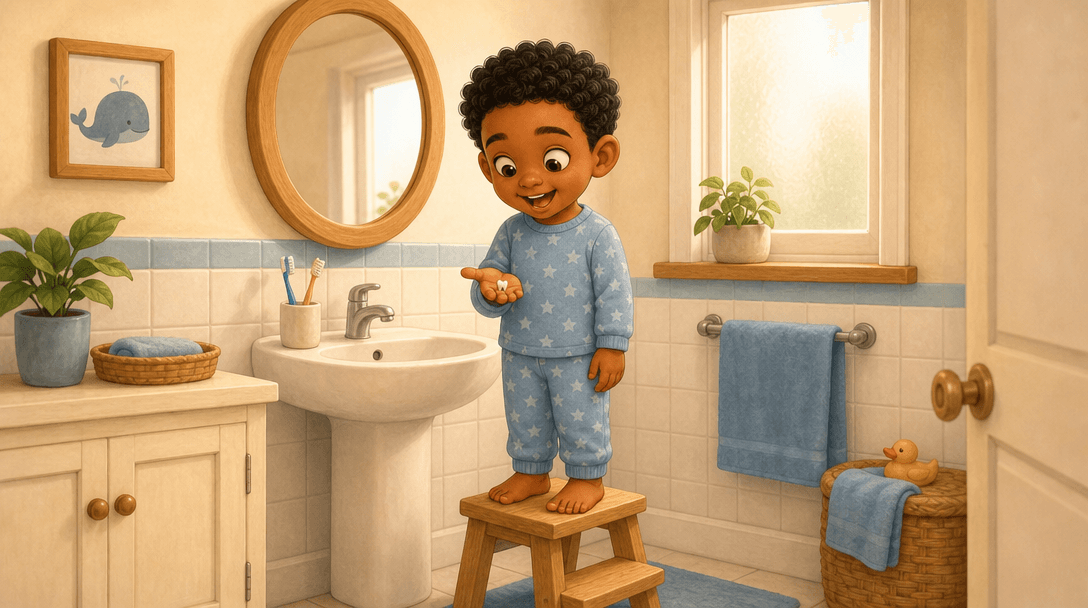
The story for this milestone
A first wobbly tooth, and the long wait for it to fall out
A personalized first lost tooth story: the wiggle, the long wait, the bedtime worry answered, and the morning after. A 2.5 minute storybook film for ages 5 to 7. Ready within 24 hours.
We make it from the details you choose. Your child, by name, in every scene.
Frequently asked questions
- How much does the tooth fairy give for the first tooth?
Delta Dental's poll has put the recent U.S. average at four to six dollars per tooth, with first teeth a little higher. Many families keep their usual amount and add a longer note or one small keepsake instead.
- What time should the tooth fairy come?
After your child is deeply asleep. A good rule of thumb is to wait at least forty-five minutes after they stop moving. Set a labeled phone alarm so the visit does not depend on staying awake.
- What should the first tooth fairy note say?
Use your child's name, mention one true thing you noticed about them recently, congratulate them on the tooth, and sign the same way you will sign every note after. Three or four sentences is plenty.
- Is glitter tooth fairy money safe?
Use biodegradable, cosmetic-grade glitter set in dried clear nail polish, keep the dusting light, and skip loose glitter entirely if a child under three lives in the house. Change the pillowcase in the morning.
- What if my child's tooth fell out at school or was lost?
The visit still happens. Leave the gift with a note saying the tooth fairy does not need the tooth to celebrate.
Sources
- American Academy of Pediatric Dentistry (AAPD), Tooth Eruption Charts. Cited for the typical first-tooth-loss age window.
- Bruce Feiler, The Stories That Bind Us (NYT). Cited for the role of first-time rituals in family memory.
FableFleet team
Founders & moms, FableFleet
We're a small team of moms building the personalized children's stories we wished existed for our own kids. Everything we publish is rooted in lived experience and cited research.