
· Updated
Tooth Fairy: The Whole Guide for Parents (What She Does, What She Looks Like, and the Traditions Worth Keeping)
The tooth fairy comes at night after a child loses a baby tooth, takes the tooth and leaves a small gift, usually money and often a short note. There is no official version: she first appeared in print in 1908, so what she looks like, what she does with the teeth and how much she leaves is up to your family. Pick a few details, keep them consistent, and the ritual does the rest.
The tooth fairy is the small family ritual that marks a lost baby tooth: she comes at night, takes the tooth, and leaves a small gift, usually money and often a short note. There is no official version of her, so what she looks like, what she does with the teeth and how much she leaves is whatever your family decides.
This guide answers the questions children actually ask, so you can pick your version before the night arrives.
The short version:
- She arrives after your child is asleep, takes the tooth, leaves a gift and goes.
- She is young as legends go. The first known printed mention is from 1908.
- She looks different in every house. Pick three details and keep them.
- What she does with the teeth is a family story. Any warm answer works if you say it the same way every time.
Where did the tooth fairy come from?
The tooth fairy is an American figure from the early twentieth century. Per the history summarized by Smithsonian Magazine, the first known printed reference was a 1908 household-advice column in the Chicago Daily Tribune.
Older European traditions had a small mouse who took children's teeth, and that mouse is still the visitor in much of the world. Because the fairy is so new, no rulebook exists, and every family gets to fill her in.
The story for this moment: Your child's Wiggly Tooth, with your child in every scene.
What does the tooth fairy do?
She does four things, in order: she arrives at night once your child is asleep, takes the tooth from wherever your family agreed it would go, leaves a gift, and slips out. That is the whole job, and the choreography is the same in almost every house even when the details differ.
The tooth might be under the pillow, in a little pocket on a tooth pillow, in a bag on the nightstand, or in a dish. The gift is money in most U.S. homes and something else in plenty of them. Some fairies leave a note, some sign with the same small squiggle for years, some leave a pinch of sparkle on the windowsill.
There are also a few things she does not do, and deciding them early keeps the tradition steady:
- She does not bargain. Whatever your house leaves is what she leaves.
- She does not punish. The tooth came out, so the gift comes. There is no "only if you brushed" version.
- She does not lecture. Her note is short and warm. If you want to mention healthy teeth, do it kindly.
- She does not need the tooth. If it was swallowed, lost at the park or went down the sink, a note explaining what happened is enough. She still comes.
The quieter job underneath all of this is that she marks the moment. A lost tooth is a real change in a child's body. Without a ritual it passes as an ordinary evening. With one, it becomes a story your child tells. The American Academy of Pediatrics' report on play describes imaginative play and small family rituals like this as good for young children.
For the practical side of being the one who does the visit, see our first tooth fairy visit guide.
What does the tooth fairy look like?
There is no single answer: she looks different in every house, and that is part of the tradition. Picture books have shown her as a thumb-sized figure with see-through wings, a grown woman in a long pale dress with a star-tipped wand, a pixie hardly bigger than a coin, or just a glow at the edge of the room.
The answer most parents land on, often after improvising once, is the simplest true one: "She looks a little different to everyone who sees her. She is the same fairy underneath." It lets your family's version sit happily next to whatever your child hears at school.
If you want a more specific household fairy, pick three details and write them down:
- Size (thumb-sized, hand-sized, hard to tell)
- Wings (yes or no, what color, silent or chiming)
- Hair or clothing (a color, a dress, "made of light")
Three is enough to be specific and few enough to remember for every sibling. Many children have firm opinions here, so ask yours first.
When a child asks for proof ("Can I see her? Can we leave a camera?"), keep it gentle: almost nobody sees her, she only comes when everyone is asleep, and she is shy of lights and cameras. Offering to let your child leave her a note with a question usually works better than any explanation.
What does the tooth fairy do with the teeth?
Nobody knows for certain, and every family answers it differently. The most common versions are that she builds a castle out of them, plants them as seeds that grow into stars, keeps them as a record of children growing up, or turns them into the fairy dust she sprinkles on other pillows.
Pick one and use it every time. A concrete answer like the castle tends to suit a five-year-old who thinks literally. The record-keeping answer holds up better as children get older and start testing the story.
Then there is the real tooth in your hand at midnight. The American Academy of Pediatric Dentistry has no medical position on what to do with it, so it is purely a family choice:
- Save the first one. A small envelope labeled with your child's name, the date and which tooth it was takes up almost no space.
- Save them all in a keepsake box. Our personalized tooth fairy gifts guide covers box ideas.
- Let them go. There is no medical reason to keep baby teeth.
If you save one, let it air-dry for a day before sealing it, because a damp envelope can grow mold.
For a child who wants to keep the tooth, the warmest compromise is that the fairy borrows it for the night to celebrate, then leaves it next to the gift in the morning. Your child gets both.
Why do tooth fairies collect teeth?
Because each baby tooth is proof that a child is growing up, and she likes to keep that proof. That is the answer most children accept without follow-up, and it does not box you in later.
A script for breakfast: "She keeps them because each tooth is a tiny proof of you growing up. She is sentimental about it, so she leaves a gift to mark the day." Two sentences, warm, and easy to repeat for every tooth and every child.
When the question starts to sound like a test ("but really, where do they go?"), a shorter answer works better than a longer one, because long answers have more holes in them. You can also turn it around: "What do you think she does with them?" Many children already have a theory, and naming it lets them own the family version.
Tooth fairy traditions around the world
Plenty of the world has a tooth visitor, and it is often a mouse rather than a fairy. These are a few of the traditions described by Smithsonian Magazine and Selby Beeler's picture book Throw Your Tooth on the Roof:
- France and francophone Canada: la petite souris, a little mouse, takes the tooth from under the pillow and leaves a coin.
- Spain and much of Latin America: Ratoncito Pérez, a mouse made famous by an 1894 story written for the young king Alfonso XIII when he lost a tooth.
- Parts of China, Korea, Japan and Vietnam: lower teeth are thrown onto the roof and upper teeth under the floor, so the new tooth grows in toward the old one.
- Some South African homes: the tooth goes in a slipper instead of under a pillow.
- Some Middle Eastern traditions: the child throws the tooth toward the sun with a wish for a strong new one.
If your family carries one of these, you can run both. Children often handle a fairy on one side of the family and a mouse on the other with ease.
At home, the traditions that last are usually small and repeatable: a tooth pillow with a pocket, a keepsake box, a first-tooth letter kept in a folder, a tiny door by the baseboard, or a signature the fairy always uses. Pick two, not five. Two traditions get done every time. Five tend to get forgotten.
Tooth fairy dust and magic
Tooth fairy dust is usually a pinch of biodegradable, cosmetic-grade glitter left where your child will find it: on the coin, on the windowsill, or folded into the note. It is the visible proof that someone came.
A few safety notes, in line with the ADA's MouthHealthy guidance on small objects around young children:
- Skip loose glitter in a house with children under three. A coin with glitter set in dried clear nail polish is the contained version.
- Keep any dust away from the pillowcase and your child's face.
- Use biodegradable glitter, and apply it with a fingertip rather than shaking the jar.
You do not need glitter at all. Quiet flourishes work just as well: a tiny bell rung once on the way out, a small footprint outline in fine pen on the windowsill, a single drop of lavender on the note (skip it for children with scent sensitivities), or a coin wrapped in foil like a sweet. Choose one or two and let them become your house's signature. Our first tooth fairy visit guide has the step-by-step for a glitter coin.
Tooth fairy ideas
The best tooth fairy ideas are small enough to repeat for every tooth. A short note plus one small flourish is the recipe that lasts.
Five-minute ideas:
- A three-sentence note with your child's name and one true thing about them.
- A single special coin, like a foreign coin or one from the year they were born.
- A coin wrapped in foil and twisted at the ends.
- A small sticker sealing the note, with your child's name on the front.
Some prep:
- A glitter coin (needs to dry overnight).
- A tooth pillow with a pocket.
- A tiny door at the baseboard (see our personalized tooth fairy gifts guide).
Ideas to skip: scavenger hunts at 6 a.m., elaborate "evidence" setups, photos of the fairy (they tend to look wrong and start the doubting early), and anything noisy enough to wake your child.
When does the first tooth come out, and how much does she leave?
Most children lose their first baby tooth between ages five and seven, usually one of the two lower front teeth, according to the American Academy of Pediatric Dentistry. The whole process wraps up around age twelve. Our first lost tooth guide covers the wiggle, the bedtime worries and the morning after.
On money, the Delta Dental Original Tooth Fairy Poll has tracked U.S. averages since 1998, and lately they have been four to six dollars per tooth, a little more for the first. The right amount is the one you can repeat for every tooth and every child. The full breakdown, plus what to put under the pillow and how to write the note, is in our first tooth fairy visit guide.
What if she forgets?
It happens to a lot of parents, and the repair is simple: a short note from the fairy the next morning or night with a reason (a busy night, strong wind), the planned gift and one small extra. Our guide to when the tooth fairy doesn't come has the morning script and notes you can copy.
When your child stops believing
Follow your child's lead. When they clearly know, do not insist she is real, because their trust matters more than the secret.
A line that keeps the warmth: "Yes, it has been me. It is one of my favorite things to do, and I would love to keep doing it as long as you want to." Many children choose to keep playing, and an older sibling who is let in on the secret often enjoys helping with a younger one's visits. The keepsake box and the letter folder tend to mean more after the secret is shared, not less.
A story for the wiggly weeks
We are Ashley and Amanda, two moms who started FableFleet. Ashley's daughter is three and has not lost a tooth yet, so we wrote this guide the way we would want it: everything in one place, before the night arrives. We make personalized storybook films, and the one for this moment is the Wiggly Tooth story, titled with your child's name. It is about two and a half minutes for ages 5 to 7, with your child in every scene and the narrator saying their name. It follows the wiggle, the long wait, the bedtime worry answered and the morning after. The tooth goes wherever your child chooses to put it, the house goes quiet, and in the morning something has happened. Nobody is named as the visitor, so it fits a family with a fairy, a mouse, a keepsake box or no ritual at all. A person checks every film, and it is ready within 24 hours. See the Wiggly Tooth story.
More in Tooth Fairy
- First Lost Tooth: What to Expect, What to Say, and How to Mark It
Most children lose their first baby tooth between ages five and seven, usually a lower front tooth, after a wiggle that lasts longer than they expect. Let it come out on its own. Answer the two bedtime worries honestly: it rarely hurts much, and if it gets swallowed, the tooth fairy still comes. A little bleeding is normal; rinse and press for a few minutes. Then mark the morning with a photo, a note and someone to tell.
- First Tooth Fairy Visit: What to Leave, How Much, and How to Pull It Off
For a first tooth fairy visit, most families leave their usual amount of money plus a short note, sometimes with one small extra for the first tooth. Delta Dental's poll puts the recent U.S. average at four to six dollars per tooth. Get the gift and note ready before bedtime, know where the tooth is, wait until your child is deeply asleep, swap quietly, and be nearby in the morning.
- Personalized Tooth Fairy Gifts: Ideas That Feel Made for Your Child (Plus Boxes, First-Tooth Gifts and a DIY Door)
The most personal tooth fairy gift is also the cheapest: a short handwritten note that uses your child's name and one true thing about them. Pair it with one small keepsake, such as a special coin, a charm, a named tooth bag or a small book. For a first tooth, add a keepsake box with labeled envelopes. A tiny door at the baseboard, made together, can be part of the gift too.
- What If the Tooth Fairy Doesn't Come? What to Say in the Morning, and Notes You Can Copy
If the tooth fairy doesn't come, stay calm and treat it as a delay, not a failure: \"She must have had a very busy night. Let's leave the tooth out again tonight.\" Then make sure the visit happens the next night, with the planned gift, a short note giving a gentle reason, and one small extra. Set an alarm so it does not happen twice. Handled warmly, the repair often becomes a favorite family story.
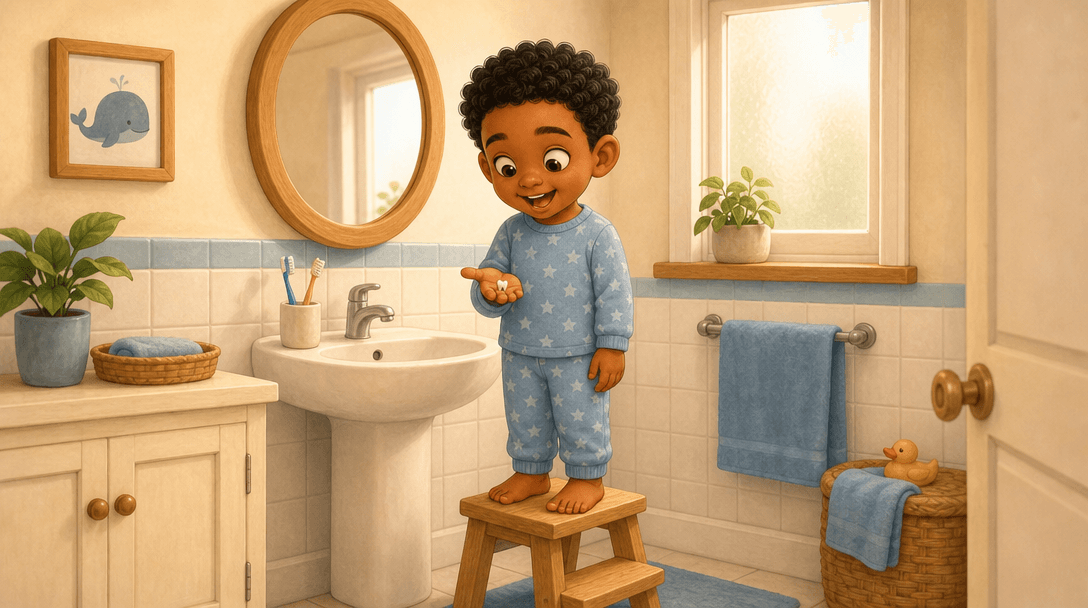
The story for this milestone
A first wobbly tooth, and the long wait for it to fall out
A personalized first lost tooth story: the wiggle, the long wait, the bedtime worry answered, and the morning after. A 2.5 minute storybook film for ages 5 to 7. Ready within 24 hours.
We make it from the details you choose. Your child, by name, in every scene.
Frequently asked questions
- Is the tooth fairy real?
She is real as a family tradition, and how literally your child believes is up to them and you. Young children usually take her at face value. When older children ask directly, an honest, warm answer that offers to keep the tradition going protects both the trust and the fun.
- What does the tooth fairy do with the teeth?
There is no official answer. Common family versions are that she builds a castle, plants them as seeds that become stars, or keeps them as a record of children growing up. Pick one and say it the same way every time.
- What does the tooth fairy look like?
She looks different in every house. Picture books show her as anything from a tiny winged figure to a glow at the edge of the room. If you want a household version, choose three details, such as size, wings and color, and keep them consistent.
- How old is the tooth fairy tradition?
Younger than most people think. The first known printed mention is a 1908 household-advice column in the Chicago Daily Tribune, according to Smithsonian Magazine. Older tooth-mouse traditions in Europe and Latin America go back further.
- How much does the tooth fairy leave?
The Delta Dental poll has put the recent U.S. average at four to six dollars per tooth. The amount that matters is one you can repeat for every tooth and every child, with the first tooth sometimes getting a little more.
Sources
- American Academy of Pediatric Dentistry (AAPD), Tooth Eruption Charts. Used for the ages-5-to-7 first-loss window and the full transition timeline through about age 12.
- Delta Dental Original Tooth Fairy Poll. Annual U.S. survey of payout norms, regional variation, and gift trends.
- American Dental Association (ADA), MouthHealthy, Babies and Kids. Clinical guidance on bleeding, care for the gap, and the first dental visit.
- American Academy of Pediatrics, The Power of Play (Pediatrics 2018). Cited for the value of small family traditions and imaginative play for kids.
FableFleet team
Founders & moms, FableFleet
We're a small team of moms building the personalized children's stories we wished existed for our own kids. Everything we publish is rooted in lived experience and cited research.