
· Updated
Personalized Tooth Fairy Gifts: Ideas That Feel Made for Your Child (Plus Boxes, First-Tooth Gifts and a DIY Door)
The most personal tooth fairy gift is also the cheapest: a short handwritten note that uses your child's name and one true thing about them. Pair it with one small keepsake, such as a special coin, a charm, a named tooth bag or a small book. For a first tooth, add a keepsake box with labeled envelopes. A tiny door at the baseboard, made together, can be part of the gift too.
The most personal tooth fairy gift is a short handwritten note that uses your child's name and mentions one true thing about them, paired with one small keepsake that fits who they are. A name on an object helps, but a specific sentence is what makes a gift feel made for one child.
Below are the ideas that work, sorted by effort, along with the questions parents ask next: what to give for the first tooth, what kind of box to keep the teeth in, and how to make a tooth fairy door.
The short version:
- Personal means specific. One true sentence about your child beats a beautifully engraved object with nothing personal in it.
- Pair the note with one small keepsake, not five.
- For the first tooth, a note plus one keepsake is the combination that lasts.
- A simple box with labeled envelopes will be used. A precious one may not.
What makes a tooth fairy gift feel personal
Three things, in order of how much they matter:
- Something true about your child. A thing they did, said or noticed this week. "I saw you share your snack with your brother at the park" is the kind of line children remember.
- Their name, written by hand with care.
- A one-of-a-kind detail. A coin from their birth year, a color only your house uses, a signature the fairy always puts on her notes.
A simple test for the sentence: if it would fit on any other child's note unchanged, it is not specific enough yet. "You are so brave" is generic. "You were so brave at the dentist on Tuesday" is theirs.
The story for this moment: Your child's Wiggly Tooth, with your child in every scene.
Personalized gift ideas, by effort
Five minutes:
- A handwritten note with your child's name and one true sentence. The most personal gift on this list, and it costs nothing.
- A coin with a story. One from the year your child was born, or from a country your family is connected to. The note says why this coin.
- A coupon for time together, written in the fairy's hand: a walk for ice cream, an extra book at bedtime, a breakfast just for two.
A little planning:
- A named tooth bag. A small cloth pouch with your child's name or initial on it. The tooth goes in, the gift comes out, and the bag lasts the whole childhood.
- A charm with their initial, the first piece of a collection that grows with every tooth.
- A small book about losing teeth, signed by the fairy on the first page.
A bigger project:
- A longer letter that weaves in specific details of your child's life right now: their friends' names, a new skill, something they are proud of. It takes half an hour and gets kept for decades.
- A keepsake box with their name on it (see below).
- A tooth fairy door you make together (see below).
A few things to skip: generic tooth fairy merchandise with a name added, anything that only works at one time of year, and custom orders that will not arrive in time. If the charm is still in the mail when the tooth comes out, give the note tonight and the charm at the next tooth.
Tooth fairy gift for a first tooth
For a first tooth, the gift that lands best is a short, specific note plus one keepsake, alongside your usual amount of money if your family leaves money. The first tooth sets the pattern, so choose something you would be happy to repeat for a younger sibling's first tooth too.
Combinations that work well:
- Note plus a special coin. Simple, personal, easy to repeat.
- Note plus a small book, chosen for the milestone and signed by the fairy.
- Note plus a charm that starts a keepsake collection.
- Note plus a coupon for time with a grown-up.
- Note, usual money, and one small extra like a sticker sheet.
What to skip for a first tooth:
- Anything you could not do again for every child's first tooth.
- Toys with batteries or assembly. The fairy is not a toy shop.
- Candy, for the obvious reason.
- Small loose pieces if a child under three shares the room, in line with the ADA's MouthHealthy guidance on small objects around young children.
If grandparents want to send something, steer them toward the keepsake side: a book, a charm, or a short handwritten note for the keepsake folder. Arriving a day or two after the visit lets each gift have its own moment.
On money, the Delta Dental Original Tooth Fairy Poll has put the recent U.S. average at four to six dollars per tooth, with first teeth getting a little more. It is a reference point, not a requirement. For how to pick your amount and write the note, see our first tooth fairy visit guide.
Tooth fairy box ideas
A tooth fairy box holds the saved teeth, the fairy's letters and any small keepsakes, and the best one is the one you will still be using at the last tooth. Practical beats pretty. A box too precious to open at midnight tends to stay empty.
Options, simplest first:
- Labeled envelopes in a memory box you already have. One small envelope per tooth, letters kept in order behind them. The most reliable option there is.
- A small wooden or ceramic box with a lid, about the size of a deck of cards or a little larger.
- A box with a compartment for each tooth, labeled by position. Look for one with a closed lid and enough room for the letters too.
- A plain craft box your child decorates. It will not stay pristine, and that becomes part of its charm.
What goes inside:
- A small envelope for each saved tooth, labeled with your child's name, the date and which tooth it was (lower front left, and so on). Write the date as year, month, day so the envelopes sort themselves.
- The tooth fairy's letters, in order.
- A photo of the first gap.
- A picture your child makes of what they think the fairy looks like.
Plan for the full set even if you do not mean to save every tooth. Children lose around twenty baby teeth, according to the American Academy of Pediatric Dentistry, and a box that fits the first tooth can feel small later. Let each tooth air-dry for a day before it goes into an envelope, so nothing gets damp.
Keep the box somewhere you can reach at night and your child cannot reach by day, like a closet shelf in your room. When your child eventually knows the secret, opening the box together and reading the letters is one of the warmest ways to close the tradition.
DIY tooth fairy door
A tooth fairy door is a tiny decorative door, a few inches tall, fixed at the baseboard to show where the fairy comes in. It does not open. Its job is to give your child somewhere to point, and making it together can be the best part.
What you need:
- A small wooden door blank from a craft store, thin balsa wood, or stiff card.
- Non-toxic acrylic craft colors or markers, and a small brush.
- Removable adhesive strips rated for walls, or two small screws for something permanent.
- Optional: a square of felt for a welcome mat, a tiny name plate.
How to make it:
- Cut the door shape if you are not using a blank. An arched top looks most like a fairy door.
- Give it a base color and let it dry.
- Add the details: a doorknob (a dot of color or a small craft brad), hinges, a window.
- Let it dry completely, ideally overnight.
- Add the welcome mat and a name plate with your child's name or initial.
- Fix it at baseboard level somewhere your child can see from bed.
Where to put it: beside the bed at floor level is the most visible spot. Behind a nightstand makes it a hidden surprise. Wherever it goes, leave it there for every visit.
Safety: skip loose glitter and small glued-on pieces that could come off, especially with a child under three in the house, and keep edges smooth.
Small mistakes to avoid: hot glue tends to let go over time, so use adhesive strips or screws. Keep the door small enough to feel fairy-sized. And put your child's name on it somewhere; without one, it is just decoration.
The American Academy of Pediatrics' report on play describes play and making things together as good for young children. The afternoon spent making the door is part of the gift.
For more ideas and the traditions around the fairy herself, see our tooth fairy guide.
Keeping it personal across siblings
Each child gets their own: their own box, their own bag, their own charms, their own name spelled right. Treat the youngest's first tooth the way you treated the oldest's. Children remember, even years apart.
A story with their name in it
We are Ashley and Amanda, two moms who started FableFleet, and we make personalized storybook films. The Wiggly Tooth story, titled with your child's name, is about two and a half minutes for ages 5 to 7, made from the details you choose, with your child in every scene and the narrator saying their name. It follows the wiggle, the long wait, the bedtime worry answered and the morning after. Nobody is named as the visitor, so it fits a family with a fairy, a mouse, a keepsake box or no ritual at all. Our little fox Finn hides three times, and at the end the film asks how many times you spotted him. A person checks every film, it is ready within 24 hours, and you can watch it in the FableFleet app, from your email link, or download it to keep. See the Wiggly Tooth story.
More in Tooth Fairy
- Tooth Fairy: The Whole Guide for Parents (What She Does, What She Looks Like, and the Traditions Worth Keeping)
The tooth fairy comes at night after a child loses a baby tooth, takes the tooth and leaves a small gift, usually money and often a short note. There is no official version: she first appeared in print in 1908, so what she looks like, what she does with the teeth and how much she leaves is up to your family. Pick a few details, keep them consistent, and the ritual does the rest.
- First Lost Tooth: What to Expect, What to Say, and How to Mark It
Most children lose their first baby tooth between ages five and seven, usually a lower front tooth, after a wiggle that lasts longer than they expect. Let it come out on its own. Answer the two bedtime worries honestly: it rarely hurts much, and if it gets swallowed, the tooth fairy still comes. A little bleeding is normal; rinse and press for a few minutes. Then mark the morning with a photo, a note and someone to tell.
- First Tooth Fairy Visit: What to Leave, How Much, and How to Pull It Off
For a first tooth fairy visit, most families leave their usual amount of money plus a short note, sometimes with one small extra for the first tooth. Delta Dental's poll puts the recent U.S. average at four to six dollars per tooth. Get the gift and note ready before bedtime, know where the tooth is, wait until your child is deeply asleep, swap quietly, and be nearby in the morning.
- What If the Tooth Fairy Doesn't Come? What to Say in the Morning, and Notes You Can Copy
If the tooth fairy doesn't come, stay calm and treat it as a delay, not a failure: \"She must have had a very busy night. Let's leave the tooth out again tonight.\" Then make sure the visit happens the next night, with the planned gift, a short note giving a gentle reason, and one small extra. Set an alarm so it does not happen twice. Handled warmly, the repair often becomes a favorite family story.
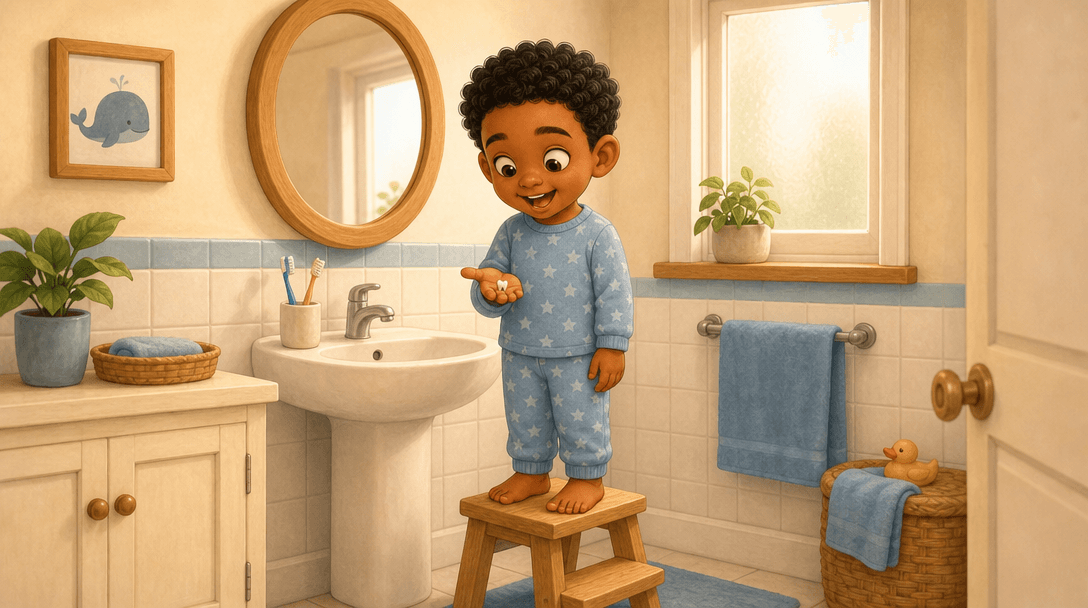
The story for this milestone
A first wobbly tooth, and the long wait for it to fall out
A personalized first lost tooth story: the wiggle, the long wait, the bedtime worry answered, and the morning after. A 2.5 minute storybook film for ages 5 to 7. Ready within 24 hours.
We make it from the details you choose. Your child, by name, in every scene.
Frequently asked questions
- What counts as a personalized tooth fairy gift?
Anything that uses your child's name, refers to something true about them, or is one of a kind. The simplest version is a handwritten note with their name and one specific sentence. Bigger versions include a named tooth bag, a keepsake box or a charm with their initial.
- What should the tooth fairy bring for a first tooth?
A short, specific note plus one keepsake, such as a special coin, a small book or a charm, along with your usual amount of money if your family leaves money. Choose something you could repeat for every child's first tooth.
- Do I need a tooth fairy box?
No. A labeled envelope in a memory box you already have works just as well. A dedicated box is nice if you plan to save several teeth and the letters together.
- Where should a tooth fairy door go?
At baseboard level, somewhere your child can see it from bed, or behind a nightstand if you want it to be a surprise. Fix it with adhesive strips or small screws and leave it in the same place for every visit.
- Is a tooth fairy door safe in a young child's room?
Yes, if it is fixed securely, has smooth edges, and has no loose glitter or small pieces that could come off. Take extra care if a child under three shares the room.
Sources
- Bruce Feiler, The Stories That Bind Us (NYT). Cited for the role of personalization in family-narrative keepsakes.
- Delta Dental Original Tooth Fairy Poll. Cited for the observed trend toward personalized keepsakes alongside cash.
FableFleet team
Founders & moms, FableFleet
We're a small team of moms building the personalized children's stories we wished existed for our own kids. Everything we publish is rooted in lived experience and cited research.