
How to Explain Halloween to a Toddler Who Has No Idea What It Is
How to explain Halloween to a toddler: a friend asked me at dinner, because her two and a half year old does not understand what it is. This is the answer I put together afterwards: skip the word holiday and teach the four things that actually happen, start with masks because that is the part that goes wrong, practise the knock at your own door, use porch lights as a map, let the bucket do the talking, and let a house be skipped.

How to explain Halloween to a toddler: the question at dinner
A few nights ago a friend and I were at dinner. She has a two and a half year old, and partway through the meal she said the thing that turned into this post: her child does not understand what Halloween is, and she does not know how to explain it.
I have a three year old, so I should have had something useful to say. What I actually had was a list of things that had not occurred to me either, because I had been thinking about the costume and the bucket and not about the fact that from where a two year old stands, Halloween is a night when the rules stop working. People's faces are wrong. Strangers give you food. You are outside in the dark, knocking on doors you have never knocked on. None of that is obvious to someone who has been alive for thirty months.
So this is the answer I wish I had given her.
What a toddler can actually understand about Halloween
Not the holiday. Two and a half is too young for "a special day when everyone pretends". What a toddler can hold is a sequence of concrete things that happen, and the good news is that Halloween is only four of them.
- You put on a costume, which is a special outfit, and other kids do too.
- You walk to a house and knock.
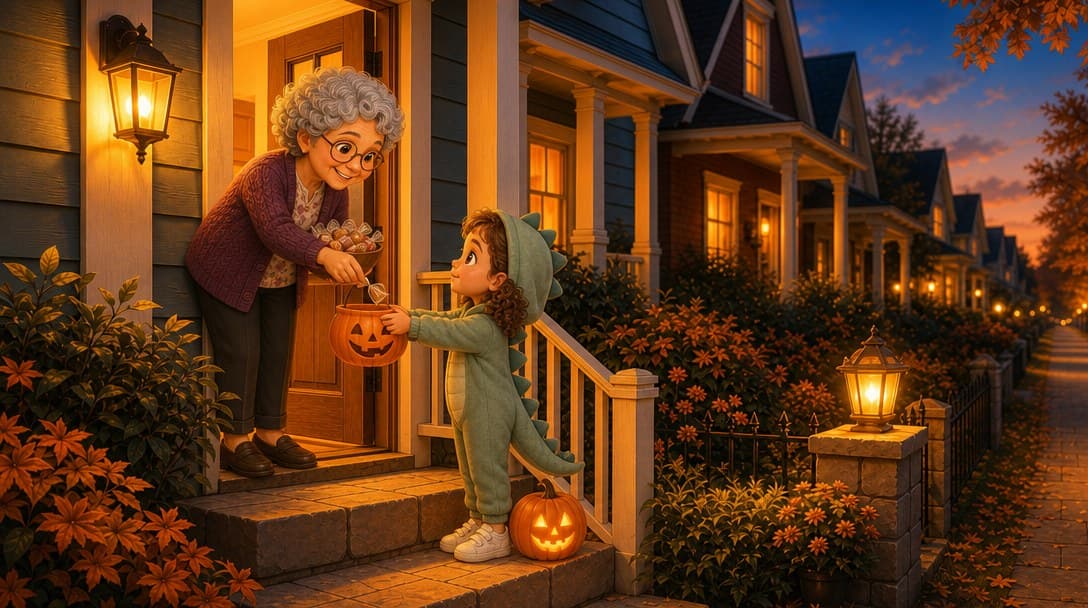
- You hold out your bucket, and the person puts candy in it.
- Some people look strange on purpose, and it is a game.
That is the whole explanation. If you can get those four in the right order, in the right words, a few times before the night, your child will recognise what is happening when it happens. Recognition is what makes a toddler feel safe. Surprise is what makes them cry.
The American Academy of Pediatrics puts "allow for plenty of time to fright-prep" first on its own list for babies and toddlers, and I think that is exactly right. A week of small mentions beats one big talk the afternoon of.
Start with the part that goes wrong: masks
If I had to pick one thing to tell my friend, it is this. The candy is easy. The dark is manageable. The masks are the problem.
Here is why. A two year old has only just worked out the rule that people look like themselves: hair, two eyes, a nose, a mouth, the same face every time. A mask breaks that rule in front of them. ZERO TO THREE describes it as a mismatch between what a child expects a face to look like and what they see, and points out that at this age a child cannot yet hold the idea that someone can look like a witch on the outside and still be Aunt Molly underneath. The fear is not a phase to be talked out of. It is the correct reaction to a rule being broken, by a brain that just learned the rule.
What helps is practice, not explanation. Get one plain, unscary mask. Put it on your own face at the kitchen table, say "still me", take it off, put it on again. Let your child hold it and look through the eye holes. Do it for a few days. You are teaching the one thing a two year old cannot work out alone: that a face can change and the person underneath stays the same.
On the night, the same trick in reverse. If a big kid in a mask comes up the path and your toddler freezes, ask the big kid to take it off for a second. Most will. Then it is just a kid from down the street, waving.
Practise the knock at your own front door
Go outside your own house with the bucket, knock, and have someone open the door and put something in it. Say "trick or treat" together. Say "thank you" together. Do it twice. Now your child has done Halloween once already, in the one place on earth where nothing is strange.
The Child Mind Institute's advice for trick-or-treat nerves is the same idea stretched over the real night: say the words with them for the first five houses, rather than expecting them to go solo at the first. I would go further for a two year old and say the words with them at every house. Nobody at the door minds.
Porch lights are a map
Toddlers do well with rules they can see. A porch light on means yes, this house is playing. A porch light off means no, we walk past. You can point to the lit ones from the sidewalk and let your child choose. Choosing is a big deal at two and a half, and it turns a confusing night into a game they are running.
Keep the map small. Three or four houses you know, ideally with people your child has seen before, is a complete Halloween for a two year old. ZERO TO THREE suggests familiar neighbours and skipping the heavily decorated houses with fog machines, and the AAP says go before dark. I would do all three. The dark is the thing that makes every other strange thing stranger.
The bucket does the talking
At the first door, the words will probably not come. Your child has practised, you have said it together, and they will stand on the step with their mouth shut and their eyes very wide. This is normal. It happens to five year olds.
Hold the bucket out with them. A held-out bucket counts as asking. Every adult who has ever answered a door on Halloween understands it perfectly, and most of them will do the talking for you: "Oh, a pumpkin! Here you go." By the third door, the whole thing usually comes out at once, and it is worth being there for.
A house is allowed to be skipped
Somewhere on the route there will be a porch that is too much: a paper ghost that moves, a strobe, a grown-up in a full mask. Your child will stop.
Crouch down to their height and ask whether the feeling is this big or THIS big, with your hands. Then say the thing that makes the whole night safe: we can skip this one. And skip it. Do not negotiate, do not coax, do not say it is only pretend, because at two it is not only pretend. The Child Mind Institute talks about letting kids face fears at a level they are ready for, and the AAP is even plainer: if your little one does not want to take part, let that be OK. A toddler who learns they can say no to a scary porch will try the next one. A toddler who gets carried up the steps will not.
If the whole night turns out to be too much, the AAP has a good fallback: see if they would rather answer your own door and hand candy out. Same costume, same bucket, none of the strangers.
The pour
Home. Coat off. Tip the bucket out onto the rug.
This is my favourite part, and it is also where the actual rules live. Sort into piles by colour, or by favourite, or by whatever your child decides is a category. Pick the few for tonight, with whatever you agreed before you left already agreed, so there is no negotiating at nine o'clock with a tired child holding a lollipop.
And this is where I would be strict with a two year old, because the AAP is. Keep the hard candies, caramel apples, popcorn, gum, jelly beans and other small candies, gummies, pumpkin seeds and anything with whole nuts away from babies and toddlers. Wrappers, stickers and little toys too. The pile of soft chocolate is plenty. The rest can quietly disappear.
A story that walks through it first
The reason this post exists is that we made a film about exactly this night, and I did not manage to say any of it out loud at dinner.
Halloween Night is a two and a half minute storybook film with your child in every scene, in the costume you pick. The words do not come at the first door, so the bucket does the talking. A porch turns out to be too spooky, and skipping it is allowed, and the mask comes off and it is a kid from down the street. Then home, and the pour. We made it for ages three to six, so for a two and a half year old it runs a little ahead of them, but the pattern is the same one, and a child who has watched themselves do it a few nights before is a child who recognises the night when it comes.
If your toddler is already past confused and into scared, I wrote a separate piece on what to do when a toddler is scared of Halloween. And if you are wondering whether to go out at all this year, here is my short answer to whether you can take a two year old trick-or-treating.
More in Halloween for Toddlers
- Can You Take a 2 Year Old Trick or Treating? Yes. Four Houses, Before Dark
Can you take a 2 year old trick or treating? Yes, and the version that works is small: three or four houses you know, before dark, a costume with nothing over the face, the words said together at every door, and a way home the moment it stops being fun. Here is the whole plan, the candy list from the American Academy of Pediatrics, and the fallback if the street turns out to be too much.
- Halloween Books for Toddlers: The Gentle Ones, and the Two on Our Shelf
Halloween books for toddlers work when nothing in them is truly frightening: faces stay faces, costumes come off, and the spooky noise turns out to be a friend. Here are the two we have at home, nine more that pass the same test sorted by age, and the kind of Halloween book worth saving until four or five.
- Toddler Scared of Halloween? Masks Break a Rule They Only Just Learned
Toddler scared of Halloween? They are not being dramatic. At two and three a child has only just learned that people look like themselves, and a mask breaks that rule in front of them. Here is what is going on, what to practise at home this week, what to do on the porch when they freeze, and why skipping a house is the move that makes next year easier.
The story for this milestone
A first Halloween, for a child who is excited and a little scared
A personalized first Halloween story: your child, by name, in the costume you choose, at the door, at the scary porch, and pouring the bucket out at home. A 2.5 minute storybook film. Ready within 24 hours.
We make it from the details you choose. Your child, by name, in every scene.
Frequently asked questions
- At what age does a child understand Halloween?
Not at two and a half, and that is fine. A toddler can understand the things that happen: you dress up, you knock, you hold out a bucket, someone puts candy in it, and some people look strange on purpose. The idea of a holiday comes years later. Teach the events, not the concept.
- How do I explain Halloween masks to a toddler?
Show, do not explain. Put a plain mask on your own face, take it off, put it on again, and let them look through the eye holes themselves. ZERO TO THREE describes the fear as a mismatch between what a child expects a face to look like and what they see, and at two they cannot yet hold the idea that a witch on the outside is Aunt Molly underneath. Practice closes the gap faster than words.
- Is Halloween too scary for a two year old?
Parts of it can be, and the parts are predictable: masks, fog machines, motion-activated decorations, and dark. Go before dark, stick to a few houses you know, skip the heavily decorated ones, and be ready to head home early. The American Academy of Pediatrics says plainly that if your little one does not want to take part, let that be OK.
- What should a toddler say at the door?
Whatever comes out, including nothing. A held-out bucket counts as asking, and every neighbour understands it. Practise trick or treat and thank you together at your own front door first, and say the words with them at the first few houses rather than expecting them to go solo.
- What Halloween candy is safe for a toddler?
The American Academy of Pediatrics lists what to keep away from babies and toddlers: hard candies, caramel apples, popcorn, gum, small candies like jelly beans, gummy candy, pumpkin seeds and anything with whole nuts. Sort at home, on the rug, with whatever you agreed already agreed.
Sources
- American Academy of Pediatrics, HealthyChildren.org, Easing Babies and Toddlers into Halloween Fun: 8 Tips for Parents. Fright-prep time, trick-or-treat before dark, Plan B costume, pack it in early, the choking list, and the line that if your little one does not want to partake, let that be OK.
- ZERO TO THREE, I'm Scared: Responding to Your Toddler's Fears. Why masks and costumes frighten a two year old (the mismatch with what a face should look like), playing with masks beforehand, crouching to describe costumes, asking visitors to take masks off.
- Child Mind Institute, Taking Halloween by the Horns. Dr. Kathryn L. Keough on fantasy versus reality in young children, previewing decorations in daylight, and saying trick or treat and thank you together for the first five houses.
FableFleet team
Founders & moms, FableFleet
We're a small team of moms building the personalized children's stories we wished existed for our own kids. Everything we publish is rooted in lived experience and cited research.