
Toddler Scared of Halloween? Masks Break a Rule They Only Just Learned
Toddler scared of Halloween? They are not being dramatic. At two and three a child has only just learned that people look like themselves, and a mask breaks that rule in front of them. Here is what is going on, what to practise at home this week, what to do on the porch when they freeze, and why skipping a house is the move that makes next year easier.

Why a toddler scared of Halloween is reacting correctly
A toddler has only just worked out that people look like themselves. Same hair, two eyes, a nose, a mouth, every single time. It sounds like nothing. It is one of the first rules a brain builds, and it is load-bearing.
A mask breaks it. ZERO TO THREE describes the fear as a mismatch between what a child expects a face to look like and what they see, and the part that stuck with me is that a two year old cannot yet hold the idea that someone can look like a witch on the outside and still be Aunt Molly underneath. They do not have the shelf to put that on yet. So when a neighbour's kid comes up the path in a full rubber mask, your toddler is not seeing a kid in a mask. They are seeing a person whose face went wrong.
Once I understood that, I stopped thinking of it as a fear to fix and started thinking of it as a gap to close. The good news is that the gap closes with practice, and the practice is easy.
What to practise at home this week
Your own face, one plain mask. Buy or make something unscary. At the table, put it on, say "still me", take it off, put it on again. Let your child hold it, look through the eye holes, put it on you. Do it a little every day. You are teaching the one thing they cannot work out alone, that a face can change and the person stays.
The decorations, in daylight. If there is a house on your street with a moving ghost or a motion-activated something, walk past it in the afternoon. The Child Mind Institute's Dr. Kathryn Keough suggests exactly this, and adds a good one: set the motion-activated decoration off yourself so your child watches you make it happen. A thing you can trigger is a machine. A thing that jumps at you is a monster.
The costume, early. The American Academy of Pediatrics puts "allow plenty of time to fright-prep" first on its toddler list. Have your child wear the costume around the house a few times before the night, so the outfit is boring by the time it matters.
What to do on the porch when they freeze
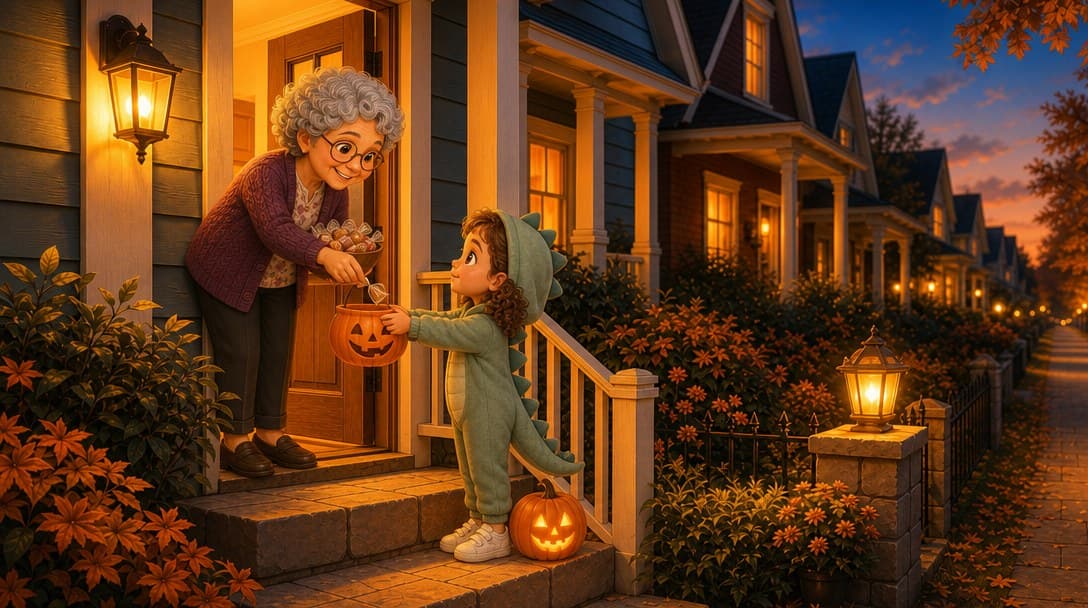
They will freeze at least once. Here is what the night in our Halloween Night film does, and it is the same thing I would do on a real step.
Crouch down to their height. Ask whether the feeling is this big or THIS big, with your hands, and let them show you. Then say the thing that makes the rest of the night possible: we can skip this one.
And skip it. Do not coax. Do not say it is only pretend, because at two it is not only pretend, and you will be arguing with a rule they cannot yet break. Walk to the next lit porch. Dr. Keough calls this gradual exposure at a level they are ready for, and the AAP is even plainer: if your little one does not want to take part, let that be OK.
If the problem is a specific big kid in a specific mask, ask the kid to take it off for a second. Most will, and the moment the mask comes off it is a kid from down the street, waving, which is the whole lesson in one second.
No mask on your toddler either
This one is not about fear, it is about seeing. The AAP recommends non-toxic makeup instead of masks so children can see clearly and avoid falls, and for a two year old I would go further and skip the face entirely. A pumpkin, a cat with ears on a headband, a dinosaur with a hood that pushes back: soft, warm, recognisable, nothing over the eyes. A costume they can see out of is a costume that gets worn past the front step.
Why skipping a house makes next year easier
A toddler who learns they can say no to a scary porch learns that Halloween is a thing they are in charge of. That child tries the next house, and next year tries the one they skipped. A toddler who gets carried up the steps because you have already walked this far learns that Halloween is a thing that happens to them, and next year the fear is bigger and has a memory attached.
That is the whole argument for a small night. Three or four houses, before dark, with people you know, and permission to stop. Here is the short plan for taking a two year old trick-or-treating, and if your child is not scared so much as baffled, start with how to explain Halloween to a toddler instead.
More in Halloween for Toddlers
- How to Explain Halloween to a Toddler Who Has No Idea What It Is
How to explain Halloween to a toddler: a friend asked me at dinner, because her two and a half year old does not understand what it is. This is the answer I put together afterwards: skip the word holiday and teach the four things that actually happen, start with masks because that is the part that goes wrong, practise the knock at your own door, use porch lights as a map, let the bucket do the talking, and let a house be skipped.
- Can You Take a 2 Year Old Trick or Treating? Yes. Four Houses, Before Dark
Can you take a 2 year old trick or treating? Yes, and the version that works is small: three or four houses you know, before dark, a costume with nothing over the face, the words said together at every door, and a way home the moment it stops being fun. Here is the whole plan, the candy list from the American Academy of Pediatrics, and the fallback if the street turns out to be too much.
- Halloween Books for Toddlers: The Gentle Ones, and the Two on Our Shelf
Halloween books for toddlers work when nothing in them is truly frightening: faces stay faces, costumes come off, and the spooky noise turns out to be a friend. Here are the two we have at home, nine more that pass the same test sorted by age, and the kind of Halloween book worth saving until four or five.
The story for this milestone
A first Halloween, for a child who is excited and a little scared
A personalized first Halloween story: your child, by name, in the costume you choose, at the door, at the scary porch, and pouring the bucket out at home. A 2.5 minute storybook film. Ready within 24 hours.
We make it from the details you choose. Your child, by name, in every scene.
Frequently asked questions
- Why is my toddler suddenly scared of Halloween decorations?
Because they move, make noise, or look like a face that is wrong, and a two year old cannot yet tell pretend from real when something startles them. Preview the decorations in daylight, show how the motion-activated ones work by setting them off yourself, and skip the houses with fog machines and strobes on the night.
- Should I make my toddler wear a mask?
No. The American Academy of Pediatrics recommends non-toxic makeup instead of masks so a child can see clearly, and the whole point of a toddler costume is that they can still see and be seen. A soft, recognisable costume with nothing over the face is the one that gets worn past the front step.
- What do I do when my toddler freezes at a scary porch?
Crouch to their height, ask whether the feeling is this big or THIS big, and say you can skip this house. Then skip it. If a big kid in a mask is the problem, ask them to take it off for a second. A child who is allowed to say no to one porch usually tries the next.
- Will my toddler grow out of being scared of masks?
Yes. ZERO TO THREE notes that these fears fade as a child's thinking matures and they can hold the idea that a person underneath a costume stays the same person. Practice at home speeds it along; forcing it does not.
Sources
- ZERO TO THREE, I'm Scared: Responding to Your Toddler's Fears. The mismatch between what a child expects a face to look like and what they see; a two year old cannot hold that a witch outside is Aunt Molly underneath; play with masks beforehand; ask visitors to remove masks; fears subside as thinking skills mature.
- Child Mind Institute, Taking Halloween by the Horns. Dr. Kathryn L. Keough: young children struggle to separate fantasy from reality; preview decorations in daylight and demonstrate motion-activated ones; gradual exposure at a level the child is ready for; follow the child's lead.
- American Academy of Pediatrics, HealthyChildren.org, Easing Babies and Toddlers into Halloween Fun: 8 Tips for Parents. Fright-prep time, before dark, Plan B costume, pack it in early, and if your little one does not want to partake, let that be OK.
FableFleet team
Founders & moms, FableFleet
We're a small team of moms building the personalized children's stories we wished existed for our own kids. Everything we publish is rooted in lived experience and cited research.