
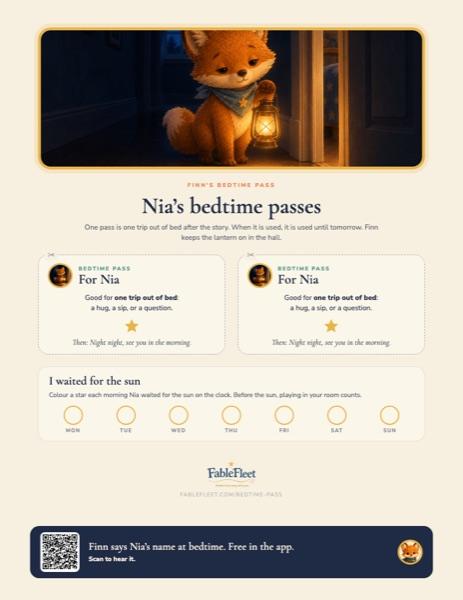
How the pass works
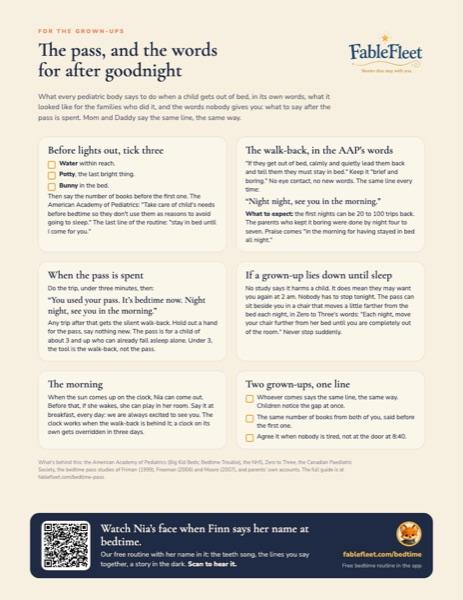
Your child gets the passes at bedtime, after the story, and holds them. One pass buys one trip out of bed, under three minutes, for a hug, a sip, or a question. When it is used, it is used until tomorrow. Any trip without a pass gets the walk-back: the American Academy of Pediatrics says “If they get out of bed, calmly and quietly lead them back and tell them they must stay in bed,” keeping it “brief and boring.” The pass that was never used is the one that matters. The psychologist who invented it put it this way: “A child saving the valuable pass may simply fall asleep waiting to use it.”
Who it is for
A child of about 3 and up who can already fall asleep alone. Pediatric psychologists have tested it with children aged 3 to 6: they left the room and called out less, settled faster, and three months later it still held. Under 3, the tool is the walk-back on its own, and the grown-ups' page has it in the pediatricians' words.
Before lights out, tick three
Water within reach, the potty, and the comfort object in the bed. The AAP's line is “Take care of child's needs before bedtime so they don't use them as reasons to avoid going to sleep.” Then say the number of books before the first one, and the last line of the routine: stay in bed until I come for you.
If a grown-up lies down until sleep
No study says it harms a child. It does mean they may want you again at 2 am, and nobody has to stop tonight. The pass can sit beside you in a chair that moves a little farther from the bed each night, in Zero to Three's words: “Each night, move your chair further from her bed until you are completely out of the room.” We lie down with ours. The whole picture is in toddler won't stay in bed.
The morning
The AAP's reward is not a sticker: “praise them in the morning for having stayed in bed all night.” The morning box is that praise made visible, a star your child colors in. If your house has a sun clock, tap the chip and the box says “I waited for the sun” instead, with the rule on the grown-ups' page: come out when the sun is up, play in your room before that.
Questions parents ask
- What is a bedtime pass?
- One token a night, a card the child can hold, good for one trip out of bed after goodnight: a sip, a hug, a question. Once it is used, it is gone until tomorrow, and any other trip gets a calm, silent walk back to bed. Ours gives two, with your child's name on each.
- Does the bedtime pass work?
- Yes, for a child of about 3 and up who can already fall asleep alone. Pediatric psychologists tested it with children aged 3 to 6: they left the room and called out less, settled faster, and three months later it still held. It works with the walk-back behind it: one pass, one trip, then calm, quiet returns.
- What age is the bedtime pass for?
- About 3 and up, for a child who can already fall asleep alone. Under 3, the tool is the walk-back, not the pass. If your child needs you in the room to fall asleep, the pass is the wrong tool, and the grown-ups' page says what to do instead.
- What do I say when the pass is spent?
- Do the trip, under three minutes, then: "You used your pass. It's bedtime now." and your goodnight line. After that, the American Academy of Pediatrics' walk-back: "calmly and quietly lead them back and tell them they must stay in bed," keeping it "brief and boring," the same words every time.
- How many times will I have to walk my toddler back?
- No body gives a number, so here are the parents'. The families we read who kept it boring reported 60 to 100 returns on the first nights and a child who stayed by night four to seven. The one that never worked was the father whose returns became a game. Nights two and three are usually worse than night one.
- We lie down with our child until they fall asleep. Can we still use it?
- No study says lying down harms a child, and nobody has to stop tonight. The pass can sit beside you in a chair that moves a little farther from the bed each night, which is Zero to Three's own plan for ending it. Never stop suddenly; the families who did got a long night of returns.
More bedtime guides
- Toddler won't stay in bed: what the pediatricians say, the bedtime pass, and the parent who lies down
- Bedtime routine for 3 year olds: what works at our house, and what the research actually says
- The free bedtime routine chart
- Everything for bedtime
Sources
- American Academy of Pediatrics, “Big Kid Beds: When to Make the Switch.” healthychildren.org
- American Academy of Pediatrics, “Bedtime Trouble.” healthychildren.org
- Zero to Three, “Sleep Challenges: Why It Happens, What to Do.” zerotothree.org
- Freeman (2006), “Treating Bedtime Resistance with the Bedtime Pass,” Journal of Applied Behavior Analysis. pmc.ncbi.nlm.nih.gov
- Moore, Friman, Fruzzetti and MacAleese (2007), “Evaluating the Bedtime Pass Program for Child Resistance to Bedtime,” Journal of Pediatric Psychology. pubmed.ncbi.nlm.nih.gov