
· Updated
Toddler Won't Stay in Bed: What the Pediatricians Say, the Bedtime Pass, and the Parent Who Lies Down
By Amanda and Ashley, two moms with four kids between us
If your toddler won't stay in bed, here is what the pediatricians say to do, and here is what we actually do. The advice is simple and hard: walk her back, calmly, the same few words every time, and keep doing it for several nights. The parents who stuck with it say the first nights were brutal and night four was quiet. From about 3, a bedtime pass helps, and we made you a free one. At our house, I lie down with her until she is asleep, and that is a fine answer too.
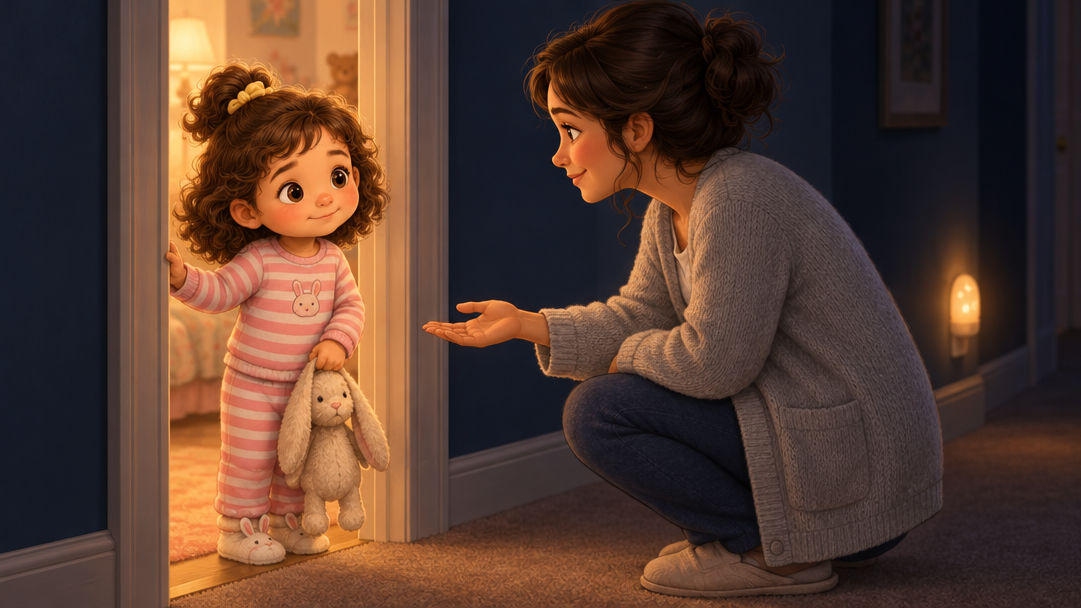
Here's what happens at our house. After the story, I lie down with my daughter until she is asleep. We've done it since she moved to a big kid bed at 18 months, we tried all the sleep training methods, and in the end we did what worked for us. So the standoff at the door, the one where you walk a 3 year old back to bed forty times without speaking, is not our evening. Our rule is in the morning instead. She has a Gro-Clock. When the sun comes up on it, she can come out. Before that, if she wakes, she can play in her room, and we are always excited to see her when the sun comes up.
I'm telling you that first because almost every article on this topic is written as though no reasonable parent would lie down, and plenty of us do. So here is what the American Academy of Pediatrics actually says, what it looked like in numbers for the parents who did it, what the bedtime pass is, and what the lying-down families do when they want out.
Finn's Bedtime is a free guided routine in the FableFleet app: see how a night with Finn goes. Prefer paper? Finn's bedtime pass and the bedtime routine chart.
Why my toddler won't stay in bed
Because she can. Zero to Three says it is not at all unusual for a toddler newly out of the crib to start wandering at night. In the accounts, the loop almost always started the week the cot sides came off or a baby was due. The child discovered the door, and the first week was 20 to 100 trips out a night with a parent on the landing.
The pediatricians say why it keeps going: if getting out of bed brings your toddler extra attention, they will do it again, and that holds even when the attention is a cross one. The Yale sleep doctor Craig Canapari calls the version that stays in bed curtain calls: the requests that come after bedtime, one after another, for attention. Water, one more book, a hug. Each small, each reasonable, each a parent in the doorway one more time. None of it is manipulation. It is a small person who has correctly noticed a pattern.
Rule these out before you work on staying in bed
- The nap. Dropping or capping it was the fix more often than anything else in the accounts. A child who napped two hours has no sleep pressure at 7. The overtired post is where the nap and the clock meet.
- Bedtime too early. Two families moved bedtime earlier and got a child lying awake until the old time. The NHS plan is the reverse: start the routine about 30 minutes before the time your child usually falls asleep, and bring it forward by 5 to 10 minutes each week.
- Real fear. The Canadian Paediatric Society says not to ignore bedtime fears. A frightened child is not stalling, and a flat walk-back lands badly on her. Zero to Three's answer is to make one of her special stuffed animals her protector.
- The needs. The pediatricians' advice is to take care of the needs before bedtime, so they are not reasons to avoid going to sleep. Water, potty, the comfort object, all before lights out. The full routine is in the pillar.
- Something physical. Teeth, ears, a tag, a wet diaper. Three strange nights in a row are worth a look before a plan.
Toddler stalling before bed: say the number of books
The best stalling line I found is the Canadian Paediatric Society's: set limits, such as how many books you will read together, make sure your child knows what they are, and stick to them. Two books, said before the first one, in a normal voice, before anyone is invested. A limit announced at the start is a fact. The same limit at the door at 8:40 is a refusal. Give the real choices early too, which pajamas, which book, so the deciding is done before the room goes dark. Then the pediatricians' last line of the routine: when you end it, tell your child to stay in bed until you come for them.
The walk-back: how many nights until a toddler stays in bed
This is what every body says, and they say it the same way. The American Academy of Pediatrics: "If they get out of bed, calmly and quietly lead them back and tell them they must stay in bed." Keep it brief and boring. The NHS says to keep taking them back with as little fuss as possible, and that you may have to repeat it for several nights. Zero to Three gives the words: It's time to sleep. You need to stay in your bed. See you in the morning. The parents I read used shorter ones: It's bedtime now. Back to bed, night night time. Pick one. Say it the same way every time.
The pediatricians' reward is not a sticker: praise in the morning, for having stayed in bed all night. If the stairs are in reach, a safety gate across the bedroom door. And do not let the breakout pay, by letting the child into your bed.
No body puts a number on it, so here are the parents'. One mother of a 3 and a half year old did it from the landing, silently: over 100 returns on night one, about 90 on night two, about 60 on night three. On night four her daughter stayed in bed. She said she felt like a failure during it and relieved after. Another family's line, back to bed, night night time, had a 21 month old settling alone in under a week. For most of the parents I read it ended this way, in two to seven nights. For some, a gate or a door rule was the thing that held.
And the one that never worked: a father did the returns for a month, about 50 a night, and his 3 year old laughed, treated it as a game, and got more and more overtired. The returns were attention. If your child is laughing by night five, the method is being done, but it is not being boring. And expect nights two and three to be worse than night one. A strategy that has produced a parent for months does not get dropped quietly. The families who stopped there went back to square one.
The bedtime pass for toddlers, and the free kit
The pass is one token, a card or a laminated square, good for one trip out of bed after goodnight: a sip, a hug, a question. Spent, it is gone until tomorrow. Any trip without it gets the silent walk-back.
Pediatric psychologists have tested it, and it works: children with a pass left the room and called out less, settled faster, and three months later it still held. The psychologist who invented it thinks he knows why: "A child saving the valuable pass may simply fall asleep waiting to use it." The practitioner rule is that it is best suited to children over three who already know how to put themselves to sleep. If your child needs you in the room to fall asleep, the pass is the wrong tool. One mother's account, a nearly 3 year old with a decorated notecard, spent it on water and cried for 18 minutes on night one, used it a few minutes in on night two, and never touched it on night three.
We don't use one, because our house settles with a parent in the room. But we made a free bedtime pass kit for the families who do, because nobody gives you the words for after the pass is spent. Two passes with your child's name and Finn holding a lantern, a morning box she marks herself, and a grown-ups' page with the walk-back in the pediatricians' words, the three things to tick before lights out, and the line for when the pass is spent. It is below.
If you lie down with your toddler, like we do
No study says lying down with your child until she sleeps harms her. I looked. What the bodies say is that it makes falling asleep alone harder: a child soothed to sleep learns to need that soothing, so when she surfaces at 2 am she looks for what she fell asleep with, and that is you. The pediatricians say not in your bed, and not to go back in when they call out. The Canadian Paediatric Society, on the same page where it wants your child to learn to fall asleep on their own, lists lying in bed with your child, talking quietly about their day, as a relaxing thing to do before sleep.
Of the parents I read who did it past 3 or 4, none regretted it. It ended between 5 and 13, usually on the child's say-so. That is the cost: it tends to last years, and the 2 am visit is real.
When you want out, the one body with a plan starts exactly where you are. Zero to Three: "end your child's bedtime routine by lying down with her or next to her bed until she falls asleep." Then, after a few days, sit a few feet from her bed. Then move the chair a little further each night until you are out of the room. The parents who did it describe the same ladder: the bed, the edge of the bed, a chair, the chair halfway, the doorway, the landing, out. Hold each step for several nights, and going back a rung for illness or a new baby is how it is meant to work. The other way out in the accounts is the check-in promise, I'll check in two minutes, and you do, with the gaps getting longer. What makes either one work is that you do exactly what you said.
Do not stop lying down suddenly. Two families did, and got 90 minutes of returns on the door night and 3 am calling for a week after.
Free printable
Finn's bedtime pass, with your child's name on it
Two passes to cut out, each good for one trip out of bed, a morning box your child marks, and a page for you with the walk-back in the pediatricians' words and what to say when the pass is spent. Nothing you type leaves your device.
What goes to bed with them (optional)
Your goodnight line (the same words every time)
Who comes if they call (tap one or two)
The morning
The morning box says "I stayed in bed," and the grown-ups' page carries the pediatricians' morning praise.
Two sheets: the passes and the morning box for your child, and a page for you. Your answers go into the print page in the address after the #, which your browser never sends to us. How the pass works.
The sun clock: for mornings, not for staying in bed
Most of the parents I read said a Gro-Clock or a similar wake clock worked. Where it failed, the failure was always the same shape: a clock with no walk-back behind it. The child overrode it in three days, or reported hourly that it was not sunrise yet. The clock tells the child when the night is over. It does not put her back in bed at 9 pm.
Ours is the morning half of our system. Lie down at night, the sun clock in the morning, play in your room until it says so. It took a while to be consistent, which is what the parents who got it working said too.
When to call the doctor: a toddler who won't stay in bed
- Getting up comes with real distress rather than negotiation, and is not easing over weeks.
- Snoring, long pauses in breathing, or waking gasping.
- Weeks of doing the method exactly, with no movement at all.
- The climbing out is unsafe, or she is not safe alone in her room.
The pediatricians' kindest line is worth keeping: "it is normal to get upset when a child keeps you awake at night." Whichever way you go, the routine before the door matters as much as the door, and ours, with the teeth song and a story that says her name in the dark, is free in Finn's Bedtime.
More in Toddler Bedtime
- Bedtime Routine for 3 Year Olds: What Works at Our House, and What the Research Actually Says
Our bedtime routine takes about half an hour, and it is the same every night: pajamas, teeth with a song, potty, Bunny and a cuddle, a few lines we say together, then a story. Lights out around 7:30. That is the whole trick. Not the steps, the sameness. Nobody official will tell you what time a 3 year old should be in bed, so I'll tell you how we worked out ours, what to do when the nap starts wrecking the evening, and why I still lie down with her until she falls asleep. It is the routine Finn runs in Finn's Bedtime, free in our app, if you want someone else to say the steps tonight.
- Bedtime Routine Chart for Toddlers (Free Printable)
Our bedtime routine chart is six steps in pictures, your child's name at the top, and a lamp to color in each night. It works because it is short and because it is the same every night. Print it free in two styles. If you would rather Finn said the steps out loud, the same routine is free in our app, as Finn's Bedtime.
- Bedtime Stories for 3 Year Olds (and 2 and 4): How to Pick One That Actually Settles Them
The best bedtime story for a 3 year old is not the best book. It is the one where nothing much happens. Here is how to judge any story you already own in thirty seconds, the books parents keep naming and what each is good for, why the same story every night beats a new one, and what changes at 2, 3 and 4.
- Daylight Saving Time With a Toddler: The Gradual Shift, Doing Nothing, and What We Did
When the clocks change you can shift your toddler's bedtime a little each night for a few days before, or do nothing and ride out a week of early mornings. Both work. Last year we shifted. This year we did nothing, because BC stopped changing its clocks. Either way the routine stays exactly the same, and that is what gets you through.
- Overtired Toddler Won't Sleep? Mine Took Hours. Here's What Was Actually Happening
An overtired toddler does not look tired. She looks wired. Mine took hours one night at my grandparents' house, and I spent most of it thinking she was fighting me. She was not. Here is what overtired actually looks like, what to do tonight (less of everything, nothing new), and what to fix this week, which is almost always the nap or the clock.

For tonight
Finn’s Bedtime is free tonight
PJs, teeth, potty, one last cuddle, then a story that says your child’s name. Finn does the routine right alongside them. In the app, free, no account to make.
Frequently asked questions
- Why does my toddler keep getting out of bed?
Because she can, and because it works. Zero to Three says it is not at all unusual for a toddler newly out of the crib to start wandering, and the pediatricians say that if getting out of bed brings extra attention they will do it again, even when the attention is cross. Rule out the nap, a bedtime that is too early, real fear, and the needs (water, potty, the comfort object) before you treat it as a limits problem.
- How do I get my toddler to stay in bed?
The pediatricians' method: if they get out of bed, calmly and quietly lead them back and tell them they must stay in bed. Keep it brief and boring, say the same short line every time, and expect to repeat it for several nights in a row. The praise comes in the morning, for having stayed in bed all night. Parents who did it exactly report 60 to 100 returns on the first nights and a child who stayed by night four to seven.
- What is the bedtime pass and does it work?
One token a night, good for one trip out of bed: a sip, a hug, a question. Spent, it is gone until tomorrow, and any other trip gets the silent walk-back. Pediatric psychologists have tested it with children aged 3 to 6, and it still held three months later. It is for children over 3 who can already fall asleep alone.
- Is it bad to lie down with my toddler until she falls asleep?
No study says it harms a child. The bodies say it makes falling asleep alone harder, because a child soothed to sleep learns to need that soothing, and she may need you again at 2 am. The pediatricians say not in your bed and not to go back when they call. Of the parents we read who did it past 3 or 4, none regretted it, and it ended between 5 and 13. It is a choice with a cost. We make it.
- How do I stop lying down with my toddler without a fight?
Slowly, and not by stopping suddenly; the families who did that got 90 minutes of returns on the door night. Zero to Three's plan starts where you are: end the routine by lying down with her or next to her bed until she falls asleep, then after a few days sit a few feet from her bed, then move the chair a little further each night until you are out of the room. Hold each step for several nights. A check-in promise you keep, back in two minutes, is the other way the parents we read did it.
- Does a Gro-Clock or wake-up clock help a toddler stay in bed?
In the morning, yes, for many families; at bedtime, no. Most of the parents we read said the clock worked, and every failure was a clock with no walk-back behind it. The clock tells your child when the night is over. It does not put her back in bed at 9 pm. One children's hospital says a wake-up clock tends to work best for children who like structure and rules.
Sources
- American Academy of Pediatrics, HealthyChildren.org, Big Kid Beds: When to Make the Switch
- American Academy of Pediatrics, HealthyChildren.org, Bedtime Trouble
- NHS, Sleep problems in young children
- Zero to Three, Sleep Challenges: Why It Happens, What to Do
- Canadian Paediatric Society, Caring for Kids, Healthy sleep for your baby and child
- Mindell and Williamson (2018), Benefits of a bedtime routine in young children, Sleep Medicine Reviews 40
- Friman et al. (1999), The Bedtime Pass: An Approach to Bedtime Crying and Leaving the Room, Arch Pediatr Adolesc Med 153(10); WebMD feature with Friman's comments
- Freeman (2006), Treating Bedtime Resistance with the Bedtime Pass, J Appl Behav Anal 39(4)
- Moore, Friman, Fruzzetti, MacAleese (2007), Evaluating the Bedtime Pass Program for Child Resistance to Bedtime: A Randomized, Controlled Trial, J Pediatr Psychol 32(3)
- Craig Canapari MD, Curtain Calls, Limit Setting and Bedtime Battles
- Alison Bevan, Fairfield County Mom, The Bedtime Pass
- Cleveland Clinic, Nighty-Night: Tips To Get Your Kid To Stay In Bed
Co-founders and moms, FableFleet
Two moms, four kids between us. We write about the moments we are living through, and we made the bedtime routine and stories our own kids use.