
· Updated
Bedtime Routine for 3 Year Olds: What Works at Our House, and What the Research Actually Says
By Amanda and Ashley, two moms with four kids between us
Our bedtime routine takes about half an hour, and it is the same every night: pajamas, teeth with a song, potty, Bunny and a cuddle, a few lines we say together, then a story. Lights out around 7:30. That is the whole trick. Not the steps, the sameness. Nobody official will tell you what time a 3 year old should be in bed, so I'll tell you how we worked out ours, what to do when the nap starts wrecking the evening, and why I still lie down with her until she falls asleep. It is the routine Finn runs in Finn's Bedtime, free in our app, if you want someone else to say the steps tonight.
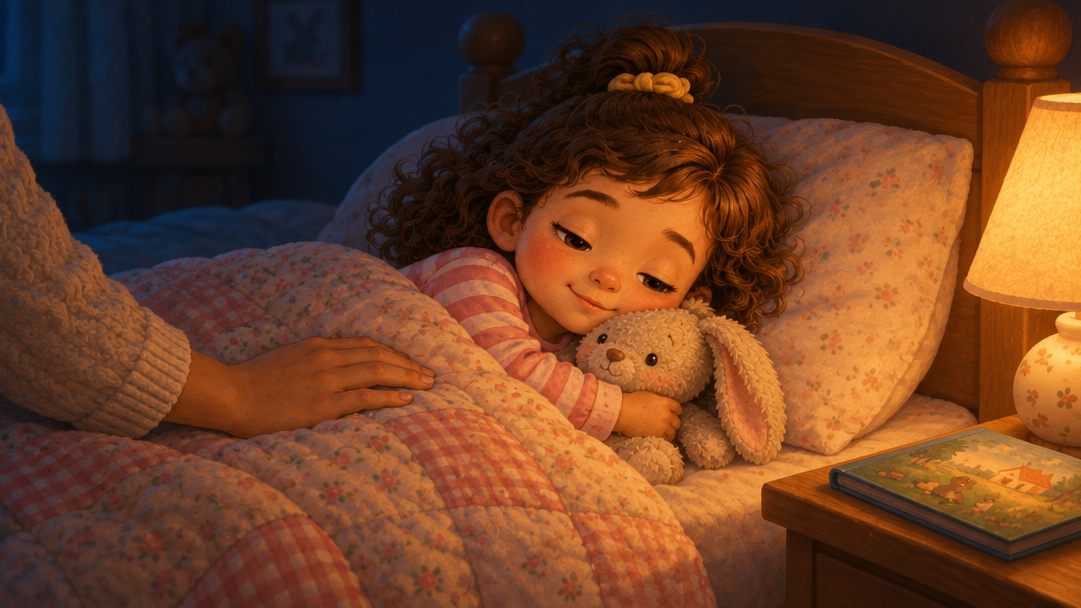
Bedtime was a hard struggle at our house. The teeth were the worst of it. My daughter never wanted to brush them, and most nights that one step turned into the whole evening. Then one night away, at my grandparents' house, she was in a room that was so bright, and nothing I did got her down. I tried blackout curtains. They didn't work. I tried a different bedtime story from YouTube and Spotify every night for about a week, and they wound her up more than they settled her. A week later I made her a story of my own, and I started reading everything I could find about what actually helps a small child let go.
Here's where we are now. She has a two-minute song for her teeth, the same one every night, and the fight went out of it. The routine is the same steps in the same order, and it is much easier. Not perfect. Much easier. This is our bedtime routine for 3 year olds, what the research says about each piece, and the bits most bedtime guides leave out, including the fact that I still lie down with her.
Finn's Bedtime is a free guided routine in the FableFleet app: see how a night with Finn goes. Prefer paper? the free bedtime routine chart.
What a bedtime routine for 3 year olds actually does
The best evidence on any bedtime question is the one about routines. In 2015 Jodi Mindell's team asked the mothers of 10,085 children in 13 regions about bedtime. A routine, as they defined it, is the same activities in the same order every night before lights out. What they found: a consistent routine went with earlier bedtimes, falling asleep faster, fewer night wakings and more sleep in all. The more nights a week, the better the sleep. Their takeaway is the one I'd put on the fridge: "the more consistently a bedtime routine is instituted and the younger started the better."
The research proves the sameness, not the steps. Whether it is a bath or a book is yours to pick. Doing it in the same order most nights is the part with evidence behind it.
How long a toddler bedtime routine should take
About half an hour. Mindell and Williamson's 2018 review puts the limit at 30 to 40 minutes, depending on what is in it. The Canadian Paediatric Society says to help your child wind down about half an hour before bedtime with stories or quiet activities, and the Sleep Foundation lands in the same place: around half an hour, a little longer if there is a bath.
Short is not lazy. A ninety-minute bedtime is lovely until the night you get home late, and then it collapses, and the collapse teaches her that bedtime is negotiable. Half an hour I can do when I'm tired. That is why it works.
Our bedtime routine, step by step
Mindell and Williamson list what a routine is made of: something to eat or drink, washing and teeth, talking, reading or singing, and touch, a cuddle or a back rub. The pediatricians' version for small children is three words: brush, book, bed. You don't need all of it. You need a handful of steps that point downward, bright to dim, loud to quiet, up to down, in the same order every night.
Ours, at 3, and it is the one in Finn's Bedtime, so Finn can run it with you:
- Pajamas. In the bedroom, so the room is where the evening is heading.
- Teeth, with the song. Two minutes, the same song. The pediatricians say every young child needs an adult's help with brushing to get it done properly. The two-minute song is ours, not theirs. It is the thing that ended the fight at our house, because when the song ends, so does the brushing.
- Potty. The last bright, brisk thing. The pediatricians' advice is to take care of the needs before bedtime, so they are not reasons to get up later.
- Bunny and a cuddle. The pediatricians say to let your child take a favorite thing to bed each night. Yours is whatever yours is.
- The lines. A few words we say together, the same every night. Ours, not any body's. They are the signal that the story is next and sleep is after it.
- The story. Lights down. In the app it is a story that says your child's name and ends in the dark. The last thing, and the same kind of last thing most nights, because it is the step right before sleep and it does the most work over time.
Free, no account. It fits inside the half hour. If you want the six steps on paper, the free bedtime routine chart is in the post below this one.
What time should a 3 year old go to bed?
No pediatric body gives a clock time. They give hours. The American Academy of Sleep Medicine, which the pediatricians support, puts children aged 3 to 5 at 10 to 13 hours in every 24, naps included, and 1 to 2 year olds at 11 to 14. So take the time she wakes, subtract the hours, subtract the nap, and that is roughly lights out.
One small study found toddlers' melatonin rose at about 7:40 pm, roughly half an hour before their parents' chosen bedtimes, and the ones put down earlier took 40 to 60 minutes to fall asleep. A child who fights bedtime may simply not be ready yet. Of the two hundred or so families whose bedtimes I read, most 3 year olds were in bed between 7 and 7:30 and asleep by 8, and a dozen chose 8 or 9 on purpose because that is when their child actually fell asleep. Ours is lights out about 7:30. If yours is 8:30 and she is cheerful at breakfast, the hours are what matter, not the clock.
If bedtime has drifted late, the NHS plan is the one with a body behind it: start the routine about 30 minutes before the time your child usually falls asleep, then bring it forward by 5 to 10 minutes each week. Moving it earlier in one jump for a child who is not tired gets you a child lying awake until the old time.
The nap is part of the bedtime routine
This is the piece that catches almost everyone somewhere between 2 and 4. The nap makes bedtime easier for a long time, and then, fairly suddenly, it starts making bedtime harder, because it is eating the sleep pressure bedtime depends on. Nothing about your routine changed. The inputs did.
The Canadian Paediatric Society says children give up naps between 3 and 5; one children's hospital puts it between 3 and 6, and offers the test I use: if it is 2 pm and your child is content and playing, they may not be tired. When the nap goes, turn naptime into quiet time and move bedtime about 30 minutes earlier for a while.
Of the families I read, dropping or capping the nap was the fix more often than anything else. Order to try: cap it at about an hour, then end it by early afternoon, then drop it, and expect a rough couple of weeks with bedtime earlier, not later. Change one thing at a time and give it several days. If your 2 year old is suddenly wild at 7 and asleep at 10, the overtired post is where the nap and the clock meet.
Bedtime stalling: say the number of books first
The Canadian Paediatric Society's line for preschoolers is the single best piece of stalling advice I found: "Set limits, such as how many books you will read together, be sure your child knows what they are, and stick to them."
Two books, said before the first one. A limit announced at the start is a fact. The same limit at the door, to a tired child, is a refusal, and the difference is entirely about timing. Give the real choices early too, which pajamas, which book, so the deciding is done before the room goes dark. And meet the needs before lights out, water, potty, Bunny, so they are not reasons to get up. The getting-up itself, and what to do about it, is its own post: toddler won't stay in bed.
The bedtime story: listened to, not watched
The pediatricians' advice for the hour before bed is nothing to watch, and their suggestion for the parent who asks about YouTube at bedtime is sleep stories instead. A story you listen to. I thought I was doing that during my YouTube week, phone face down, and they still wound her up, because a story made to be watched is built to hold attention. Lively voices, music, something happening every twenty seconds.
So the last step of our routine is a story that is slow on purpose, the same every night, with her name in it, and the phone goes face down before it starts. That is what Finn's story is. The bedtime stories post has the whole of what I learned that week.
Lying down with your 3 year old until she falls asleep
The standard advice is to leave while your child is sleepy but not yet asleep. The Canadian Paediatric Society wants your child to learn to fall asleep on their own. The pediatricians say not to go back into the room when they call out.
I don't do it. We laid with her since she transitioned to a big kid bed at 18 months. We tried all the sleep training methods, and in the end we did what worked for us. I still lie down with her until she is asleep.
So I went looking for the research on whether that is a problem. No study says lying down with your child harms her. What the bodies say is that it makes falling asleep alone harder: a child who is soothed to sleep learns to need that soothing, so a child who falls asleep with you there may want you there again at 2 am. That is the cost, and it is real. And the Canadian Paediatric Society, on the same page where it wants your child to fall asleep alone, lists "laying in bed with your child talking quietly about their day" as a relaxing thing to do before sleep. The bodies are gentler about it than the internet is.
Of the parents I read who did this past 3 or 4, not one regretted it. And if you want out, Zero to Three's plan starts exactly where you are: end the routine by lying down with her or next to her bed until she falls asleep, then after a few nights sit a few feet away, then move the chair a little further each night until you are out of the room. Lying down is step one of a plan, not a bad habit. The whole ladder is in the won't-stay-in-bed post.
A bedtime routine that travels: when you are not at home
This is the part most bedtime guides skip, and the part I now think about most, because it is the week that started all of this.
Almost everything in a routine is cues, and most of the cues are the room. When you sleep somewhere new you keep the steps and lose almost all the signals. The American Academy of Pediatrics puts it in one line: "Make sure the sleep routines you use can be used anywhere." What travels: the order, roughly the usual time, the same song and the same story, and one object. What does not travel is the light. If the room is bright, solve the light first, before you decide your child has forgotten how to sleep.
Our blackout curtains didn't work in that room. Nothing I tried that week did. What I took from it is that the routine has to travel: the same song, the same lines and the same voice saying her name, in any room, from a phone. That is what Finn's Bedtime is.
Bedtime routine for 2 year olds
Shorter and more physical. The same shape, fewer words: pajamas, teeth with your help, one book, the comfort object, the song. The nap is still doing real work, so protect it, and watch for the first signs it is pushing bedtime later. The Canadian Paediatric Society says security items, a blanket or a stuffed animal, are often important at this age. The routine can start now; Mindell's finding is that the younger it starts, the better.
Bedtime routine for 4 year olds
Language has arrived, and so has negotiation, which is where the book count and the early choices earn their keep. The nap is likely gone or going, which makes bedtime easier and the late afternoon harder; bedtime may need to move earlier for a while, which feels backwards and usually is not. Fears show up at this age, and the Canadian Paediatric Society says not to ignore them. Zero to Three's advice is to make one of his special stuffed animals his protector, and not to tell her that monsters aren't real, because in her dreams they are.
When the bedtime routine does not work
Decide in advance, because the decision made at 8:50 is rarely the one you would choose calmly. Protect two things even when everything else goes: the order and the last step. Ninety minutes late from a birthday party, you can lose the bath, lose a book, and still do what is left in the usual sequence, ending with the usual story. A compressed routine in the right order still says what is coming.
Do not treat one bad night as evidence. Illness, travel, a new baby, the clocks changing, a house full of visitors will all produce nights that look like regression and are not. Act on a pattern over a week or two, not a Tuesday. The pediatricians' kindest line is that it is normal to get upset when a child keeps you awake at night.
When to talk to your doctor about your 3 year old's sleep
- Snoring, long pauses in breathing, or waking gasping.
- Well outside the hours for her age and struggling in the day.
- Bedtime resistance with real distress rather than negotiation, not easing over weeks.
- A sudden change in a child whose sleep was settled.
A routine is a tool for an ordinary problem. These are not that, and none of them mean you did the routine wrong. The stories that end our routine, for 2, 3 and 4, are in bedtime stories for 3 year olds.
More in Toddler Bedtime
- Bedtime Routine Chart for Toddlers (Free Printable)
Our bedtime routine chart is six steps in pictures, your child's name at the top, and a lamp to color in each night. It works because it is short and because it is the same every night. Print it free in two styles. If you would rather Finn said the steps out loud, the same routine is free in our app, as Finn's Bedtime.
- Bedtime Stories for 3 Year Olds (and 2 and 4): How to Pick One That Actually Settles Them
The best bedtime story for a 3 year old is not the best book. It is the one where nothing much happens. Here is how to judge any story you already own in thirty seconds, the books parents keep naming and what each is good for, why the same story every night beats a new one, and what changes at 2, 3 and 4.
- Daylight Saving Time With a Toddler: The Gradual Shift, Doing Nothing, and What We Did
When the clocks change you can shift your toddler's bedtime a little each night for a few days before, or do nothing and ride out a week of early mornings. Both work. Last year we shifted. This year we did nothing, because BC stopped changing its clocks. Either way the routine stays exactly the same, and that is what gets you through.
- Overtired Toddler Won't Sleep? Mine Took Hours. Here's What Was Actually Happening
An overtired toddler does not look tired. She looks wired. Mine took hours one night at my grandparents' house, and I spent most of it thinking she was fighting me. She was not. Here is what overtired actually looks like, what to do tonight (less of everything, nothing new), and what to fix this week, which is almost always the nap or the clock.
- Toddler Won't Stay in Bed: What the Pediatricians Say, the Bedtime Pass, and the Parent Who Lies Down
If your toddler won't stay in bed, here is what the pediatricians say to do, and here is what we actually do. The advice is simple and hard: walk her back, calmly, the same few words every time, and keep doing it for several nights. The parents who stuck with it say the first nights were brutal and night four was quiet. From about 3, a bedtime pass helps, and we made you a free one. At our house, I lie down with her until she is asleep, and that is a fine answer too.
For tonight
Finn’s Bedtime is free tonight
PJs, teeth, potty, one last cuddle, then a story that says your child’s name. Finn does the routine right alongside them. In the app, free, no account to make.
Frequently asked questions
- What is a good bedtime routine for a 3 year old?
The same few steps in the same order every night, about half an hour, ending in the dark. The research that followed 10,085 children found that the more consistently a routine is done, and the younger it starts, the better the sleep. Ours is pajamas, teeth with a two-minute song, potty, the comfort object and a cuddle, a few lines said together, then a story with the lights down. The pediatricians' short version is brush, book, bed.
- What time should a 3 year old go to bed?
No pediatric body gives a clock time. The American Academy of Sleep Medicine puts children aged 3 to 5 at 10 to 13 hours in every 24, naps included, so count back from wake-up and subtract the nap. One small study found toddlers' melatonin rose at about 7:40 pm. Most of the families we read had a 3 year old in bed between 7 and 7:30 and asleep by 8; some chose 8 or 9 on purpose. Ours is lights out about 7:30.
- How long should a toddler bedtime routine take?
About half an hour. Mindell and Williamson's review puts the limit at 30 to 40 minutes, depending on what is in it. The Canadian Paediatric Society says to wind down about half an hour before bedtime, and the Sleep Foundation says around half an hour, a little longer if there is a bath. A routine that has stretched past an hour has usually absorbed a negotiation somewhere.
- Is it bad to lie down with my toddler until she falls asleep?
No study says it harms a child. What the bodies say is that it makes falling asleep alone harder: a child soothed to sleep learns to need that soothing, so she may need you again at 2 am. The pediatricians say not in your bed and not to go back in when they call. The Canadian Paediatric Society lists lying in bed with your child, talking quietly about their day, as a relaxing wind-down on the same page where it wants children to fall asleep on their own. It is a choice with a cost, and Zero to Three's plan for ending it starts by lying down, then a chair moved farther each night.
- Why does my 3 year old suddenly fight bedtime?
Check the nap first. Somewhere between 3 and 5, or up to 6 by one children's hospital's count, the nap stops helping bedtime and starts eating it. Cap it at about an hour, end it by early afternoon, then drop it, and move bedtime 30 minutes earlier for a while. Also check for a bedtime that is too early for a child who is not tired, a new baby or a new bed, and real fear, which the Canadian Paediatric Society says not to ignore.
- Should a 3 year old have screens before bed?
Nothing to watch in the last hour. The pediatricians' answer for a parent asking about YouTube at bedtime is sleep stories instead: a story you listen to, with the phone face down. That is what Finn's story is.
Sources
- Mindell, Li, Sadeh, Kwon, Goh (2015), Bedtime Routines for Young Children: A Dose-Dependent Association with Sleep Outcomes, Sleep 38(5)
- Mindell and Williamson (2018), Benefits of a bedtime routine in young children, Sleep Medicine Reviews 40
- American Academy of Sleep Medicine, Paruthi et al. (2016), Recommended Amount of Sleep for Pediatric Populations
- American Academy of Pediatrics, HealthyChildren.org, Bedtime Trouble
- American Academy of Pediatrics, HealthyChildren.org, Healthy Sleep Habits: How Many Hours Does Your Child Need?
- American Academy of Pediatrics, HealthyChildren.org, Brush, Book, Bed
- American Academy of Pediatrics, Helping Kids Thrive in a Digital World: AAP Policy Explained (2026)
- American Academy of Pediatrics Center of Excellence, Q&A: Watching YouTube to fall asleep
- Canadian Paediatric Society, Caring for Kids, Healthy sleep for your baby and child
- NHS, Sleep problems in young children
- Zero to Three, Sleep Challenges: Why It Happens, What to Do
- Sleep Foundation, Bedtime Routines for Children
- LeBourgeois et al. (2013), Dissonance Between Parent-Selected Bedtimes and Young Children's Circadian Physiology, University of Colorado Boulder
- Cleveland Clinic, 4 Signs Your Child Is Ready To Stop Napping
- Craig Canapari MD, Curtain Calls, Limit Setting and Bedtime Battles
Co-founders and moms, FableFleet
Two moms, four kids between us. We write about the moments we are living through, and we made the bedtime routine and stories our own kids use.