
· Updated
Best Potty Training Books for Toddlers, Preschoolers and Parents
The best potty training books come in two kinds. For parents: Oh Crap (Glowacki), The No-Cry Potty Training Solution (Pantley) and the free American Academy of Pediatrics toilet training hub. For toddlers: Once Upon a Potty (Frankel), Potty (Patricelli) and A Potty for Me (Katz). Preschoolers need characters their own age and a real story: Time to Pee (Willems) and Everyone Poops (Gomi). Skip anything with shame, a promised timeline or a checklist on the back. And the most specific potty book there is, you write yourself.
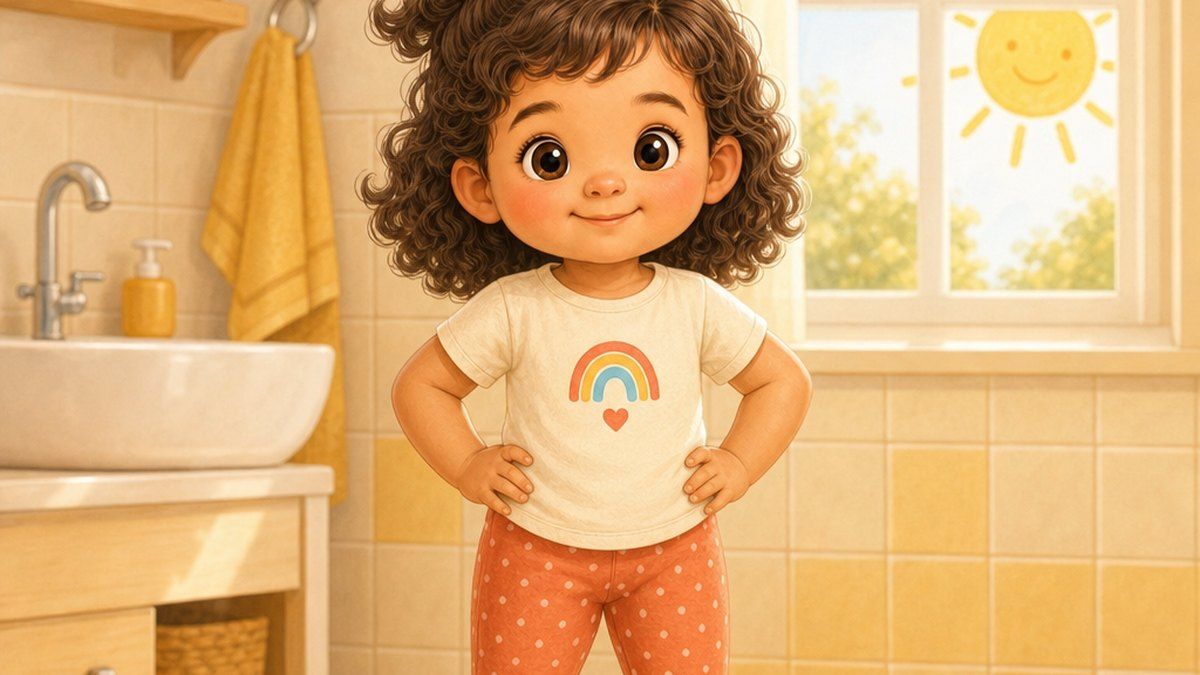
Match the book to the moment: a parent book the week before, a toddler book in the bedtime rotation two to four weeks ahead, and a story you write yourself if your child needs the real bathroom on the page. Here is what each one is best at, what to skip, how to read them, and a seven page social story template.
Free to print: a potty chart with your child's name and a picture for every step.
Books for parents
Our daughter trained in three days at home at 18 months, and the line we used at every accident was "that's okay, accidents happen." That is the tone I look for in any potty book now, for parents or for kids: calm, no shame, accidents allowed. These are the parent titles other parents keep citing.
Jamie Glowacki, "Oh Crap! Potty Training" (2015). The structured intensive method, in staged blocks. A strong voice, which some parents love and some find too loud. Reach for it if you want a clear, opinionated plan. The method is walked through in potty training methods.
Elizabeth Pantley, "The No-Cry Potty Training Solution" (2007). The gentle one. Scripts, a slower pace, child led. The pick if you want something that respects a child's resistance instead of bulldozing it.
The American Academy of Pediatrics toilet training hub (healthychildren.org). Free, pediatric and balanced. Start here for a baseline before committing to any method book.
Julie Fellom, "Diaper-Free Toddlers" (2006). If you are planning a 3 day run, this is the original source, strongest on the day one walkthrough.
And one that is not a potty book at all: Carla Naumburg's "How to Stop Losing Your Sh*t with Your Kids," for the nightstand if week one is going sideways.
Books for toddlers, 18 months to 3
Alona Frankel, "Once Upon a Potty" (1975). The classic, with boy and girl editions. What makes it last is how low key it is. A young child has body parts the book names in plain words, needs to go, sits on a little potty, and has a small win. That is the whole story. It reads in three or four minutes and the pages survive being read fifty times. Many four year olds find it babyish.
Leslie Patricelli, "Potty." Direct, funny, and the right size for a small child. The bald baby hero works for any child.
Karen Katz, "A Potty for Me." Lift the flap, one flap per step. Best from 18 months to about two and a half.
Taro Gomi, "Everyone Poops." The classic for the poop side, which is where our daughter lagged. Helpful when poop is the sticking point. Two to five.
Books for preschoolers, 3 to 5
A three, four or five year old has usually outgrown the board book with a baby on the cover. Preschool potty books need a different register: characters their own age (most three year olds reject a baby hero before page one), a story rather than a sequence of steps, a longer read of six to ten minutes, words for body parts that match your house, and a tone that describes rather than instructs. "Big kids do this" tends to backfire with a child who is touchy about not being big yet.
Mo Willems, "Time to Pee." The voice preschoolers know from the Pigeon books, a short story, a calm tone. Three to five.
Taro Gomi, "Everyone Poops." Especially useful when poop is the sticking point of preschool training.
Frankel and Katz still work at the lower end, three to three and a half, for children who have not already heard them.
Use them differently than with a toddler: read once or twice in the lead up rather than every night for a month, talk about it afterward ("Did you notice how she walked to the potty without being asked?"), and pair the book with a plain conversation about how your family does this: "Our family uses the toilet during the day. Sometimes we have accidents. That is normal." That last line is basically the sentence I said over and over in my own house. For a preschooler with strong resistance, a book is sometimes the wrong tool altogether; try a quiet break first (see potty training accidents and regression). For a preschooler training next to a younger sibling, steer away from books built on being a big kid.
What to skip
- A checklist on the back cover. Children do not read checklists; it is there to make the parent anxious.
- A character much older than your child, or a baby hero for a four year old. The see myself in them part breaks.
- Accidents framed as embarrassing. Children absorb that fast, and it is the opposite of the tone you want.
- A promised timeline ("trained in three days"). It sets your child up to feel behind.
- Fear as motivation, including public accident scenes.
- "Complete potty training kit" bundles. The kit part is clutter.
How to read them
Start two to four weeks before training: slip one child book into the bedtime rotation with no expectation beyond enjoying it (when to start potty training if you are not sure when that is). Read the same book often; for a toddler, repetition is the feature. Let your child hold it. Use the book's words in everyday speech. Keep your voice calm and matter of fact; an excited voice on the potty page can leave a child feeling they have to perform on the real one. When the interest fades, around week three or four, the book has done its job. After a regression, go back to the book you used first; the familiar character is a bridge.
And read your own parent book the week before, the chapter or three you need. Most of us over read these and over think the method. If you want something on the fridge as well as on the shelf, our free potty chart has a picture of each step, so a child who cannot read yet can follow it.
Write your own potty social story
My daughter did not need a formal social story to train. Some children do, and it is the most specific potty book there is, because you write it about your own child, in your own bathroom.
A social story is a short story in the first person that walks your child through the real routine in their real setting, in calm, matter of fact language, with the small details that can worry a young child (the flush, the door, where the towel is), a calm line about accidents, and a quiet positive ending. Carol Gray developed the format in 1991 for children with autism, and it helps a much wider group: children with sensory differences, language delays, strong bathroom anxiety, a child moving between two homes (write one for each), or any child who learns better from a printed sequence.
The sentence mix. Mostly descriptive ("I sit on the potty." "The potty is in our bathroom near the bathtub.") and perspective ("Sometimes my body has a feeling that means I need to use the potty." "My mom is happy when I try."), with a directive sentence only now and then ("When my body has the feeling, I walk to the potty."). Roughly two to five describing sentences for every instructing one. Children who feel instructed dig in; children who feel described relax.
A seven page template to adapt:
1. My name is [name]. I am [age]. This is my story about using the potty. 2. Sometimes my body has a feeling that means I need to use the potty. I might feel it in my belly. 3. When I feel that feeling, I walk to the bathroom. Our bathroom has a potty in it. [A photo of your actual bathroom.] 4. I pull down my pants. I sit on the potty. Sometimes pee comes out. Sometimes poop comes out. Sometimes nothing comes out, and that is OK. 5. When I am done, I wipe. I stand up. I pull up my pants. I wash my hands at the sink. [A photo of the sink.] 6. My mom or dad is happy when I try. Sometimes I have accidents. That is OK. Accidents help me learn. 7. Most children my age are learning to use the potty. I am doing a great job at learning. I am proud of me.
Print it on heavy paper or fold it into a booklet. Photos of the real bathroom make it concrete; simple line pictures suit a child who is overwhelmed by detail. Read it twice a day in the week before you start, then before each sit in the first three days, and go back to the accidents page after an accident if your child seems worried. For children with bigger sensory or developmental needs the story is one tool among several (a picture schedule, a soft seat insert, the same cue words from every caregiver, an occupational therapist if you can get one), but it is the best place to start, because you can write it and change it yourself with no appointment.
Free printable
A potty chart with your child's name on it
A picture of Nia for every step, so a child who cannot read yet can follow it. Nothing you type leaves your device.
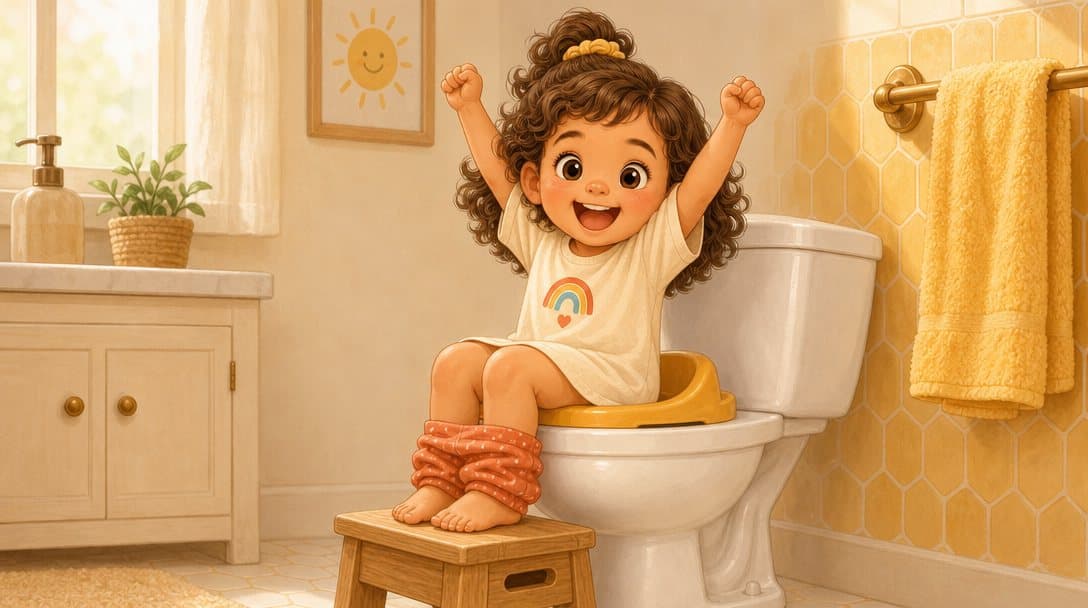
Steps on the chart (pick 3 to 5)
Start with steps your child can already nearly do. A full row on the first day is the point.
The name and goal go into the print page in the address after the #, which your browser never sends to us. We cannot see them. How to use a potty chart so it helps.
Color in a lamp each time. Every lamp counts, and a lamp is never taken away.
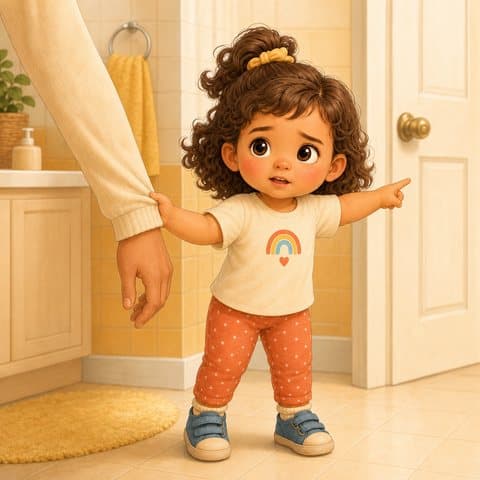 I told a grown-upbefore it happened
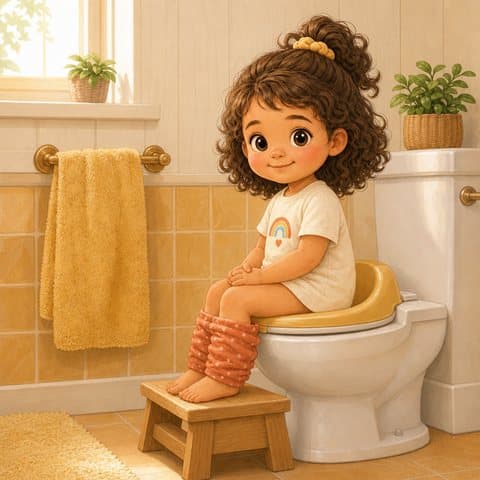 I sat on the pottyeven for a minute
 I washed my handssoap and a song
 Dry all morningor all afternoon
 When the chart is full
 Why a story works when a lecture does not
Children under four learn through play, repetition and seeing themselves in a character. Plain instruction lands poorly, especially for something this bodily; the AAP's statement on play treats it as one of the main ways young children learn, not an extra. A character their own age going through the routine gives a child three things at once: a picture of the steps, a rehearsal of the feeling (the character ends up proud, so your child feels that before they have done anything), and something to repeat twenty times in two weeks.
That goes for videos too. If you use one, look for a character your child's age, one simple arc, no fear, a calm narrator, under ten minutes, and watch it together rather than during the potty sit, so your child links the sit to their body and not to a screen. Fade it the way you would fade a sticker chart.
How FableFleet fits
Every book on this list does a lot, and the one thing none of them can do is name your own child. Our potty story is a personalized storybook film where your child is the main character, by name, made for ages 2 to 4: noticing the feeling on the inside, the cold seat and the step stool, and a grown-up who waits, right up to the flush. It sits alongside the bedtime book and the story you write, not in place of them. I did not have it for my daughter; FableFleet did not exist yet.
More in Potty Training
- Potty Training Methods Compared: 3 Day, Oh Crap and Child-Led, and What Worked for Us
There are three potty training methods worth knowing: child-led, which pediatricians default to and takes weeks to months; the 3 day method, three days at home with no diaper; and Oh Crap, the same idea spread over one to two weeks in stages. All three work for a child who is ready, and none of them works for a child who is not. We did three days at home with our daughter. The method gave the training a shape; her readiness did the rest.
- How to Potty Train a Boy: Sitting First, Standing Later
To potty train a boy, start him sitting for both pee and poop, and add standing only once sitting is fully reliable. That is the position of the American Academy of Pediatrics, the Mayo Clinic and Nemours. Boys finish a couple of months later than girls on average, but the gap is small next to how different one child is from the next. We trained our daughter; our son's turn is still ahead. This is the pediatric guidance on boys, next to what carries over from doing it once.
- Night Time Potty Training and Pull-Ups: When to Switch, and When to Wait
Night dryness is mostly body, not behavior. A hormone that slows urine overnight and a bladder big enough for the whole night both have to grow in, and that often comes months or years after daytime training. Wet nights are normal up to age five or six. In the day, cotton underwear teaches the cue because your child feels wet; pull-ups muffle it, so they belong to naps, nights and travel. Wait for the dry morning signal before switching to underwear at night. Our daughter's nights came on their own, a good while after her days.
- Potty Training Accidents and Regression: What They Mean and What to Say
Potty training accidents are normal: three to eight a day in week one, one to three in week two, close to none by week four. Say one short, calm sentence every time; ours was "that's okay, accidents happen." When accidents come back after a child was dry, that is a regression, and it is usually information: a new sibling, a move, a daycare change, an illness, or the one most parents miss, constipation. Most regressions settle in two to four weeks.
- When to Start Potty Training: What Age, and the Readiness Signs We Watched For
There is no single right age to start potty training. Pediatricians put the first readiness signs at 18 to 24 months and typical daytime training between 24 and 36 months, and most families start somewhere in between. What tells you it is time is a pattern that holds for about two weeks: dry stretches of two hours, some curiosity about the toilet, simple instructions followed, and a cooperative mood. My daughter showed signs at 16 months and was trained by 18. That was her timing, not a target.
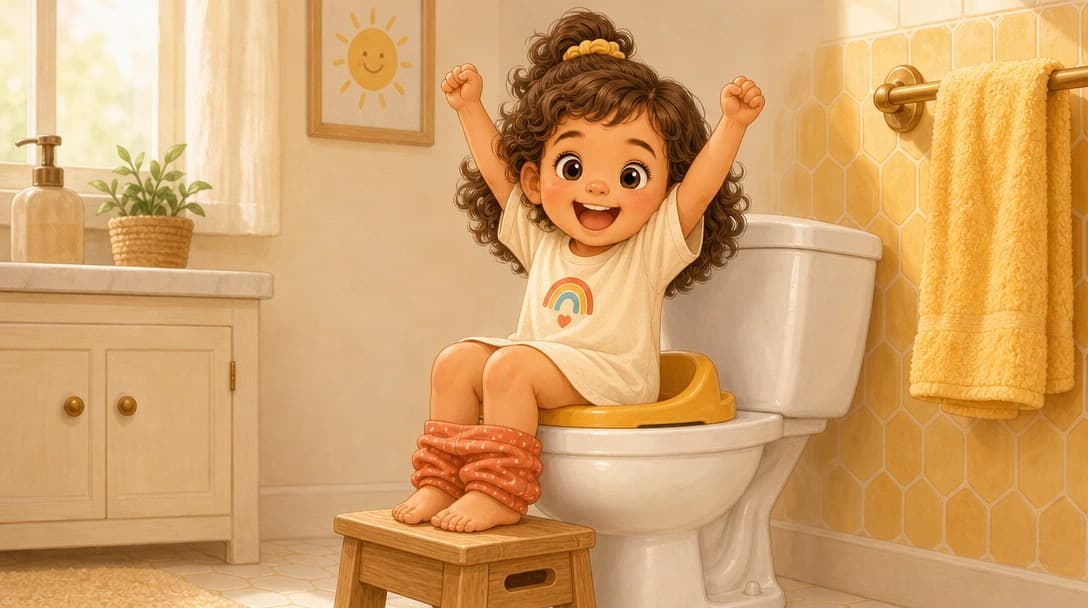
The story for this milestone
Learning the potty by noticing the feeling first
A personalized potty training story: noticing the feeling on the inside, the cold seat and the step stool, a grown-up who waits, and the flush met properly. A 2.5 minute storybook film for ages 2 to 4.
We make it from the details you choose. Your child, by name, in every scene.
Frequently asked questions
- What are the best potty training books for parents?
The three most-cited parent titles are Jamie Glowacki's "Oh Crap! Potty Training" (Touchstone, 2015) for a structured intensive method, Elizabeth Pantley's "The No-Cry Potty Training Solution" (McGraw-Hill, 2007) for a gentle pace, and the free American Academy of Pediatrics healthychildren.org toilet training hub for the pediatric baseline. If you are planning a 3 day run, Julie Fellom's "Diaper-Free Toddlers" workshop materials are the original source.
- What is the best potty training book for a 3 year old?
Most 3-year-olds respond to picture books with characters their own age and a simple story. Good picks are Mo Willems' "Time to Pee" (Hyperion), Leslie Patricelli's "Potty" (still works at 3), and Alona Frankel's "Once Upon a Potty" if your child has not heard it already. For more potty training books for preschoolers, see the 3 to 5 section above. Skip baby-faced characters at this age.
- What age should I start reading potty books?
A few weeks to a few months before active training, and then throughout it. Bedtime reading pairs well with the introduction phase, when nothing is expected yet. A board book at bedtime from around 18 months suits almost any child.
- What is a potty social story?
A short story a parent writes, in the first person, about their own child's real bathroom and real routine. Carol Gray developed the format in 1991 for children with autism, and it also helps children with sensory differences, language delays, bathroom anxiety, or a strong need for visual structure. It mostly describes rather than instructs, and it includes a calm sentence about accidents.
- Does a potty training video help?
It can. Children under 4 learn through play, repetition and seeing themselves in a character more than through instruction, which is the point of the AAP's Power of Play statement. Pick one short, calm video with a character your child's age, watch it together, and treat it as a second teaching channel, not a replacement for the potty, the routine or your voice.
Sources
- Glowacki, Jamie. "Oh Crap! Potty Training" (Touchstone, 2015). Primary parent-side intensive method reference.
- Pantley, Elizabeth. "The No-Cry Potty Training Solution" (McGraw-Hill, 2007). Gentle parent-side alternative.
- Fellom, Julie. "Diaper-Free Toddlers" workshop materials (San Francisco, 2006). Original source of the 3 day method.
- Frankel, Alona. "Once Upon a Potty" (HarperCollins, originally 1975). Classic child-side read-aloud, boy and girl editions.
- American Academy of Pediatrics, healthychildren.org Toilet Training hub. Free pediatric baseline for parents, and context for the training arc.
- American Academy of Pediatrics, "The Power of Play, A Pediatric Role in Enhancing Development in Young Children". Play and story as primary ways young children learn.
- Gray, Carol. "The New Social Story Book" (Future Horizons, revised editions). Primary source for the social story format and sentence ratio.
- National Autistic Society, "Toilet training, advice for parents". Practical guidance on adapting toileting for autistic children.
- Common Sense Media, "Best Potty Training Apps and Videos for Kids". Parent-side reference for evaluating specific videos.
- Common Sense Media, "Best Books for Potty Training". Parent-curated lists for age-range book picks.
FableFleet team
Founders & moms, FableFleet
We're a small team of moms building the personalized children's stories we wished existed for our own kids. Everything we publish is rooted in lived experience and cited research.