
· Updated
When to Start Potty Training: What Age, and the Readiness Signs We Watched For
There is no single right age to start potty training. Pediatricians put the first readiness signs at 18 to 24 months and typical daytime training between 24 and 36 months, and most families start somewhere in between. What tells you it is time is a pattern that holds for about two weeks: dry stretches of two hours, some curiosity about the toilet, simple instructions followed, and a cooperative mood. My daughter showed signs at 16 months and was trained by 18. That was her timing, not a target.
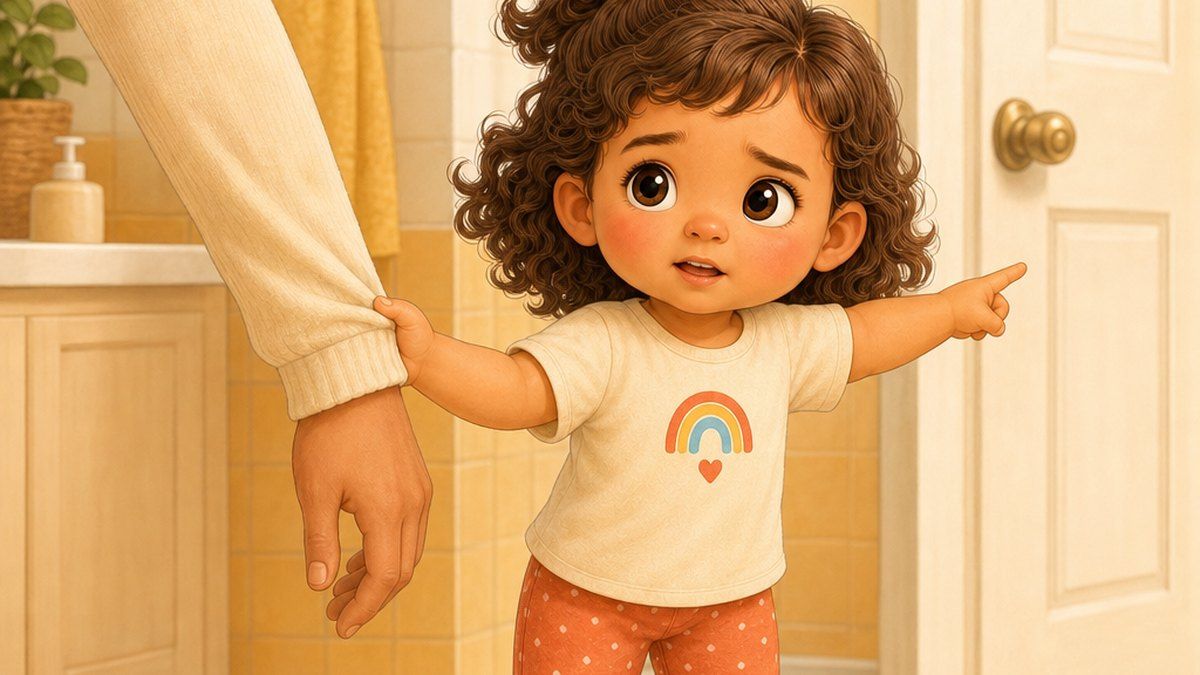
Start when the signs hold, not when the calendar says. Here are the four kinds of ready, a two week way to watch for them, what 18 months really looks like, and the two false starts most families hit.
Free to print: a potty chart with your child's name and a picture for every step.
The four kinds of ready
With our daughter I started watching around 16 months and she was trained by 18, sooner than most. I did not get there by following a calendar. I got there by reading her. We had practiced going diaper free at a family cabin, without fully committing because it was not our own home, and once we were back and I saw the signs hold, we committed. Three days at home, and she was trained.
When I started reading up, I expected a tidy checklist. What the American Academy of Pediatrics describes instead is four kinds of ready, and your child needs a little of each.
Physical. Can walk to and sit on a small potty, stays dry for about two hours at a time, poops at fairly predictable times, and can manage clothes with a little help. The two hour dry stretch is the sign pediatricians keep coming back to. It means you are not asking a body to do something it cannot do yet.
Cognitive. Can follow a simple two step instruction ("walk to the potty, sit down") and has some word for what is going on, even a made up one.
Behavioral. Curious about the bathroom, follows you in to watch, pulls at a wet diaper or asks to be changed.
Emotional. Wants to cooperate, can stay with one thing for a few minutes, and is not at the peak of a "no" phase.
You do not need all four on the same morning. You need enough of each that the picture holds for about two weeks.
The two week watch
A checklist answered in one sitting tells you less than two weeks of noticing. For ten to fourteen days, with no commitment to start, jot down:
- When the diaper is wet. Three checks a day. Wetness that clusters after meals and naps, and dry stretches getting longer, are strong physical signs.
- What happens right before a poop. Hiding, going quiet, a particular spot, a focused face. A child with a clear tell is closer than one whose poops happen mid play with no warning.
- Interest moments. Following you to the bathroom, asking about the toilet, watching another child on a potty. Three to five in two weeks is a useful bar.
- Two step instructions. Done within about ten seconds of being asked?
Four out of four and your child is ready. Two missing, wait three to four weeks and watch again. The waiting is the part that pays you back.
The range, not the number
I figured a pediatric source would hand me a number. What the AAP gives is a window: 18 to 24 months for early readiness, 24 to 36 for typical daytime training. The research underneath it, back to Brazelton in 1962, says readiness predicts success better than age does. My daughter landed at the very early end, and I want to be clear that it worked only because her body was ready, not because eighteen months is a magic number.
18 to 22 months. Start here only if several signs are clearly there: two hour dry stretches at most checks for two weeks, interest in the bathroom, two step instructions followed, a cooperative stretch. Two or fewer showing, wait.
22 to 30 months. The big middle, where most families start and the signs are easier to read. Do the two week watch, pick a method that fits your house (the comparison is in potty training methods), get daycare on board, and decide in advance that a pause and restart is allowed. It is the most underused move at this age because it feels like quitting. It is not.
Over 30 months. A later start does not mean a worse outcome. Plenty of children who train at 32 or 36 months finish fast because they are more mature. Ask why it has not started: usually a missed signal, a big change, or a fear (a loud flush, something that scared them once). Deal with that first, then start the way you would at any age. Past four with no interest and no progress, bring it to your pediatrician.
Why earlier is not faster. Starting age and time to finish are not a straight line. Children started before they are ready often take two to three times longer than children started once readiness shows. A clean three week run at 28 months is easier on everyone than a messy eight week slog from 22. The choice was never earlier is better. It is that ready is faster.
Two things people will tell you that you can let go of: that earlier is better (no medical evidence backs it) and that boys take forever (the gap is a couple of months on average, smaller than the difference between one child and the next). Starting with a boy? How to potty train a boy covers sitting first.
18 months: introducing, not training
My own daughter is the reason I am careful here. She was an early ready kid, and I do not want anyone reading her timeline as the schedule every 18 month old should be on. For most children, 18 months is the runway.
Introducing is right for nearly any 18 month old: a small floor potty in the room where your child plays (sitting on it, ignoring it and climbing on it all count), a short potty book at bedtime once or twice a week (picks in best potty training books), the same cue words every time, and saying what is happening when a grown-up uses the bathroom. Children learn this by watching more than by being told.
Signs an 18 month old might be ready to train: three or more of these, steady for two weeks: dry for two hours at most checks, predictable poop times, interest in the toilet or a wet diaper, two step instructions followed, a word or gesture for pee or poop, and a few minutes of focus without distress.
Training a ready 18 month old is gentler than with an older toddler. A small floor potty, because a seat insert is usually too high for a body this small (ours was a duck that basically lived in the truck). Sit at predictable moments, after waking, after meals, before nap and bath, for two to five minutes. Keep the naked phase to a day or two. Keep diapers for naps and nights for a long while. Praise the steps, not only the result: "You walked to the potty. You sat down. That is exactly right." And expect a longer run: eight to sixteen weeks for daytime is normal at this age, where an older toddler might take two to four.
The two false starts
Starting because the calendar said so. "She is 22 months and most kids start around then" is not a reason if she is not showing the signs. It buys weeks of frustration and a child who loses interest. If you started and it is going badly, stop: "We are going to take a break from the potty. The diapers are fine for now." Wait three to six weeks and try again with a clean slate. The pause is the fix.
Waiting because the obvious signals never showed. Some children show readiness so quietly you miss it. They do not bring you a clean diaper or announce anything. They watch, and one day you realize they have been ready for a month. If your child is well into their third year and you have not started, leave the potty in the room they play in, read a book about it at bedtime, and look for the small unprompted moves.
The badge. The internet hands out a lot of credit for "trained at 18 months," and that pressure sneaks into decisions. I say this as the parent of an early ready kid, so I have felt the pull of wanting to claim it. A child who trains at 26 months in a clean five weeks is not behind one who struggled for six months from 19. The total work is set by readiness; starting earlier does not move it up the calendar, it piles more on. If a relative is pushing: "Our pediatrician says to follow the readiness signs, and we are still watching." Repeat as needed.
Daycare
When daycare uses the same cue and routine, your child gets many more hours of practice and training moves faster. Different words or a different schedule there can stretch it out by months. Before you start, ask three things: what words they use, what they do at an accident, and when they switch from pull-ups to underwear. Then match your home routine to it. Ours moved my daughter up a room once she was trained, which told me they were watching the same milestone we were.
Free printable
A potty chart with your child's name on it
A picture of Nia for every step, so a child who cannot read yet can follow it. Nothing you type leaves your device.
Steps on the chart (pick 3 to 5)
Start with steps your child can already nearly do. A full row on the first day is the point.
The name and goal go into the print page in the address after the #, which your browser never sends to us. We cannot see them. How to use a potty chart so it helps.
Color in a lamp each time. Every lamp counts, and a lamp is never taken away.
 I told a grown-upbefore it happened
 I sat on the pottyeven for a minute
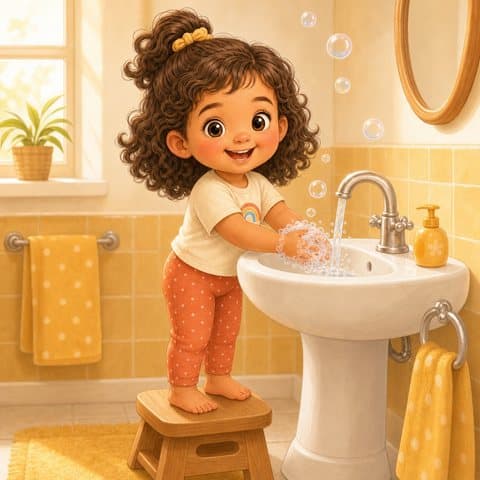 I washed my handssoap and a song
 Dry all morningor all afternoon
 When the chart is full
 The week before you start
Setup, not training. Put the small potty somewhere visible. Read a potty book or two at bedtime with nothing attached to it. Let your child sit on the potty fully clothed. Buy the underwear together and let them choose; the underwear itself does real motivational work. Tell your child once, calmly, "Next week we are going to start using the potty in the day," then drop it. And have your one calm accident sentence ready from the first hour; potty training accidents has the one we used, and the free potty chart is built around rewarding the trying, which is what the first week is.
How FableFleet fits
Once you have read the signs and decided it is time, the lead up is where a story earns its keep. Our potty story is a personalized storybook film where your child is the main character, by name, made for ages 2 to 4: noticing the feeling on the inside, the cold seat and the step stool, and a grown-up who waits, right up to the flush. A quiet way to make the new thing feel familiar before day one. I did not have it for my daughter; FableFleet did not exist yet.
More in Potty Training
- Potty Training Methods Compared: 3 Day, Oh Crap and Child-Led, and What Worked for Us
There are three potty training methods worth knowing: child-led, which pediatricians default to and takes weeks to months; the 3 day method, three days at home with no diaper; and Oh Crap, the same idea spread over one to two weeks in stages. All three work for a child who is ready, and none of them works for a child who is not. We did three days at home with our daughter. The method gave the training a shape; her readiness did the rest.
- Best Potty Training Books for Toddlers, Preschoolers and Parents
The best potty training books come in two kinds. For parents: Oh Crap (Glowacki), The No-Cry Potty Training Solution (Pantley) and the free American Academy of Pediatrics toilet training hub. For toddlers: Once Upon a Potty (Frankel), Potty (Patricelli) and A Potty for Me (Katz). Preschoolers need characters their own age and a real story: Time to Pee (Willems) and Everyone Poops (Gomi). Skip anything with shame, a promised timeline or a checklist on the back. And the most specific potty book there is, you write yourself.
- How to Potty Train a Boy: Sitting First, Standing Later
To potty train a boy, start him sitting for both pee and poop, and add standing only once sitting is fully reliable. That is the position of the American Academy of Pediatrics, the Mayo Clinic and Nemours. Boys finish a couple of months later than girls on average, but the gap is small next to how different one child is from the next. We trained our daughter; our son's turn is still ahead. This is the pediatric guidance on boys, next to what carries over from doing it once.
- Night Time Potty Training and Pull-Ups: When to Switch, and When to Wait
Night dryness is mostly body, not behavior. A hormone that slows urine overnight and a bladder big enough for the whole night both have to grow in, and that often comes months or years after daytime training. Wet nights are normal up to age five or six. In the day, cotton underwear teaches the cue because your child feels wet; pull-ups muffle it, so they belong to naps, nights and travel. Wait for the dry morning signal before switching to underwear at night. Our daughter's nights came on their own, a good while after her days.
- Potty Training Accidents and Regression: What They Mean and What to Say
Potty training accidents are normal: three to eight a day in week one, one to three in week two, close to none by week four. Say one short, calm sentence every time; ours was "that's okay, accidents happen." When accidents come back after a child was dry, that is a regression, and it is usually information: a new sibling, a move, a daycare change, an illness, or the one most parents miss, constipation. Most regressions settle in two to four weeks.
The story for this milestone
Learning the potty by noticing the feeling first
A personalized potty training story: noticing the feeling on the inside, the cold seat and the step stool, a grown-up who waits, and the flush met properly. A 2.5 minute storybook film for ages 2 to 4.
We make it from the details you choose. Your child, by name, in every scene.
Frequently asked questions
- Is 2 too young to start potty training?
For some children, yes, and for others, no. The American Academy of Pediatrics puts the early readiness window at 18 to 24 months, and some children show clear readiness by 22 to 24 months while others not until 28 to 30. Age is a range, not a starting gun. Readiness is the real signal.
- Is 3 too late to start potty training?
No. A large share of children daytime-train between 3 and 4, which is within the normal range. A later start often goes faster because the child is more mature. If your child is well past 4 and showing no interest at all, mention it at your next pediatric visit.
- Is 18 months too early to potty train?
For most children, 18 months is the introduction phase rather than active training: the potty is out, the words are named, nobody expects anything. A small number of 18-month-olds show three or more readiness signs steadily for two weeks, and for them a gentle early start can work. If the signs are not there, wait six to twelve weeks and look again.
- How do I know my child is ready for potty training?
Look for four kinds of ready: physical (dry for about two hours, poops at fairly predictable times), cognitive (follows a simple two-step instruction), behavioral (curious about the toilet, pulls at a wet diaper) and emotional (wants to cooperate, can focus for a few minutes). You want a pattern that holds for about two weeks, not one good morning.
- Should I wait for summer to start potty training?
Summer can be easier because of fewer layers and bare legs outdoors, but the season matters less than readiness. If the signs are there in February, do not wait six months for warm weather. If they are not there in June, the long days will not create them.
Sources
- American Academy of Pediatrics, "The Right Age to Potty Train". The 18 to 24 month readiness window, the 24 to 36 month range for daytime training, and readiness over age.
- American Academy of Pediatrics, healthychildren.org Toilet Training hub. The four kinds of readiness and the two-hour dry stretch.
- Mayo Clinic, "Potty training, How to get the job done". Readiness signs, including staying dry for about two hours.
- Brazelton TB. "A child-oriented approach to toilet training." Pediatrics. 1962;29,121-128.. Foundational research showing readiness predicts success better than age.
- KidsHealth / Nemours, "Toilet Training". Plain-language readiness signs and timing.
FableFleet team
Founders & moms, FableFleet
We're a small team of moms building the personalized children's stories we wished existed for our own kids. Everything we publish is rooted in lived experience and cited research.