
· Updated
Night Time Potty Training and Pull-Ups: When to Switch, and When to Wait
Night dryness is mostly body, not behavior. A hormone that slows urine overnight and a bladder big enough for the whole night both have to grow in, and that often comes months or years after daytime training. Wet nights are normal up to age five or six. In the day, cotton underwear teaches the cue because your child feels wet; pull-ups muffle it, so they belong to naps, nights and travel. Wait for the dry morning signal before switching to underwear at night. Our daughter's nights came on their own, a good while after her days.

Run day and night as two separate projects. Cotton in the day from the first morning. Pull-ups at night until the mornings come up dry on their own. Here is why night takes longer, how underwear, training pants and pull-ups differ, the signal to wait for, and when bedwetting is worth a call.
Free to print: a potty chart with your child's name and a picture for every step.
Why night takes longer
Honestly, this is the part I never trained at all. My daughter was daytime trained at eighteen months, and night came on its own a good while after. What tipped me off was the morning diaper being empty, day after day, until one morning I realized I was putting a dry diaper on a kid who did not need it. So we stopped. She still wakes up to pee sometimes, but not often, and the whole thing happened without a chart or an alarm or a pep talk.
The thing nobody told me clearly: daytime and nighttime are barely the same project. Daytime is learning to read a body cue and act on it. Nighttime is plumbing, and two things have to grow in first. A hormone, vasopressin, concentrates urine during sleep so the bladder fills slowly; for some children it is there early, for others not fully until five or six, and nothing a child does can hurry it. And the bladder has to be big enough for a whole night, which also fixes itself with growth. The American Academy of Pediatrics and the NHS both say occasional wet nights up to five or six are normal, and regular bedwetting up to seven is not unusual. The gap between day and night is expected. It is not you failing, and it is not your child failing.
Daytime first: underwear, training pants or pull-ups
We skipped the slow transition entirely. When my daughter trained we went straight to big kid underwear from day one, no pull-up middle step at home, and the underwear itself was part of the motivation. Ours was Peppa Pig. She did not want to get those wet, and that mattered to her in a way a pull-up never could, because a pull-up feels like a diaper and Peppa Pig on cotton feels like a thing worth protecting.
The difference between the three comes down to one question: how fast does your child feel wet? Plain cotton holds almost nothing, so they feel it instantly; the bluntest tool and the most effective for teaching the cue. Training underwear is cotton with a padded middle: it holds a small accident long enough to reach a bathroom, and they still feel it right away. Pull-ups hold about as much as a diaper and feel mostly dry even after a full accident. Feeling wet is what links the body cue to the potty. Pull-ups muffle it; cotton keeps it loud and clear.
So: daytime at home, from the first day, cotton or training underwear, not pull-ups. Outings in weeks one to three, a judgment call either way: cotton plus a full change of clothes, or pull-ups for the first outing or two, then underwear once your child is catching the cue at home. Naps and nights, pull-ups until the dry morning signal holds.
If daytime training has stalled in pull-ups, the cue is muffled and, for some children around two and a half to three, the pull-up has become a permission slip. Switching to underwear for two weeks is one of the best moves you have. The first three days are messy. Then it speeds up.
Before day one: fifteen to twenty pairs of cotton or training underwear (the high count is first week laundry), a small pack of pull-ups for naps, nights and outings, a waterproof mattress cover, a wet bag for the diaper bag, and spare pants. For boys the underwear choice is the same while they are sitting; how to potty train a boy covers the standing switch.
When pull-ups are exactly right
Pull-ups at night are not failure and not a regression. They are scaffolding while the body catches up. A child who is daytime trained at 26 months and in night pull-ups through age four is squarely in the normal range. The moments they are right: naps and nights until the signal holds, long car trips, the first outing or two, and sleeping somewhere new. Name them as a tool for a moment, not a default. "We are wearing a pull-up for the airplane" lands very differently from "we are wearing pull-ups today," and children notice.
When my daughter sleeps somewhere that is not her own bed, a cabin, a grandparent's house, a hotel, she still goes into a night diaper. A strange room, a hallway she does not know, being up later than usual, often with more to drink than a normal night: it all stacks the odds against a dry bed. It is not a regression. It is a sensible choice for an unfamiliar place, and it goes back in the drawer when we are home. If a grandparent or daycare is pushing you to be done with night pull-ups: "Our pediatrician says this is normal, and we are waiting for the dry morning signal."
The dry morning signal
If daytime is not settled yet, start with when to start potty training and potty training methods, and give it about three months of solid daytime before you think about nights. Ours were months apart, and night came without us doing anything.
The green light has three parts: dry after naps, consistently; two or three dry mornings in a row, with nothing different on your side and no alarm; and some interest in being dry at night or questions about wearing underwear to bed. When all three are there, start the switch. Until they are, the body is telling you it is not ready, and pushing will not move the biology an inch.
Making the switch
Once the signal has held for about a week: ease off big drinks in the last two hours before bed (a sip is fine, a full cup is what you are avoiding), one last pee at lights out, a waterproof mattress cover that stays on for six months, and a low key heads up: "We are trying underwear tonight." Information, not an announcement or a chart. Some pediatricians suggest one lift to the toilet before you go to bed yourself; others prefer not to break sleep. Try it and see. Most children make the switch within two to four weeks.
Wet nights after the switch. There is usually at least one, so have the words ready: "Your bed got wet, that is okay, we will clean it up and try again tomorrow." The same "that's okay, accidents happen" tone from the daytime, and it carries over. A few wet nights in the first month are normal. Go back to pull-ups for a month or two if you see two or more wet nights a week for three to four weeks, wet nights along with new daytime accidents or constipation, or a child who is upset about the wetting itself. Going back is an adjustment, not a setback: "Your body needs a little more time, and that is fine." For the daytime side of accidents and how constipation plays in, see potty training accidents and regression.
What the guidance does not back: punishing wet beds, big reward systems for staying dry, or holding back drinks for long stretches. The first two hurt the relationship without changing any biology; the third edges toward dehydration without speeding anything up.
Free printable
A potty chart with your child's name on it
A picture of Nia for every step, so a child who cannot read yet can follow it. Nothing you type leaves your device.
Steps on the chart (pick 3 to 5)
Start with steps your child can already nearly do. A full row on the first day is the point.
The name and goal go into the print page in the address after the #, which your browser never sends to us. We cannot see them. How to use a potty chart so it helps.
Color in a lamp each time. Every lamp counts, and a lamp is never taken away.

 I told a grown-upbefore it happened
 I sat on the pottyeven for a minute
 I washed my handssoap and a song
 Dry all morningor all afternoon
 When the chart is full
 When to talk to your pediatrician
Most bedwetting never needs a doctor. It is worth a conversation if wet nights start again after six months of dry ones, frequent bedwetting continues past seven, peeing is painful, wet nights come with new daytime accidents, or your child is upset enough that it affects their sleep or their mood. For older children with frequent bedwetting, usually six and up, the AAP, NHS and KidsHealth all point to a bedwetting alarm as the first step; under five or six, the hormone and bladder are still growing and an alarm tends to bring frustration instead of dry nights. Talk to your pediatrician before you buy one.
How FableFleet fits
Night dryness is mostly a waiting game, and the daytime milestone that comes first is where a story helps. Our potty story is a personalized storybook film where your child is the main character, by name: noticing the feeling on the inside, the cold seat and the step stool, and a grown-up who waits, right up to the flush. Listening to their own body is something they get to watch go well before they do it. I did not have it for my daughter; FableFleet did not exist yet.
More in Potty Training
- Potty Training Methods Compared: 3 Day, Oh Crap and Child-Led, and What Worked for Us
There are three potty training methods worth knowing: child-led, which pediatricians default to and takes weeks to months; the 3 day method, three days at home with no diaper; and Oh Crap, the same idea spread over one to two weeks in stages. All three work for a child who is ready, and none of them works for a child who is not. We did three days at home with our daughter. The method gave the training a shape; her readiness did the rest.
- Best Potty Training Books for Toddlers, Preschoolers and Parents
The best potty training books come in two kinds. For parents: Oh Crap (Glowacki), The No-Cry Potty Training Solution (Pantley) and the free American Academy of Pediatrics toilet training hub. For toddlers: Once Upon a Potty (Frankel), Potty (Patricelli) and A Potty for Me (Katz). Preschoolers need characters their own age and a real story: Time to Pee (Willems) and Everyone Poops (Gomi). Skip anything with shame, a promised timeline or a checklist on the back. And the most specific potty book there is, you write yourself.
- How to Potty Train a Boy: Sitting First, Standing Later
To potty train a boy, start him sitting for both pee and poop, and add standing only once sitting is fully reliable. That is the position of the American Academy of Pediatrics, the Mayo Clinic and Nemours. Boys finish a couple of months later than girls on average, but the gap is small next to how different one child is from the next. We trained our daughter; our son's turn is still ahead. This is the pediatric guidance on boys, next to what carries over from doing it once.
- Potty Training Accidents and Regression: What They Mean and What to Say
Potty training accidents are normal: three to eight a day in week one, one to three in week two, close to none by week four. Say one short, calm sentence every time; ours was "that's okay, accidents happen." When accidents come back after a child was dry, that is a regression, and it is usually information: a new sibling, a move, a daycare change, an illness, or the one most parents miss, constipation. Most regressions settle in two to four weeks.
- When to Start Potty Training: What Age, and the Readiness Signs We Watched For
There is no single right age to start potty training. Pediatricians put the first readiness signs at 18 to 24 months and typical daytime training between 24 and 36 months, and most families start somewhere in between. What tells you it is time is a pattern that holds for about two weeks: dry stretches of two hours, some curiosity about the toilet, simple instructions followed, and a cooperative mood. My daughter showed signs at 16 months and was trained by 18. That was her timing, not a target.
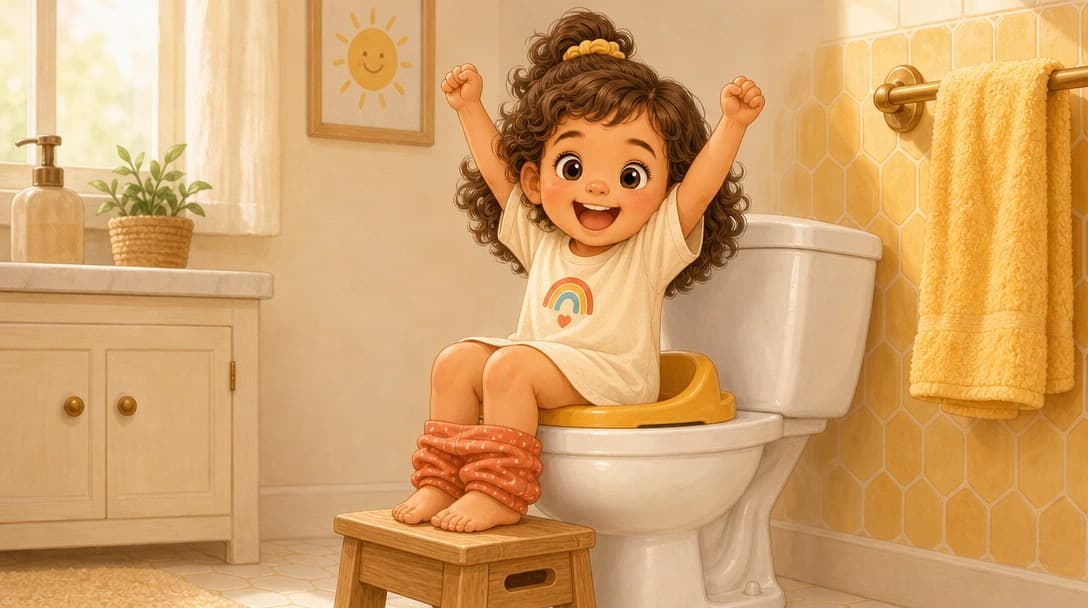
The story for this milestone
Learning the potty by noticing the feeling first
A personalized potty training story: noticing the feeling on the inside, the cold seat and the step stool, a grown-up who waits, and the flush met properly. A 2.5 minute storybook film for ages 2 to 4.
We make it from the details you choose. Your child, by name, in every scene.
Frequently asked questions
- When should you start night time potty training?
Wait until daytime training has been steady for about three months, then watch for the dry-morning signal: dry after naps, two or three dry mornings in a row with nothing changed, and some interest in being dry. Until then, pull-ups at night are the right answer, not a sign of failure.
- How long does night time potty training take?
Once the dry-morning signal is steady, most children make the switch to underwear at night within two to four weeks. For some, that signal does not arrive until age 5 or 6, which is normal. Regular bedwetting up to age 7 is not unusual and rarely means anything is wrong.
- Should I wake my child to pee at night?
Some pediatricians suggest a single lift, carrying your sleepy child to the toilet before you go to bed yourself, for a few weeks during the switch. Others find broken sleep does not help in the long run and prefer to wait for the body to be ready. Both have support. Try one, watch, and adjust.
- When should I switch from pull-ups to underwear in the day?
From the first day of active training. Cotton underwear lets your child feel wet right away, which teaches the body cue; a pull-up feels mostly dry and muffles it. Keep pull-ups for naps, nights and travel, and for the first outing or two if you like.
Sources
- American Academy of Pediatrics, "Bedwetting". Vasopressin and bladder capacity, normal age ranges for wet nights, and first steps including alarms for older children.
- NHS, "Bedwetting in children". Normal bedwetting through age 5 to 7, and the pull-ups-at-night framing.
- American Academy of Pediatrics, healthychildren.org Toilet Training hub. Pediatric framing of underwear and pull-ups during daytime training.
- Mayo Clinic, "Potty training, How to get the job done". Day and night as separate milestones.
- KidsHealth / Nemours, "Toilet Training". Night dryness lagging daytime, and bedwetting alarms for older children.
FableFleet team
Founders & moms, FableFleet
We're a small team of moms building the personalized children's stories we wished existed for our own kids. Everything we publish is rooted in lived experience and cited research.