
· Updated
Bedtime Stories for 3 Year Olds (and 2 and 4): How to Pick One That Actually Settles Them
By Amanda and Ashley, two moms with four kids between us
The best bedtime story for a 3 year old is not the best book. It is the one where nothing much happens. Here is how to judge any story you already own in thirty seconds, the books parents keep naming and what each is good for, why the same story every night beats a new one, and what changes at 2, 3 and 4.
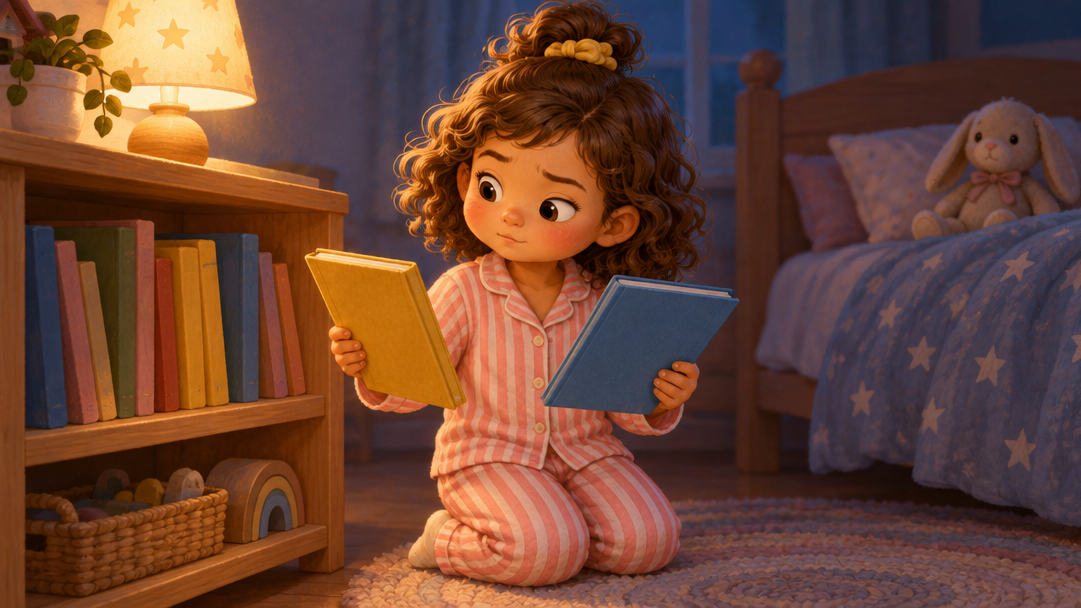
I spent about a week auditioning bedtime stories, a different one every night, when my 3 year old would not settle in a very bright room at my grandparents' house. Some had millions of plays. Several were lovely. They made things worse, and it took me several nights to work out why: they were built to hold her attention, and holding attention is exactly the wrong job for the last ten minutes before sleep.
That is the problem with recommendation lists. They answer whether this is a good story for a 3 year old, and at bedtime that is not the question. The question is whether it helps a child stop paying attention. So rather than another list of bedtime stories for 3 year olds, here is how to judge any story you already own, what the books parents actually name are rated for, and what changes at 2, 3 and 4.
Finn's Bedtime is a free guided routine in the FableFleet app: see how a night with Finn goes. Prefer paper? the free bedtime routine chart.
The four tests for a bedtime story
These came out of that week, not out of a textbook, and they have held up since.
How much happens. The most reliable single test. A character who wants something, is thwarted, and succeeds is a plot, and a plot is a reason to stay awake. What you want is closer to a description: a place, a rhythm, a small gentle sequence with nothing at stake. If you can summarize it as not much, pleasantly, it is a bedtime story.
The pace of the language. Read a page aloud and listen to yourself. Short punchy sentences keep a brain tracking. Longer, repetitive, rolling sentences let it drift. Repetition is doing real work here, which is why the traditional bedtime books repeat phrases over and over.
How it ends. A bang, a joke, a twist, a triumphant resolution: endings like that are small events, and events wake people up. You want a last page quieter than the one before it.
Does it ask them to join in. Flaps, counting, questions on every page, join-in noises. All of these ask your child to do something, and doing something is the opposite of letting go. Wonderful books. Wrong moment.
A story that passes all four will strike you as slightly dull. That is the correct response. You are not the audience.
A bedtime story for a 3 year old: Finn Hears It First
This is the story Finn tells in Finn's Bedtime, the bedtime routine in our app, and it is built on the four tests above. Read it slowly, in your quietest voice. After each "Do you?" leave a pause so your child can guess.
The house is quiet, and Finn is listening.
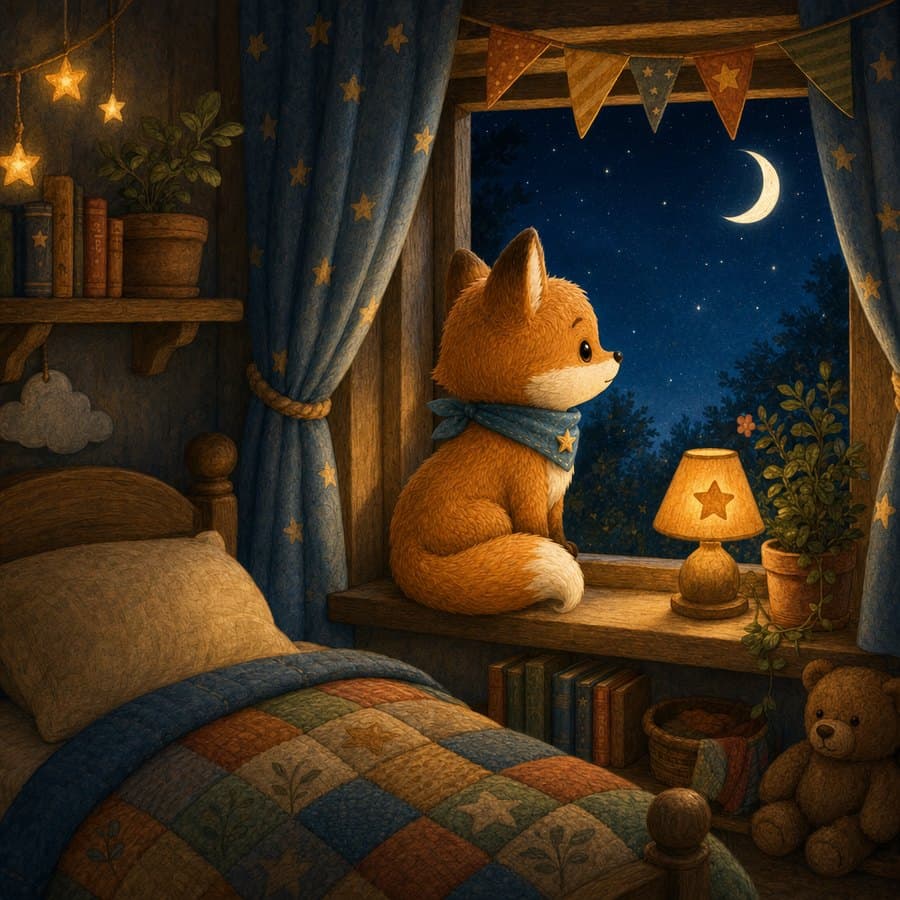
You are in bed. Your stuffy is in bed. And Finn is at the window, where he always is at this time of night. His tail is curled around his paws. His ears are up.
Finn has one wish tonight. He wants to hear the very last sound of the night. When the last sound comes, Finn knows that everyone is asleep. And then Finn can sleep too.
So Finn listens.
Something, somewhere, is humming. Finn's ears turn. Finn knows what it is. Do you?
It is the fridge, in the kitchen. It hums all night, a low, warm hum. It keeps the milk cold, and the butter cold, and the little bit of cheese cold.
Is that the last sound of the night? Not yet.
Just the house, saying goodnight.
Now there is a creak. A long, slow creak, from the hall. Finn's ears turn. Finn knows what it is. Do you?
It is the floor. All day long, the floor is walked on. Lots of feet, and the chair being pushed in, and somebody running when they were told not to. Now nobody is walking on it, so it stretches. The way you stretch when you get into bed. A long, slow stretch, and a little creak at the end.
Is that the last sound of the night? Not yet.
Just the house, saying goodnight.
In the kitchen, there is a small sound, and then a smaller one. Finn's ears turn. Finn knows what it is. Do you?
It is the kettle. It was busy at dinnertime. Now it is cooling down, and as it cools, it makes one small sound, and then it is quiet. Done for the day.
Is that the last sound of the night? Not yet.
Just the house, saying goodnight.
By the wall, there is a tiny tick. Finn's ears turn. Finn knows what it is. Do you?
It is the radiator. It has been warm all evening. Now it is letting the warm go, a little at a time. Every time it lets some go, it makes a tiny tick. The ticks get further and further apart. Finn likes them.
Is that the last sound of the night? Not yet.
Just the house, saying goodnight.
Then, on the wall, something moves. A shadow. A shape with a point on the end. Finn's ears go flat. He looks at it. It looks at him. It moves when he moves.
Finn turns around, very slowly, and looks behind him.
It is his tail. It is always his tail.
Finn turns back to the window and sits up a little straighter, the way you do when nobody saw. His tail curls back around his paws, where it belongs.
By the front door, two somethings are resting after a long day of running around. They do not make a sound. Finn listens anyway. That is the kind of listener Finn is. Finn knows what they are. Do you?
It is the shoes. Nobody needs them now. They will be right there in the morning, ready for the day.
Is that the last sound of the night? No. The shoes did not make a sound at all.
Just the house, saying goodnight.
Downstairs, there is a click. Finn's ears turn. Finn knows what it is. Do you?
It is the lamp in the living room. A grown-up has turned it off. Now that room is dark and cozy too, and the grown-up is going to bed.
Is that the last sound of the night? Not yet. Almost.
Just the house, saying goodnight.
Outside, the wind comes along the street. It tries the door. Once. A soft push, to see if the door is shut. The door is shut. The wind goes on down the street.
But the wind comes back. A little louder this time. It leans on the window, right where Finn is sitting, and the glass hums. Finn is small. The wind is big. And Finn says, very quietly, so only you can hear him: that one was a bit loud.
You know what to tell him. You can whisper it.
It's just the wind, Finn.
Finn's tail settles. His ears come back up. He heard you.
The wind leans on the window one more time, gently. Then it goes on its way, and it does not come back.
Just the wind, saying goodnight.
Now the house is still. The fridge is humming, low and warm. The floor has finished stretching. The radiator gives one last tiny tick. The lamp is off.
Everything feels heavy and sleepy. Your blanket feels heavy and warm. Your arms are heavy. Your eyes are heavy.
Finn listens. Is there one more sound?
There is. A slow, soft sound. It is coming from your bed.
It is you, breathing.
Breathe in, slowly. And breathe out, slowly.
In. And out.
That is the last sound of the night. Finn heard it first.
Now Finn knows. Everyone is safe, and everyone is warm, and everyone is sleepy.
Finn stays awake until you are asleep. Then, and only then, he curls up on the windowsill, with his tail over his nose, and he sleeps too.
Goodnight.
Just the house, saying goodnight.
Today you can hear Finn tell this story, with your child's name in it, and do the whole bedtime routine free in our app.
The bedtime books parents name, and what each is good for
These are the ones parents name most, with the age the reviewers give and what each one is good for.
- Goodnight Moon. Rated 2 and up; parents say 3. The goodnight-to-the-room ritual every house owns. The reviewers say pediatricians recommend a bedtime routine, something familiar and soothing, and praise the pace, rhythm and repetition. The recurring one-star complaint is that it is boring, which by the tests above is the point, and one satire notes it hands a child a new way to stall: saying goodnight to everything.
- The Going to Bed Book. Rated 2 and up. The one picture book that is literally a routine: wash, pajamas, teeth, exercise, bed. Short and funny. The exercise page is the only lively one.
- Llama Llama Red Pajama. Rated 3 and up. The book about the curtain call itself, calling for Mama. The reviewers say "young children experiencing separation anxiety at bedtime will find reassurance." It has a plot, so it is an early-evening book in our house, not the last one.
- Time for Bed. Rated 2 and up. Animal parents putting animal babies to bed, rhyming, soft. Passes all four tests.
- Bedtime for Frances. Rated 4 and up. The stalling book: water, a kiss, a tiger, a giant, the crack in the ceiling. Older than this page's band, funny for a 4 year old, and a plot.
Pick by the tests, not the list. The American Academy of Pediatrics' Brush, Book, Bed page keeps it to one line: read a favorite book, or two.
The same bedtime story every night
Three year olds ask for the same book until you can recite it, and the instinct is to introduce variety. At bedtime, variety is working against you. Familiarity is what lets attention disengage. A story your child has heard twenty times has no surprises left, so there is nothing to stay awake for, and the opening lines become a signal in their own right, the way the bathroom light going off is a signal. This is the mistake I was making that whole week: every night a new story, every night a fresh reason to pay attention.
Read the new books earlier in the evening. Keep the last one boring and identical.
Bedtime stories at 2
Short, and the pictures do the work. One book, the same one most nights, and the pediatricians' "Read a favorite book (or two)!" is already generous at this age. The routine around it matters more than the book: Mindell's study of 10,085 children found that the more consistently a bedtime routine is done, and the younger it starts, the better. A board book that survives being chewed is the right book.
Bedtime stories at 3
Language has arrived, and so has stalling. One more is the whole game, so the Canadian Paediatric Society's line is the one to use: "Set limits, such as how many books you will read together, be sure your child knows what they are, and stick to them." Two books, said before the first one. This is also the age the researchers single out: a language-based bedtime routine at age three predicted higher language abilities later. The story is not a treat. It is doing work.
Bedtime stories at 4
Four is exactly the age for dinosaurs, sharks and enormous machinery, and that appetite is worth feeding. It just does not go last. The exciting story happens before pajamas and the quiet one is the final step. Because the order is fixed, it stops being a negotiation after a few nights: the answer to can we read the dragon one is yes, and then. Fears show up at 4 too, and the CPS says not to ignore bedtime fears; a book with a monster in it moves to daytime for a while.
Reading or audio bedtime stories
Different tools, different jobs. Reading together is closeness, and for a lot of parents it is the best fifteen minutes of the day. The pediatricians' line is that "even just 15 minutes each day, to read aloud together will help improve your child's language development and social-emotional skills." Its limit is that it ends when you stop, and stopping is itself a transition.
Audio keeps going while you leave, and a good one fades out on its own, so the end arrives gradually rather than as an event. The pediatricians' own suggestion for the parent asking about videos at bedtime is sleep stories instead. The catch is that most audio for children is made to be engaging, so choose slow, one narrator, no music with a beat, and autoplay off. The thirty second test for bedtime stories on YouTube is below.
Plenty of families do both: a book together, then something quiet as they settle. That is what we do. The book is hers to choose, early. The last thing is the story in Finn's Bedtime, free in our app, which says her name and ends in the dark, built against exactly the tests above.
What she heard in a YouTube bedtime story
The week I tried a different YouTube bedtime story every night, phone face down, they wound her up every time. What she heard was a story made to be watched: a lively narrator doing voices, music underneath, a hook in the first minute, and something happening every twenty seconds so nobody clicks away. It was good at its job. Its job was the opposite of mine.
The American Academy of Pediatrics gets asked about toddlers and YouTube at bedtime, and their suggestion is sleep stories and singing, reading or storytelling instead. A story you listen to. That is the right answer, and it is also where I went wrong for a week, because not every story you listen to is a sleep story.
Bedtime stories on YouTube: the thirty second test
You can sort most of them in thirty seconds. Close your eyes and listen.
- The voice. Does it rise and fall, do characters get different voices, is there acting in it? Performance is engagement. You want one volume, one pace, slightly monotonous.
- The music. Any bed of music with a rhythm is keeping time, and keeping time keeps a brain tracking. Ambient texture is fine. A tune is not.
- The first minute. Did anything happen? A problem introduced, a character in trouble, a question raised? A hook is a reason to stay awake.
- Your own reaction. The most reliable test. If you find yourself mildly interested, it is too interesting.
- The ending. Does it resolve with a flourish, or fade? A satisfying finish is a small event, and events wake people up.
Bedtime stories on YouTube: turn off autoplay
Of everything on this page, this is the one I would change first. A child who is nearly asleep gets pulled back by a new voice, new music and a new opening, and because you are usually out of the room by then, you do not notice for several minutes. It undoes the wind-down in fifteen seconds at the most fragile moment of the evening. The pediatricians name autoplay as a feature not built with children in mind. Turn it off in settings ahead of time, when you are not in the middle of bedtime, or use something with a fixed ending or a sleep timer so silence arrives on purpose.
A practical way to sort the bedtime stories you own
Take the books in the bedroom and make three piles.
- Bedtime pile. Passes the four tests. Usually smaller than people expect; three or four books is plenty.
- Early evening pile. Great books that are too engaging for last thing. Adventure, jokes, flaps. Not demoted, just moved.
- Daytime pile. Counting, learning, anything interactive. Not part of the evening at all.
Leave only the bedtime pile in the bedroom. Half of bedtime story trouble is a bookshelf offering thirty options at the moment a child is looking for a reason to stay up. Two or three choices is agency. Thirty is a negotiation. Re-sort it every few months; a book that was too exciting in the spring is often exactly boring enough by the autumn.
A story is the last step of a wind-down, not a replacement for one. The shape of the routine, the half hour and the order, is in bedtime routine for 3 year olds.
More in Toddler Bedtime
- Bedtime Routine for 3 Year Olds: What Works at Our House, and What the Research Actually Says
Our bedtime routine takes about half an hour, and it is the same every night: pajamas, teeth with a song, potty, Bunny and a cuddle, a few lines we say together, then a story. Lights out around 7:30. That is the whole trick. Not the steps, the sameness. Nobody official will tell you what time a 3 year old should be in bed, so I'll tell you how we worked out ours, what to do when the nap starts wrecking the evening, and why I still lie down with her until she falls asleep. It is the routine Finn runs in Finn's Bedtime, free in our app, if you want someone else to say the steps tonight.
- Bedtime Routine Chart for Toddlers (Free Printable)
Our bedtime routine chart is six steps in pictures, your child's name at the top, and a lamp to color in each night. It works because it is short and because it is the same every night. Print it free in two styles. If you would rather Finn said the steps out loud, the same routine is free in our app, as Finn's Bedtime.
- Daylight Saving Time With a Toddler: The Gradual Shift, Doing Nothing, and What We Did
When the clocks change you can shift your toddler's bedtime a little each night for a few days before, or do nothing and ride out a week of early mornings. Both work. Last year we shifted. This year we did nothing, because BC stopped changing its clocks. Either way the routine stays exactly the same, and that is what gets you through.
- Overtired Toddler Won't Sleep? Mine Took Hours. Here's What Was Actually Happening
An overtired toddler does not look tired. She looks wired. Mine took hours one night at my grandparents' house, and I spent most of it thinking she was fighting me. She was not. Here is what overtired actually looks like, what to do tonight (less of everything, nothing new), and what to fix this week, which is almost always the nap or the clock.
- Toddler Won't Stay in Bed: What the Pediatricians Say, the Bedtime Pass, and the Parent Who Lies Down
If your toddler won't stay in bed, here is what the pediatricians say to do, and here is what we actually do. The advice is simple and hard: walk her back, calmly, the same few words every time, and keep doing it for several nights. The parents who stuck with it say the first nights were brutal and night four was quiet. From about 3, a bedtime pass helps, and we made you a free one. At our house, I lie down with her until she is asleep, and that is a fine answer too.
For tonight
Finn’s Bedtime is free tonight
PJs, teeth, potty, one last cuddle, then a story that says your child’s name. Finn does the routine right alongside them. In the app, free, no account to make.
Frequently asked questions
- What makes a good bedtime story for a 3 year old?
A calm shape rather than a particular title: not much happens, the language is slow and repetitive, the ending fades instead of resolving, and it does not ask your child to join in. Plenty of excellent children's books fail all four, which makes them daytime books, not bad books. The pediatricians keep it to one line: read a favorite book, or two.
- How many bedtime stories should a 3 year old have?
One or two, and the number said before the first one. The Canadian Paediatric Society's line is to set limits, such as how many books you will read together, make sure your child knows what they are, and stick to them. A limit announced at the start is a fact; the same limit at the door is a refusal.
- Should I read the same bedtime story every night?
If your child wants to, yes, and it is more useful than it looks. A story heard twenty times has no surprises left, so there is nothing to stay awake for, and the sound of it beginning becomes a cue in its own right. A new story every night re-engages attention and removes the signal. Read the new books earlier in the evening.
- What are the best bedtime books for toddlers?
The ones parents name are Goodnight Moon (rated 2 and up), The Going to Bed Book (2 and up), Time for Bed (2 and up), Llama Llama Red Pajama (3 and up) and Bedtime for Frances (4 and up). The first three pass the calm-shape tests; the last two have a plot and belong earlier in the evening.
- Are interactive bedtime books a good idea?
Not as the last story. Lift-the-flap, counting-along and spot-the-character books are built to get a child participating, and participating is the opposite of letting go. They are good books doing what they were made for. Move them earlier in the evening.
- Should I read or play an audio story at bedtime?
Both work, for different jobs. Reading is closeness, and the pediatricians say even fifteen minutes a day of reading aloud together helps your child's language development. Audio keeps going as you leave and can fade out on its own, and it is the pediatricians' own suggestion in place of a video. Many families do a book together, then something quiet as the child settles. Choose slow, one narrator, no beat, and autoplay off.
Sources
- American Academy of Pediatrics, HealthyChildren.org, Brush, Book, Bed
- American Academy of Pediatrics Center of Excellence, Q&A: Watching YouTube to fall asleep
- Mindell et al. (2015), Bedtime Routines for Young Children: A Dose-Dependent Association with Sleep Outcomes, Sleep 38(5)
- Mindell and Williamson (2018), Benefits of a bedtime routine in young children, Sleep Medicine Reviews 40
- Canadian Paediatric Society, Caring for Kids, Healthy sleep for your baby and child
- Common Sense Media, Goodnight Moon
- Common Sense Media, The Going to Bed Book
- Common Sense Media, Llama Llama Red Pajama
- Common Sense Media, Time for Bed
- Common Sense Media, Bedtime for Frances
- Lit Hub, The 50 Best One-Star Amazon Reviews of Goodnight Moon
Co-founders and moms, FableFleet
Two moms, four kids between us. We write about the moments we are living through, and we made the bedtime routine and stories our own kids use.