
Book About Being Brave: The Picks That Actually Land With Scared Kids
Book about being brave: the picks that consistently land are gentle picture books where a character faces a specific fear (dark, monsters, first time doing something hard) and finds their brave. Pediatric sources (KidsHealth, Zero to Three) treat story as one useful piece of the calm bedtime mix, not a cure. What a brave book gives your child is shared vocabulary and a rehearsal for their own moment. What it will not do alone: erase a fear or replace a predictable bedtime routine. Pair the book with the calm plan.

If you searched "book about being brave," you probably have a specific kid in mind, a specific fear at bedtime, and a specific hope that the right story will help. Here is the honest version. Story helps, but it is one piece of the mix, not the whole solution. The friends I have asked who found the exact right brave book for their kid all said the same thing: the book was the moment that gave their kid the language for the fear, and that language became something to hold onto at bedtime. That is what a good pick can do. Below is the curated set that keeps coming up from librarians and pediatric guidance, sorted by age and the specific fear it fits.
What a good book about being brave actually does
Pediatric sources are pretty specific about how story fits into fear work. KidsHealth from Nemours and Zero to Three both name reading as a piece of the calm reassurance toolkit for childhood fears. It shows up alongside routine, nightlight, and comfort object; it does not replace them.
The thing a good story does that other tools cannot is give your kid language. If your child is scared but has no words for it, the fear is bigger than it needs to be. When a character in a book says "I am scared of the dark" out loud, your child gets a way to say the same thing. When the character finds their brave, your child gets a way to see themselves doing that too. That is what "shared vocabulary and rehearsal" looks like in practice.
The friends I have asked who felt a book actually landed all mentioned the same pattern: it worked because it named the specific fear their kid had, and it worked because the character in the book felt reassuringly familiar. Kids do not identify with generic "be brave" messaging. They identify with a small character having their exact moment.
Picture books about being brave, the classics that keep coming up
Here is the curated shortlist that pops up most often from librarians, pediatric writing, and the parents I have asked. Ages are approximate; use your judgment based on your kid.
There's a Nightmare in My Closet by Mercer Mayer. Ages roughly 3 to 6. The classic monster-in-the-closet story. A child confronts a monster, discovers it is more scared than they are, and they end up sleeping side by side. Perfect for kids working on closet or monster fears.
Sheila Rae, the Brave by Kevin Henkes. Ages roughly 4 to 7. Sheila Rae thinks she is fearless until she gets lost, and it turns out her supposedly-scared little sister is the one who leads her home. Great for the "I have to be the brave one" older-sibling framing.
The Berenstain Bears in the Dark by Stan and Jan Berenstain. Ages roughly 4 to 7. Brother Bear is scared of the dark after a spooky story. A gentle, familiar-brand take on dark-fear that works well as part of a nightly routine.
The Kissing Hand by Audrey Penn. Ages roughly 3 to 6. A little raccoon is nervous about the first day of school. His mom kisses his palm and tells him he can press his hand to his cheek whenever he misses her. Perfect for separation fears; also useful as a comfort-object model.
Little Miss Brave / Mr. Brave by Roger Hargreaves. Ages roughly 3 to 5. Very simple. Good for the youngest end of the picture-book audience for kids who need the word "brave" attached to a specific character.
Bedtime for Frances by Russell Hoban. Ages roughly 3 to 7. Frances is a small badger who cannot get to sleep because she keeps thinking of scary things. Her parents talk her through it. A comfortable, calm read for kids with generalized bedtime fears.
Books about being brave for older kids (5 to 8)
For slightly older kids, the picks shift toward stories about facing something new or hard, not just monsters.
The Dark by Lemony Snicket, illustrated by Jon Klassen. Ages roughly 5 to 8. A boy walks through the dark house to face "the dark" itself. Quiet and poetic. Kids who like slightly weirder art love this one.
After the Fall by Dan Santat. Ages roughly 5 to 8. Humpty Dumpty after the fall, afraid to climb again. About getting back up after being scared. Excellent for kids who have had a specific scary experience they are still recovering from.
Ada Twist, Scientist by Andrea Beaty. Ages roughly 5 to 8. Not strictly a "being brave" book, but a great model for a kid who is scared of trying and doing something hard.
Beautiful Oops by Barney Saltzberg. Ages roughly 4 to 8. Reframes mistakes and mishaps. Useful for kids whose fear is really a fear of doing it wrong.
The Judgmental Flower by Julia Cook. Ages roughly 5 to 8. Social-anxiety oriented, useful for kids whose fear is about being seen or judged.
The pattern for older-kid brave books is that they trend from "monsters and the dark" toward "trying and failing and trying again." That reflects how kids' fears themselves shift with age, per KidsHealth's fear map.
What a book about being brave will NOT do alone
Let me be straight about this piece because it is where a lot of well-intentioned parenting-blog posts overpromise.
A book alone will not end a fear. KidsHealth and AAP guidance both frame story as one part of a bigger reassurance mix, not the mix itself. If your child is scared of the dark and you read the right book, the fear does not evaporate. What can change is that your child now has a piece of language and a small mental picture to hold onto at bedtime.
A book alone will not replace a predictable routine. Whatever calm sequence you have (bath, book, cuddle, one reassurance sentence, lights out) is doing more work than any single title on the list above.
A book alone will not fix a fear that has spilled into daytime. If your child is refusing to be alone anywhere, having physical symptoms, or getting worse rather than better over weeks, that is a pediatrician conversation, not a book-shopping conversation.
The friends I have asked who really loved a specific brave book all said the same thing: the book helped once the calm routine was already in place. Not before. First the routine, then the story.
Pairing a book with what actually calms bedtime fears
Here is how the parents I have asked ended up folding a brave book into the calm plan.
Read the book during the day, once, in a low-stakes moment. Not right at bedtime when the fear is loud. Reading it during the day gives your kid space to react and ask questions without the pressure of "we have to go to sleep in ten minutes."
Then bring the book into the bedtime routine as one of the reads, on days when your kid asks for it. Not every night, so it does not become a demand-load. The nights it comes out are the nights you let your kid choose it.
Let your child talk about the character during the day if they want to. "Remember how the monster in the closet was more scared than the boy?" The daytime conversation is where the story does its lasting work.
Do not use the book to shame or coach at bedtime. "Remember, Sheila Rae was brave, so you should be brave too" turns the story into pressure. Just read it, calmly.
For the broader calm-plan, the how not to be scared of the dark spoke is the step-by-step, and the full childhood fears guide has the wider context. Story slots into that plan, it does not replace it.
How FableFleet fits
FableFleet is personalized animated stories, video-only, made just for your child. I want to be honest about the framing here because the topic is books.
We do not sell books. What we make is a personalized animated story video where your child is the star, by name, with their family and friends woven in. When the character on the screen is your kid, not a raccoon or a badger or a bear, the rehearsal moment lands a little differently. Your kid hears the story as themselves, and the memory they hold at bedtime is a memory of themselves being the brave one.
That is a different kind of tool than a book, and it is a fair complement to the picks above. A great brave book gives your child a story about a character. A personalized story gives your child a story about themselves. Both go on the shelf next to the nightlight and the comfort object, not instead of them. That is the honest promise.
More in Anxiety and Fears
- Childhood Fears: A Calm, Pediatrician-Backed Guide for Parents
Childhood fears are the normal, developmental worries kids move through, from stranger fear as a baby to monsters and the dark in preschool to real-world worries in early school years. Pediatric authorities (AAP, KidsHealth, Lurie Children's) treat most childhood fears as a phase that eases with time, calm routines, and gentle reassurance. What helps most: take the fear seriously, keep bedtime predictable, add small comfort tools (nightlight, comfort object, brave-flashlight), avoid scary media, and skip the mocking or forced exposure. Call your pediatrician if a fear stops sleep, eating, or play, or if it lasts more than a few weeks with no easing.
- Fear of the Dark: A Calm, Real Guide for Parents at Bedtime
Fear of the dark is one of the most common childhood fears and typically peaks between ages 3 and 6. Pediatric authorities (KidsHealth, AAP, Lurie Children's) treat it as a normal developmental phase driven by the imagination outpacing the ability to soothe itself. What helps most: take the fear seriously, keep a predictable bedtime routine, add a small nightlight and comfort object, and skip scary media before bed. Call your pediatrician if the fear stops sleep for weeks, spreads to daytime, or comes with physical symptoms like stomachaches or panic-like breathing.
- How Not to Be Scared of the Dark: The Bedtime Plan That Works
How not to be scared of the dark is a step-by-step calm plan, not a single magic move. Pediatric guidance (KidsHealth, AAP, Zero to Three) converges on the same short list: name the feeling, keep the bedtime routine predictable, add a small nightlight and a favored comfort object, hand your child one thing they control (like a brave-flashlight), talk about the fear during daytime rather than at lights-out, and model calm yourself. Most kids move through the phase in weeks to months. Call your pediatrician if the fear lasts weeks with no easing or blocks sleep.
- Infant Bad Dreams: What the Pediatric Sources Actually Say
Infant bad dreams are almost never nightmares in the true sense until around the toddler years. Pediatric authorities (AAP, KidsHealth, Cleveland Clinic, Mayo Clinic) treat waking crying in babies under about 6 months as much more likely to be discomfort, hunger, gas, sleep-cycle transitions, or overtiredness than a bad dream. Real nightmares typically start around 1 to 2 and peak between 3 and 6. Night terrors are different from nightmares and are handled differently. What helps most: a calm predictable bedtime, low-stimulation evenings, and a soft response when your child wakes upset. Call your pediatrician if wakings are worsening or come with concerning symptoms.
- Monsters Under the Bed: A Calm Guide for the Scared Bedtime
Monsters under the bed is one of the most common preschool fears, driven by the same developing imagination that lets a 3 or 4 year old play pretend. Pediatric sources (Lurie Children's, KidsHealth, AAP) treat it as a normal phase most kids move through with calm reassurance, a predictable bedtime routine, and small comfort tools (nightlight, brave-flashlight, a favored stuffed animal). What helps: take the fear seriously without confirming the monster. What backfires: mocking, forcing exposure, or scary media before bed. Call your pediatrician if the fear stops sleep for weeks or spreads to daytime.
The story for this milestone
For the child who wants to and cannot, both at once
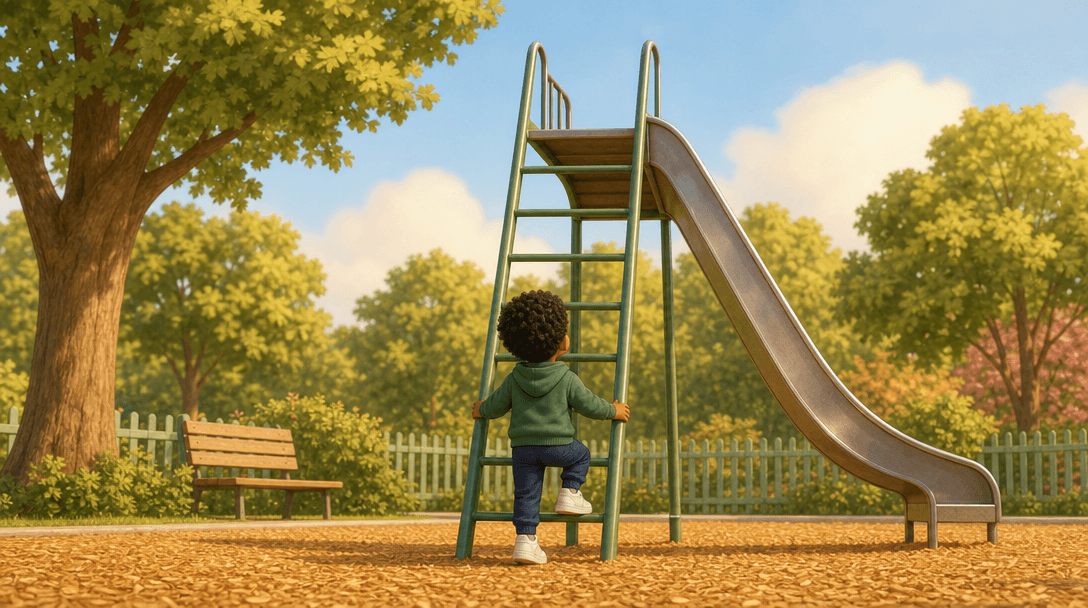
A personalized story for a cautious child: the thing that looks bigger in person, the watching, three steps instead of the whole slide, and going with the fear still there. A 2.5 minute storybook film.
We make it from the details you choose. Your child, by name, in every scene.
Frequently asked questions
- What is a good book about being brave?
Some of the picks that come up most from librarians and pediatric sources are 'There's a Nightmare in My Closet' by Mercer Mayer, 'Sheila Rae, the Brave' by Kevin Henkes, 'The Dark' by Lemony Snicket (for slightly older kids), 'After the Fall' by Dan Santat, and 'The Kissing Hand' by Audrey Penn for separation fears. Match the specific fear your child has (dark, monster, being alone, trying something new) to a title that names that fear directly.
- What are the best children's books about facing fears?
The picks that consistently come up: 'There's a Nightmare in My Closet' (Mercer Mayer), 'The Dark' (Lemony Snicket), 'Bedtime for Frances' (Russell Hoban), 'The Berenstain Bears in the Dark,' and 'Sheila Rae, the Brave' (Kevin Henkes). For older kids, 'After the Fall' by Dan Santat is often mentioned. The important part is not the title on its own; it is pairing the book with a calm bedtime routine and small comfort tools.
- Is there a book to help kids with the dark?
Yes. 'There's a Nightmare in My Closet' by Mercer Mayer is the classic. 'The Dark' by Lemony Snicket is a slightly older, poetic take. 'The Berenstain Bears in the Dark' is another gentle option for the 4 to 7 range. KidsHealth's approach is to read the book during daytime or as part of the calm bedtime routine, not as an emergency response mid-fear, so the picture your child holds at 2am is one they have practiced with.
- How can a story help my child feel braver?
A story does a specific thing pediatric sources (KidsHealth, Zero to Three) name: it gives your child shared vocabulary and a rehearsal for their own moment. Reading about a character who was scared and then found their brave gives your child language to describe their fear and a memory to reach for at bedtime. It is not a cure; it is one calm piece of the mix, and it works best when paired with a predictable routine and small comfort tools.
Sources
- KidsHealth (Nemours), Helping Kids Cope with the Dark. Story and comfort routines as reassurance for preschool fears.
- KidsHealth (Nemours), Childhood Fears and Worries. Do not mock, take the fear seriously, use calm daytime conversation.
- Zero to Three, Handling Fears. Routines, transitional objects, story as reassurance for young kids.
- AAP HealthyChildren.org, Anxieties and Fears. When calm strategies are enough vs when to loop in a pediatrician.
FableFleet team
Founders & moms, FableFleet
We're a small team of moms building the personalized children's stories we wished existed for our own kids. Everything we publish is rooted in lived experience and cited research.