
Monsters Under the Bed: A Calm Guide for the Scared Bedtime
Monsters under the bed is one of the most common preschool fears, driven by the same developing imagination that lets a 3 or 4 year old play pretend. Pediatric sources (Lurie Children's, KidsHealth, AAP) treat it as a normal phase most kids move through with calm reassurance, a predictable bedtime routine, and small comfort tools (nightlight, brave-flashlight, a favored stuffed animal). What helps: take the fear seriously without confirming the monster. What backfires: mocking, forcing exposure, or scary media before bed. Call your pediatrician if the fear stops sleep for weeks or spreads to daytime.

If your kid just started saying there is something under the bed, and you are searching for the right thing to say back, you are in the most common bedtime moment in the preschool years. The good news, and it is real news, is that this is developmental, most kids move through it, and there is a calm plan that works. The parents I have asked all say it out loud once it is behind them: the households where the fear got small fastest were the ones where the grown-up did not panic, did not mock, and stuck with a small predictable routine every night until the kid stopped asking. That is what this guide is. My three-year-old is right at the edge of this window and I have been reading everything I can from the pediatric side, so this is the version I am planning to run when the first "there is something under my bed" lands at our house.
Why are monsters under the bed such a common fear
The reason monsters under the bed shows up so predictably in the preschool years is not that your kid watched something they should not have, and it is not that you did something wrong. It is developmental, and the pediatric authorities are direct about this.
Lurie Children's puts it plainly: preschoolers have not fully separated pretend from real. The same brain that at 3 or 4 hosts a tea party with three imaginary guests can, at 3 or 4, populate the dark under the bed with something scary. The imagination is the engine. It is doing exactly what it is supposed to do at this age; the fear is the side effect.
KidsHealth from Nemours adds the second piece, which is bedtime specifically. During the day, the sensory anchors that reassure your kid are everywhere: they can see the room, they can see you, there is noise, there is movement. At lights out, the visual anchors vanish. The imagination fills in the gaps, and the gap under the bed is a particularly rich place for a preschool imagination to work with.
The friends I have asked all said roughly the same thing about their kids: the monster showed up somewhere between 3 and 5, usually not connected to a specific scary thing. Sometimes a book or a scene from a movie triggered it, but often it just appeared, the way a lot of preschool fears do, when the imagination hit a new gear.
The framing that helped every parent I talked to move through it is this: your child is not defective and you are not failing. Your child is at the age where the imagination is loud enough to make a small sound feel alive. Your job is not to prove the monster is not there. Your job is to be the calm they borrow while their brain catches up.
What actually helps when a child is scared of the monster under the bed
Here is the short, pediatric-guidance-backed toolkit, in the order I would use it.
Say the calm sentence. KidsHealth is specific: do not brush past the fear with "there is nothing to be afraid of" as if that resolves it, because from your child's perspective it does not. Try "I hear you. I know it feels scary. I am right here." Said quietly. Once. That single sentence, delivered without drama, does more work than most parents expect.
Do a quick calm look together. The parents I have asked all landed here. A one-time, thirty-second, matter-of-fact look under the bed with your child on your hip. "Nothing there, just some dust bunnies. I checked." No dramatic monster hunt. No big performance. Just a small confirmation that reassures without inflating the monster into a Real Thing.
Turn on the nightlight. A dim light in the room or the hall does two things at once: it reduces the sensory unknown, and it gives your child something to look at when the imagination is trying to fill in the dark. KidsHealth flags the nightlight-plus-comfort-object combo as one of the most reliable preschool-fear supports.
Offer one comfort tool. A favored stuffed animal who "watches" the room. A brave-flashlight the child can turn on themselves. A soft blanket that "protects" the bed. One tool, chosen calmly by you, presented calmly. Kids who feel a small piece of agency move through the phase faster than kids who feel completely overtaken by the fear.
Say the same one-line reassurance every night. Consistency is soothing. Whatever your line is (mine is going to be some version of "you are safe, I am close, sleep well"), pick it and use it every night for weeks. The predictability does part of the work.
Do a check-in a few minutes after lights out. A brief head-in-the-doorway whisper: "you are doing great." Then out. Kids know it is coming; it is a small anchor that adds up.
The AAP's HealthyChildren.org guide to anxieties and fears frames the whole set the same way: take the feeling seriously, keep bedtime predictable, and let time do the rest. There is no magic single move. The calm mix wins.
The engage vs redirect question
This is the specific piece parents keep asking me about privately, and it deserves its own beat because the sources actually converge on an answer.
The short version: engage briefly, then redirect to the routine. Do not have a nightly debate about whether the monster exists (that keeps the monster central), and do not refuse to look at all (that leaves the fear alone in the dark). The pediatric middle ground is the one-time quick calm look, followed by the tool, followed by the routine, said in about the same order every night. KidsHealth and CHOP both describe this as validating the feeling while not confirming the fear.
The "monster spray" ritual (a spritz of water from a labeled bottle) is one many parents I have asked ended up using. It is not officially endorsed by any pediatric authority I found and it does slightly confirm the monster idea. Some kids love it; some kids find it stressful because it makes the monster more real to them. If your kid asks for it and seems calmer with it, it is fine. If your kid finds it stress-inducing, drop it. The point is your child's calm, not the ritual.
The one thing to avoid, per CHOP's guidance on irrational fears, is forcing exposure. "Just be brave, walk in there yourself" often deepens fear rather than dissolving it. Small graduated steps done with you are what works.
Rituals that work: nightlight, brave-flashlight, comfort object
The tools most parents lean on are short.
Nightlight. Dim, warm-toned, in the room or the hall. KidsHealth's dark-fear guidance says either placement is fine; the point is that darkness has a small anchor.
Brave-flashlight. A small child-sized flashlight the kid can turn on themselves. Kept where they can reach it. Agency matters, per CHOP: a kid who feels they have one tool they control moves through fear faster than a kid who feels powerless.
Comfort object. A stuffed animal, a blanket, a small pillow. If they already have one, that is the one to use. Zero to Three specifically flags transitional objects as one of the most useful supports for toddler and preschool fears.
Story-time on the routine. A short calm book. The calmer the last input, the calmer the settle.
Do not go on a shopping trip. One or two tools is more than enough. More gear usually just gives your kid the impression the fear is a big deal.
What NOT to do when your child says there is a monster under the bed
The parents I have asked all named the same amplifiers, and it lines up with pediatric guidance.
Do not mock the fear. "Do not be silly, there is no monster" makes the child feel dismissed and often makes the fear more entrenched. KidsHealth is unequivocal.
Do not confirm the monster. "Yes, there was a monster but I chased it away" seems clever in the moment and then you have to chase it away again tomorrow.
Do not scare-tactic. "If you get out of bed the monster will get you" gets used in exhausted moments and it deepens the fear meaningfully.
Do not force exposure. "Just walk into your dark room by yourself" seldom works, per CHOP. Small graduated steps with you present are the pattern that helps.
Do not play scary media before bed. Kids' imaginations at this age are absorbent, and KidsHealth flags this specifically.
Do not shame yourself for wanting the phase over. Being tired at the end of a long day is allowed. Just do not let the tired-you make choices that will make tomorrow-you tireder.
When to worry about a bedtime monster fear
Most preschool monster fears are a phase. The AAP, KidsHealth, and Lurie Children's all treat them as normal development, and the calm plan is usually enough.
Watch for the same red flags any childhood fear can carry. Fear that stops sleep for weeks with no easing. Fear that spreads into daytime (refusing to be alone in any room, refusing to go upstairs, refusing to enter certain parts of the house). Physical symptoms tied to the fear: stomachaches at bedtime, panic-like breathing, headaches. Refusal to go to school or a caregiver's over the fear. Nightmares that are worsening rather than easing.
If any of those show up, that is your cue to call your pediatrician. Do not wait for the fear to become a bigger problem. Pediatricians see this all the time, they can screen for anxiety disorders or specific phobias, and they can refer you to a child psychologist if the situation calls for it. The full childhood fears guide has the fuller red-flag map, plus the age-typical fear map that helps you locate where your child is on the developmental arc. The sibling-piece fear of the dark covers the closely related bedtime lane, since monsters-under-the-bed and dark-fear are usually part of the same package for kids in the preschool window.
How FableFleet fits
FableFleet is personalized animated stories, video-only, made just for your child. When the character on screen has your kid's name and their siblings' names and their best friend's name in the story, and that character is a little scared at bedtime and finds their brave, your child gets a rehearsal.
The reason it fits this specific fear is that monsters-under-the-bed is fundamentally about the imagination. You cannot argue an imagination fear away. What you can do is give the imagination a different picture to hold: a personalized story where the character like your child looks under the bed, finds nothing scary, and settles in with their nightlight. Your kid hears that story as themselves, not as somebody else, and the picture stays in their head at 2am. That is the whole promise, in plain terms. It is not a cure and I would not sell it as one. It is one calm, personal picture on your kid's shortlist when the imagination gets loud.
More in Anxiety and Fears
- Childhood Fears: A Calm, Pediatrician-Backed Guide for Parents
Childhood fears are the normal, developmental worries kids move through, from stranger fear as a baby to monsters and the dark in preschool to real-world worries in early school years. Pediatric authorities (AAP, KidsHealth, Lurie Children's) treat most childhood fears as a phase that eases with time, calm routines, and gentle reassurance. What helps most: take the fear seriously, keep bedtime predictable, add small comfort tools (nightlight, comfort object, brave-flashlight), avoid scary media, and skip the mocking or forced exposure. Call your pediatrician if a fear stops sleep, eating, or play, or if it lasts more than a few weeks with no easing.
- Book About Being Brave: The Picks That Actually Land With Scared Kids
Book about being brave: the picks that consistently land are gentle picture books where a character faces a specific fear (dark, monsters, first time doing something hard) and finds their brave. Pediatric sources (KidsHealth, Zero to Three) treat story as one useful piece of the calm bedtime mix, not a cure. What a brave book gives your child is shared vocabulary and a rehearsal for their own moment. What it will not do alone: erase a fear or replace a predictable bedtime routine. Pair the book with the calm plan.
- Fear of the Dark: A Calm, Real Guide for Parents at Bedtime
Fear of the dark is one of the most common childhood fears and typically peaks between ages 3 and 6. Pediatric authorities (KidsHealth, AAP, Lurie Children's) treat it as a normal developmental phase driven by the imagination outpacing the ability to soothe itself. What helps most: take the fear seriously, keep a predictable bedtime routine, add a small nightlight and comfort object, and skip scary media before bed. Call your pediatrician if the fear stops sleep for weeks, spreads to daytime, or comes with physical symptoms like stomachaches or panic-like breathing.
- How Not to Be Scared of the Dark: The Bedtime Plan That Works
How not to be scared of the dark is a step-by-step calm plan, not a single magic move. Pediatric guidance (KidsHealth, AAP, Zero to Three) converges on the same short list: name the feeling, keep the bedtime routine predictable, add a small nightlight and a favored comfort object, hand your child one thing they control (like a brave-flashlight), talk about the fear during daytime rather than at lights-out, and model calm yourself. Most kids move through the phase in weeks to months. Call your pediatrician if the fear lasts weeks with no easing or blocks sleep.
- Infant Bad Dreams: What the Pediatric Sources Actually Say
Infant bad dreams are almost never nightmares in the true sense until around the toddler years. Pediatric authorities (AAP, KidsHealth, Cleveland Clinic, Mayo Clinic) treat waking crying in babies under about 6 months as much more likely to be discomfort, hunger, gas, sleep-cycle transitions, or overtiredness than a bad dream. Real nightmares typically start around 1 to 2 and peak between 3 and 6. Night terrors are different from nightmares and are handled differently. What helps most: a calm predictable bedtime, low-stimulation evenings, and a soft response when your child wakes upset. Call your pediatrician if wakings are worsening or come with concerning symptoms.
The story for this milestone
For the child who wants to and cannot, both at once
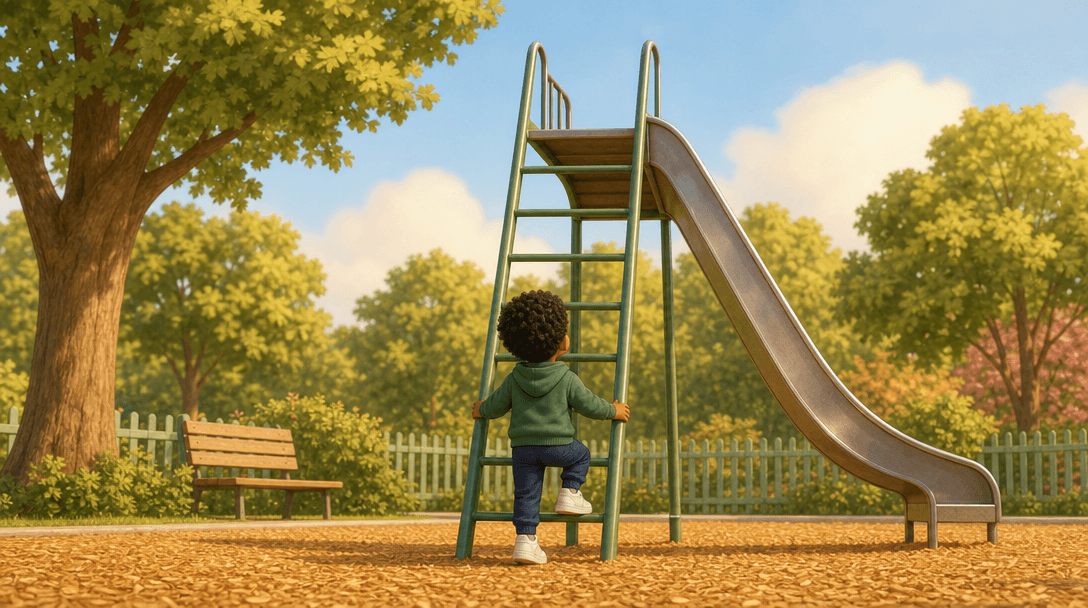
A personalized story for a cautious child: the thing that looks bigger in person, the watching, three steps instead of the whole slide, and going with the fear still there. A 2.5 minute storybook film.
We make it from the details you choose. Your child, by name, in every scene.
Frequently asked questions
- Are monsters under the bed real?
No. What is real is your child's imagination, which in the preschool years is powerful enough to make a small sound feel alive. Lurie Children's and KidsHealth both frame this as developmentally normal for kids roughly 3 to 6. Take the fear seriously without confirming the monster; that middle ground is where kids move through this phase fastest.
- How do I get my child to stop being afraid of monsters?
You cannot argue a monster fear away, but you can shrink it. KidsHealth and AAP guidance points at the same short list: acknowledge the feeling, keep bedtime predictable, offer one small comfort tool (nightlight, brave-flashlight, favored stuffie), skip scary media in the hour before bed, and let time do the rest. Most kids move through the phase within weeks to months.
- What age do kids stop believing in monsters?
Belief in imaginary bedtime creatures usually softens between ages 5 and 7 as kids get better at telling pretend from real, which Lurie Children's names as the underlying developmental shift. Some kids age out of the specific monsters-under-the-bed fear faster; others keep a lingering unease about the dark into early elementary years. Both are within the normal range.
- Should I check under the bed or ignore the monster?
The honest answer from KidsHealth and CHOP is somewhere in the middle. A quick calm look together can reassure a young child without confirming the monster is real. Long dramatic monster hunts, or refusing to look at all, both tend to backfire. Once you have looked, move to the calm routine and the comfort tool. Repeat the same short response the next night.
Sources
- Lurie Children's, Childhood Fears and Phobias. Preschool imagination as the engine of monster and closet fears.
- KidsHealth (Nemours), Childhood Fears and Worries. Age-typical fears, response guidance, do-not-mock rule.
- KidsHealth (Nemours), Helping Kids Cope with the Dark. Practical toolkit, comfort object and nightlight guidance.
- AAP HealthyChildren.org, Anxieties and Fears. When to worry, when a fear crosses into phobia territory.
- CHOP, Tackling Irrational Fears in Children and Teens. Do not force exposure, small steps, agency for the child.
FableFleet team
Founders & moms, FableFleet
We're a small team of moms building the personalized children's stories we wished existed for our own kids. Everything we publish is rooted in lived experience and cited research.