
Childhood Fears: A Calm, Pediatrician-Backed Guide for Parents
Childhood fears are the normal, developmental worries kids move through, from stranger fear as a baby to monsters and the dark in preschool to real-world worries in early school years. Pediatric authorities (AAP, KidsHealth, Lurie Children's) treat most childhood fears as a phase that eases with time, calm routines, and gentle reassurance. What helps most: take the fear seriously, keep bedtime predictable, add small comfort tools (nightlight, comfort object, brave-flashlight), avoid scary media, and skip the mocking or forced exposure. Call your pediatrician if a fear stops sleep, eating, or play, or if it lasts more than a few weeks with no easing.

Here is the reassuring version, because the internet does not lead with it enough. Most childhood fears are a normal developmental phase, not a sign anything is wrong with your child or with your parenting. The families who have the calmest 2am moments are the ones who take the fear seriously without feeding it, keep bedtime predictable, and trust that the phase moves. The bulk of this guide walks through what the pediatric authorities (AAP, KidsHealth, Lurie Children's, CHOP, Zero to Three) actually say about what is normal at each age, why the preschool imagination makes the closet feel alive, what helps at the moment your kid says "there is something in my room," and the small handful of signs that mean it is time to loop in your pediatrician. I have a three-year-old right on the edge of this window, so this is the version I am planning to run when the first "I heard something" lands at our house.
What childhood fears actually are (and why they show up)
Let me start with the reframe every mom I have talked to says helped her most. Childhood fears are not a defect and they are not a parenting grade. The AAP's HealthyChildren.org guide to anxieties and fears calls it plainly: almost all children experience fears at some age, and the specific fear typically changes as they grow. KidsHealth from Nemours frames the same idea: fears come and go throughout childhood as kids learn what is threatening and what is not.
The reason it feels so intense in the preschool years is a piece of good news dressed up as bad news. Your child's imagination is coming online. The same brain that at 3 or 4 can host an entire tea party with three stuffed animals can also, at 3 or 4, populate the closet at bedtime with something scary. Lurie Children's says it as plainly as any medical center will: preschoolers have not yet fully separated pretend from real, so the same imagination that fuels their play also fuels their fear. The fear is real to them, even when the monster is not real to you.
There is a second reason worth naming, because the parents I have asked keep bringing it up. Bedtime is when the day's supports drop away. During the day your kid is busy: playing, being watched by you or a teacher, moving. At night they are alone with their thoughts and the dark, and the sensory world thins out. KidsHealth's Helping Kids Cope with the Dark guide is direct about this: darkness makes it easier for a child's mind to invent scary things because the visual anchors that reassure them during the day are gone.
The takeaway across every source I checked is the same. A child having a fear is not a sign the child is broken and not a sign you did something wrong. It is a sign the imagination is doing its job, and the imagination will eventually catch up to reality.
What age do children develop fears
Different fears show up at different ages, and having the map in your head helps a lot. This is drawn from AAP, KidsHealth, and Lurie Children's; the specifics vary a little between sources, but the shape is the same.
Infants (0 to about 12 months). Fear at this stage is sensory and relational. Loud noises, sudden movements, and strangers can spike a startle response. Stranger anxiety often appears around 6 to 9 months, and separation anxiety (the classic scream when you leave the room) often peaks in the second half of the first year and again around 15 to 18 months.
Toddlers (about 1 to 3). Loud noises like vacuums and blenders can be legitimately scary. Bath drains, flushing toilets, big animals, and being left with a new caregiver all show up as fear triggers. Some toddlers start showing the very beginnings of nighttime fear, especially if they have transitioned to a bed or a room without a caregiver visible.
Preschoolers (about 3 to 6). This is the peak imagination-fear window. The dark, monsters, closet creatures, being alone in a room, animals (especially dogs, especially loud ones), thunder and lightning, and imaginary characters from stories all land in this age. Preschoolers can also fear things they have seen or overheard in adult media, even briefly, so KidsHealth flags this as a good moment to be strict about what is playing in the room.
Early school-age (about 6 to 9). Fears start to shift from imaginary to real-world. Being hurt, illness, someone breaking in, storms, spiders, and social fears (being embarrassed, being alone) become more common. Kids at this age also start to worry about things they have seen in the news.
Older kids (about 9 to 12 and up). Fears trend toward social evaluation, school performance, appearance, and personal safety. Fears at this age tend to be more thought-driven than imagination-driven.
The Lurie Children's piece adds a useful anchor: most childhood fears are developmentally expected, and the presence of a fear is not the same as a phobia. A phobia is severe, persistent, and interferes with daily life. Most kid fears do not.
Why is my child afraid of the dark
If your kid used to be fine at bedtime and is suddenly asking for every light in the house on, you are in the most common single childhood-fear moment there is. This is where every source I read converges, so let me lay it out plainly.
Fear of the dark shows up because two things happen at the same time in the preschool years. The imagination is powerful (the kid can now conjure a scary picture from a small sound), and the sensory reassurances of daylight (seeing the room clearly, seeing you nearby) go away at lights-out. KidsHealth from Nemours puts it this way in Helping Kids Cope with the Dark: your child's imagination fills in what their eyes cannot verify.
The parents I have asked all noticed the same thing: dark fear rarely comes out of nowhere. It often follows a scary book, an accidentally overheard show, a change in routine, a new sibling, a new bedroom, or just a growth-of-imagination leap. It does not mean you did something wrong. It means the imagination has grown up faster than the ability to soothe itself.
There is one thing worth saying, because it is the piece parents miss most. Your calm is a legitimate sensory tool for your kid. Your voice, your hand on their back, the fact that you take them seriously without confirming the monster, all register at the nervous-system level. That is why the how-to for the dark is not really about lights and stuffed animals, it is about how you show up.
I broke the practical step-by-step into its own guide, how not to be scared of the dark, so you can send it to your co-parent or your babysitter. The two also-related-search phrases most parents ask alongside "why is my child afraid of the dark" are "how do I help" and "when will it end," and both are answered further down.
How do I help my child with fear of the dark
Here is the pediatric-guidance short list, in the order I would use it. It draws on AAP, KidsHealth, Lurie Children's, and Zero to Three, and it is deliberately calm.
Take the fear seriously, without confirming the monster. KidsHealth is specific: do not say "there is nothing to be afraid of" as if that ends the conversation, because from your child's seat the fear feels real. But do not confirm the monster is real either. The middle ground is validating the feeling. "I hear you. I know it feels scary. I am right here." That single sentence, said calmly, is more useful than any device you can buy.
Keep the bedtime routine predictable. The AAP is consistent across its sleep and anxiety guidance: a calm, sequenced bedtime (bath, book, cuddle, lights out) tells your child's nervous system what comes next. Predictability is soothing. Novel bedtimes are not.
Add small comfort tools. A dim nightlight in the room or the hall. A favored stuffed animal or transitional object. A small brave-flashlight the child can turn on themselves. Zero to Three specifically flags the value of a comfort object as a bridge for young children. KidsHealth adds the flashlight-and-nightlight combo. None of these is a cure by itself; they are supports.
Give the child a small sense of control. CHOP's guidance on irrational fears is emphatic here: children who feel some agency over the scary moment are the children who move through it fastest. "You get to choose which stuffie stays with you." "You can turn the flashlight on any time." "You can call me one time, and I will come." Small choices reduce panic.
Avoid scary media before bed. KidsHealth calls this out plainly: shows, stories, or even overheard adult conversation can seed a fear. The hour before bed should be low-stimulation.
Do not force it. CHOP specifically warns against forced exposure ("just walk into your room alone, you are being silly") because it often deepens fear rather than dissolving it. Small graduated steps, done with your child, work.
Model calm. If you are visibly stressed at bedtime, your child registers that. If you can be calm, present, and matter-of-fact about the whole thing, your child borrows some of your regulation.
The parents I have asked also flag one very practical piece: a brief planned check-in a few minutes after lights out. Just a poke of the head into the room, a whisper of "you are doing great," and then out again. Kids know it is coming. It is a tiny anchor that adds up.
How not to be scared of the dark
I get variations of this question all the time from friends: give me the step-by-step, the shortest possible version, because I am tired and I need to tell my kid something at 8:04 tonight. Here is that shortest version, drawn from the same set of sources.
Say "I hear you, I know it feels scary, I am right here." Sit with your child. Turn on the nightlight. Hand them the brave-flashlight or the comfort object. Read one calm short book. Say the same sentence you say every night at lights out. Do the check-in a few minutes later. Repeat tomorrow.
That is the whole plan, at the lowest possible level of energy needed to run it. Everything else in the parenting literature is a variation on those seven moves. If you want the full deeper walk-through, the how not to be scared of the dark spoke breaks each step down with the exact language most parents I have asked found useful.
Nightmares, night terrors, and monsters at bedtime
These three get lumped together and they are not the same thing. The AAP's guide to Nightmares and Night Terrors, the Cleveland Clinic explainer on nightmares vs. night terrors, and Mayo Clinic's nightmare-disorder page all agree on the distinction, and it matters because the response is different.
Nightmares are bad dreams the child wakes up from. They happen in the second half of the night during REM sleep. The child is awake and can usually be comforted with your calm presence and a quiet reassurance. Nightmares peak roughly ages 3 to 6 and usually decrease as kids get older. Comfort briefly, keep the light dim, keep the routine consistent, and put them back to sleep.
Night terrors are different. They usually happen in the first third of the night during deep non-REM sleep. The child looks awake (eyes open, screaming, thrashing) but is not really awake and will not remember it in the morning. The AAP is clear on this: do not try to wake or engage the child. Keep them safe, keep the room dark, do not turn on the overhead light, and wait it out. Night terrors typically fade with age.
Monster-at-bedtime moments are not really dreams at all. They are the imagination populating the dark room at lights-out. The child is fully awake. The response is the calm-toolkit above: validate, comfort, tool, routine.
Knowing which one you are in matters because the same "comfort a scared child" instinct that helps a nightmare can actually prolong a night terror. If your child suddenly starts screaming in a way that does not respond to you, and comes with staring or thrashing, and it is in the first hour or two of sleep, it is most likely a night terror. The infant bad dreams spoke goes deeper on the nightmare-vs-terror distinction for the younger end, plus what waking crying in babies usually is (mostly not dreams).
When to talk to your pediatrician about childhood fears
Most childhood fears do not need a specialist. The AAP, KidsHealth, and Lurie Children's all treat the everyday fear window as normal development, and calm-and-patient at home is enough. But there is a smaller set of signs that mean it is time to loop in your pediatrician, and this is the list to keep in your back pocket.
Watch for fears that are severe and last more than a few weeks with no easing. Fears that stop your child from sleeping, eating, or engaging in normal daily activities. Physical symptoms that come with the fear: stomachaches, headaches, panic-like breathing, or trouble catching a breath. Refusal to go to school, or to a caregiver's, over the fear. Repeated night terrors in a child older than 6. Nightmares that are worsening rather than easing. Any fear that seems to be tied to a real event you know about (a scary experience, a loss, a change) and is not easing over time.
AAP and Lurie Children's both frame the escalation the same way. Start with your pediatrician. They know your child, they can screen for anxiety disorders and phobias, and they can refer you to a child psychologist or a therapist if it is time. Anxiety disorders and specific phobias in children are treatable, usually with cognitive-behavioral therapy adapted for kids, and often more effective the earlier they are addressed. CHOP's Tackling Irrational Fears piece is worth reading if you are in that zone.
The message I want to lodge here is the one every friend I have asked said made a difference: a pediatrician visit does not mean the fear is severe. Sometimes it just means the pediatrician can reassure you that the fear is normal, which is worth the visit on its own. Do not wait until you are exhausted.
A calm bedtime plan when a childhood fear takes over
If a specific fear is currently running your bedtime, the parents I have asked all describe roughly the same plan when it works. Let me lay it out.
Do the calming part of the routine one notch slower than usual. A slightly longer bath, an extra book, an extra minute of cuddle. Not a fight against the fear, an offering to your child's nervous system.
Say the fear out loud, once, with them. "You are worried about the monster under the bed. I hear you." Do not spend more than a minute on it. You are naming it, not solving it.
Show them one small comfort tool. Not a shopping trip. One thing. A nightlight you turn on together. A special stuffie who "watches" the room. A brave-flashlight kept under the pillow. You choose calmly. Their input is welcome, their veto is not.
Give them one thing to hold in their head. "If you feel scared, you can squeeze the brave-flashlight." "If you need me one time, call and I will come. After that, we are quiet." A single tool, a single rule.
Do a brief check-in a few minutes after lights out. Whisper. Do not turn on the light. "You are doing great. Sleep well."
Repeat the plan tomorrow. And the night after. Predictability is the medicine. The night your child does the whole routine and asks for no light or no check-in is the night you will realize the phase moved.
If none of that is working and you are exhausted, that is the moment to call the pediatrician. Not as a last resort, as an ordinary next step.
How FableFleet fits
I want to name this one honestly, because I read a lot of parenting blogs before I built one and I noticed they all try to sneak a product in without saying why. Here is why FableFleet fits this moment.
FableFleet is personalized animated stories, video-only, made just for your child. When a personalized story is about your kid, by name, going through the very thing they are scared of, and the character like your child finds their brave, your child gets a rehearsal moment. They hear "someone like me was a little scared of the dark, too, and then this happened, and then they were okay." When it is your own kid's name in the story, the rehearsal lands differently than when it is Frances or Sheila Rae.
This is not a promise the story will end the fear. It will not. Fears end when the imagination catches up to reality, and no piece of content shortcuts that. What a story like this can do is give your kid language and a memory to hold onto at bedtime, and give you an unhurried moment to talk about the fear before the 2am version arrives. If you want to see the whole story-based approach through the shopper's lens, the book about being brave spoke walks through the picture-book side and the story-video side together.
The promise is very simple. A personalized animated story with your child's name and their family and friends woven in, delivered as a short video. No shopping, no configuration puzzle for you, no jargon anywhere in the copy for a reason. The heart of it is that a kid who sees themselves as the brave one on the screen has a slightly easier time being the brave one in the room. That is why we made it, and that is why I wanted it woven into this guide about childhood fears specifically rather than tacked on at the end.
If you are in the middle of a hard bedtime tonight, my sincere wish for you is a calm one. Take the fear seriously without confirming the monster. Keep the routine. Do the check-in. Tomorrow will be easier than tonight, and next month will be easier than tomorrow. The parents I have asked who lived through this phase all say the same thing when it is behind them: the calm won.
More in Anxiety and Fears
- Book About Being Brave: The Picks That Actually Land With Scared Kids
Book about being brave: the picks that consistently land are gentle picture books where a character faces a specific fear (dark, monsters, first time doing something hard) and finds their brave. Pediatric sources (KidsHealth, Zero to Three) treat story as one useful piece of the calm bedtime mix, not a cure. What a brave book gives your child is shared vocabulary and a rehearsal for their own moment. What it will not do alone: erase a fear or replace a predictable bedtime routine. Pair the book with the calm plan.
- Fear of the Dark: A Calm, Real Guide for Parents at Bedtime
Fear of the dark is one of the most common childhood fears and typically peaks between ages 3 and 6. Pediatric authorities (KidsHealth, AAP, Lurie Children's) treat it as a normal developmental phase driven by the imagination outpacing the ability to soothe itself. What helps most: take the fear seriously, keep a predictable bedtime routine, add a small nightlight and comfort object, and skip scary media before bed. Call your pediatrician if the fear stops sleep for weeks, spreads to daytime, or comes with physical symptoms like stomachaches or panic-like breathing.
- How Not to Be Scared of the Dark: The Bedtime Plan That Works
How not to be scared of the dark is a step-by-step calm plan, not a single magic move. Pediatric guidance (KidsHealth, AAP, Zero to Three) converges on the same short list: name the feeling, keep the bedtime routine predictable, add a small nightlight and a favored comfort object, hand your child one thing they control (like a brave-flashlight), talk about the fear during daytime rather than at lights-out, and model calm yourself. Most kids move through the phase in weeks to months. Call your pediatrician if the fear lasts weeks with no easing or blocks sleep.
- Infant Bad Dreams: What the Pediatric Sources Actually Say
Infant bad dreams are almost never nightmares in the true sense until around the toddler years. Pediatric authorities (AAP, KidsHealth, Cleveland Clinic, Mayo Clinic) treat waking crying in babies under about 6 months as much more likely to be discomfort, hunger, gas, sleep-cycle transitions, or overtiredness than a bad dream. Real nightmares typically start around 1 to 2 and peak between 3 and 6. Night terrors are different from nightmares and are handled differently. What helps most: a calm predictable bedtime, low-stimulation evenings, and a soft response when your child wakes upset. Call your pediatrician if wakings are worsening or come with concerning symptoms.
- Monsters Under the Bed: A Calm Guide for the Scared Bedtime
Monsters under the bed is one of the most common preschool fears, driven by the same developing imagination that lets a 3 or 4 year old play pretend. Pediatric sources (Lurie Children's, KidsHealth, AAP) treat it as a normal phase most kids move through with calm reassurance, a predictable bedtime routine, and small comfort tools (nightlight, brave-flashlight, a favored stuffed animal). What helps: take the fear seriously without confirming the monster. What backfires: mocking, forcing exposure, or scary media before bed. Call your pediatrician if the fear stops sleep for weeks or spreads to daytime.
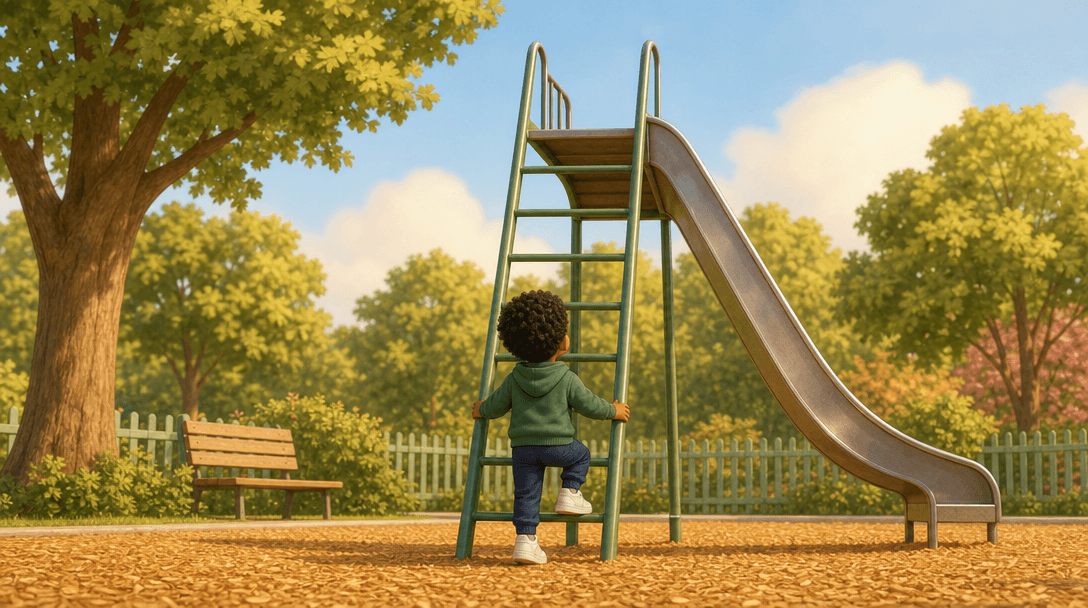
The story for this milestone
For the child who wants to and cannot, both at once
A personalized story for a cautious child: the thing that looks bigger in person, the watching, three steps instead of the whole slide, and going with the fear still there. A 2.5 minute storybook film.
We make it from the details you choose. Your child, by name, in every scene.
Frequently asked questions
- When do kids get scared of the dark?
Fear of the dark most often shows up between ages 2 and 4 and typically peaks between 3 and 6. KidsHealth and Lurie Children's both frame it as a common preschool fear that fades as kids learn the difference between imagined and real. If your child hits the fear later, or holds onto it well past 8 with no easing, it is worth mentioning at the next pediatrician visit rather than waiting it out alone.
- Are monsters under the bed real?
No, and pediatric sources are clear on this. What is real is your child's imagination, which in the preschool years is powerful enough to make the sound in the closet feel alive. Do not laugh the fear off, but also do not confirm the monster is real. KidsHealth's approach is take the feeling seriously, help your child feel in charge (nightlight, brave-flashlight, a favored stuffed animal), and let time do the rest.
- Is fear of the dark normal?
Yes. KidsHealth calls fear of the dark one of the most common preschool fears, and both Lurie Children's and the AAP treat it as an expected developmental phase for kids roughly ages 2 to 8. It is only worth escalating if the fear is severe, lasts weeks with no easing, or is stopping sleep, appetite, or normal play. In that case a call to your pediatrician is the right next step.
- How do I stop nightmares in kids?
You cannot fully stop nightmares (most kids have some), but you can lower the odds. AAP and Mayo Clinic guidance points at the same short list: a calm predictable bedtime routine, no scary shows or stories in the hour before bed, enough total sleep so your child is not overtired, and a soft response when a nightmare does happen. If nightmares are getting worse instead of better, or are happening most nights for weeks, call the pediatrician.
Sources
- AAP HealthyChildren.org, Anxieties and Fears: What's Normal and What's Not. Age-typical fear map, when to seek help, phobias and anxiety disorders framing.
- AAP HealthyChildren.org, Nightmares and Night Terrors. Distinction, sleep cycle timing, when to call the pediatrician.
- KidsHealth (Nemours), Childhood Fears and Worries. Age-typical fears, red flags, do-not-mock guidance.
- KidsHealth (Nemours), Helping Kids Cope with the Dark. Fear of the dark practical toolkit, take the fear seriously.
- Lurie Children's, Childhood Fears and Phobias. Preschool imagination, peak ages, when to consult a specialist.
- CHOP, Tackling Irrational Fears in Children and Teens. Do not force exposure, small steps, when a phobia is a phobia.
- Cleveland Clinic, Nightmares vs. Night Terrors. Timing, cognition, why you do not wake a child in a night terror.
- Zero to Three, Handling Fears. Toddler-and-preschool reassurance framing and routine anchoring.
FableFleet team
Founders & moms, FableFleet
We're a small team of moms building the personalized children's stories we wished existed for our own kids. Everything we publish is rooted in lived experience and cited research.