
Infant Bad Dreams: What the Pediatric Sources Actually Say
Infant bad dreams are almost never nightmares in the true sense until around the toddler years. Pediatric authorities (AAP, KidsHealth, Cleveland Clinic, Mayo Clinic) treat waking crying in babies under about 6 months as much more likely to be discomfort, hunger, gas, sleep-cycle transitions, or overtiredness than a bad dream. Real nightmares typically start around 1 to 2 and peak between 3 and 6. Night terrors are different from nightmares and are handled differently. What helps most: a calm predictable bedtime, low-stimulation evenings, and a soft response when your child wakes upset. Call your pediatrician if wakings are worsening or come with concerning symptoms.

If you searched "infant bad dreams" tonight, someone in a small pair of pajamas is currently upset and you are trying to figure out what just happened. Here is the honest, pediatric-guidance-backed version, because the internet is really cluttered on this specific topic. Very young babies do not have narrative nightmares. Real bad dreams start later than most parents expect, and night terrors are their own thing that gets confused with nightmares constantly. I have a 4-month-old right now and we are doing our share of middle-of-the-night wake-ups here, so this is one topic where the mom-voice writing from the middle of it, and the medical guidance, both point at the same calm answer.
Are infant bad dreams even a thing (the short honest answer)
Very young babies (roughly under 6 months) do not have narrative nightmares in the way older kids do. Their brains are still developing the cognitive machinery for the kind of dream that scares you awake. Cleveland Clinic's explainer on nightmares vs night terrors and the AAP both frame it plainly: infant waking crying is much more likely to be something physical or something sleep-cycle-related than a bad dream.
That is the piece I want to lodge first, because it is very reassuring once you hear it, and because it usually redirects the parenting anxiety toward a more useful set of causes. If your 3-month-old just woke up screaming, the reasonable first checklist is not "what did she dream?" It is hungry, wet, gas, too hot or cold, teething early, coming out of a REM cycle and briefly waking. The AAP is direct about this in its sleep-problem guidance.
We are living the middle-of-the-night infant wake-up phase in our house right now with our 4-month-old, and everything I have read from the pediatric side has pointed me at the same short list. It has been more useful than the "was it a bad dream" version of the question, and it has kept the responses simpler.
What waking crying in infancy usually is
Let me put the alternatives to "bad dream" in one place, because this is the practical part.
Hunger. Especially before about 6 months, the growth-driven feeding pattern still shows up in overnight wakings for many babies. Not always a "must feed now" moment; sometimes a shorter comfort-back-to-sleep.
Discomfort. Wet diaper, uncomfortable sleep position, tag on the sleep sack, too warm, too cold, a light or a sound in the room.
Gas or reflux. Very common in early infancy. A middle-of-the-night wake that resolves with a burp, or with an upright hold for a few minutes, is almost always this.
Sleep-cycle transitions. Babies cycle through sleep stages faster than adults do. Brief wakings between cycles are normal. If the baby is not settled enough with the current sleep routine, those brief wakings can turn into full wakings.
Overtiredness. The paradox parents almost never guess. A baby who missed a nap, or had a stimulating late afternoon, is often harder to settle at night, not easier. KidsHealth and the AAP both flag overtiredness as an underrated driver of overnight wakings.
A regression or a milestone. Around 4 months and again around 8 to 10 months, sleep patterns often change in ways that show up as more overnight wakings. It is not a nightmare; it is a developmental step showing up in the sleep window.
If your baby is otherwise thriving (gaining weight, eating well during the day, alert when awake), a bumpy stretch of overnight wakings is almost always one of the above and not a dream problem. If wakings come with fever, breathing changes, refusal to feed, or extreme distress that will not resolve, call your pediatrician.
When infant bad dreams (and real toddler nightmares) start
Real nightmares typically start showing up around ages 1 to 2. The frequency picks up through the preschool years, and the peak is usually between about 3 and 6, according to AAP and Mayo Clinic guidance. They usually happen in the second half of the night during REM sleep. A kid who has one wakes up upset and can usually tell you (in a vague way) that something scary happened.
That "second half of the night" and "wakes up upset and can be comforted" pattern is the main clinical marker for a nightmare versus a night terror.
Nightmares peak in the preschool years for a reason: the same imagination that fuels play at 3 or 4 also fuels the vivid dream. Everything is louder in the imagination at this age. Mayo Clinic's page on nightmare disorder specifically flags daytime stress, a change in routine, over-tiredness, and scary media as common triggers.
For most kids, nightmares decrease as they get older. They can persist into elementary school and beyond in a low-key way; that is within normal. What is not within normal is nightmares getting worse rather than better over months. That is a call-your-pediatrician signal.
Nightmares vs night terrors: the difference
This is the piece that gets confused most, and it matters because the response is different.
Nightmares happen in the second half of the night during REM sleep. Your child wakes upset, can usually be comforted, remembers something scary (even if vaguely), and settles back down with your calm presence and a quiet reassurance. This is the response the parents I have asked describe: brief comfort, dim light, back to bed, done.
Night terrors happen in the first third of the night during deep non-REM sleep. Your child looks awake, screaming, thrashing, eyes possibly open, sometimes even sitting up, but is not really awake and will not remember it in the morning. AAP and Cleveland Clinic guidance is explicit: do not try to wake or engage the child. Keep them safe, keep the lights dim, do not turn on the overhead, and wait it out. Trying to wake a child in a night terror often prolongs it and can be more upsetting for both of you.
Night terrors are less common than nightmares and are technically rare in babies under 12 months. They peak in the preschool and early school years and most kids outgrow them without treatment.
If you are looking at your kid at 11pm and cannot tell whether it is a nightmare or a night terror, here is the practical rule of thumb. Time of night is the biggest tell. Nightmares tend to be later; night terrors tend to be earlier. Whether the child can respond to you is the next tell. If they cannot register your presence, keep them safe and do not wake them.
If night terrors are frequent, or continuing well past age 6, or you are worried about safety, call your pediatrician. The AAP notes this is a moment to check in.
What to do when your baby or toddler wakes up scared
For a nightmare or a general upset-wake, the pediatric-guidance response is short and calm.
Go to the child. Speak quietly. Keep lights dim (do not turn on the overhead). Offer a brief reassurance and a soothing touch. Say the same short sentence you say every night: "you are safe, I am here." Stay for a few minutes if it helps, then help them settle back in their own bed. Do not launch a long conversation about the dream at 3am. Save the dream conversation for the next day if it is worth having, and even then, keep it short.
The AAP is specific about a few things worth naming here. First: consistency is more important than clever technique. Whatever you do the first night, do roughly the same thing every night, so the child learns bedtime is safe. Second: try to keep bedtime, wake time, and total sleep amount stable across the week. Sleep-deprived kids have more nightmares. Third: skip scary media in the hour before bed. Even a preview, even an accidentally overheard scene, can seed a bad dream.
For a night terror, again: keep the child safe (guide them away from stairs, hold them if they will let you but do not force it), keep lights dim, do not try to wake them, wait it out. In the morning, do not bring it up. Most kids do not remember it and drawing attention to it can create anxiety around bedtime.
If your child is a toddler and old enough to consume story, this is the age where a calm reassuring bedtime story becomes a genuinely useful part of the wind-down. The bedtime "picture" your child holds at 2am is easier when there is a specific calming one in their head. The sibling piece fear of the dark covers the calm-toolkit angle, and the full childhood fears guide covers the wider red-flag map.
When to talk to your pediatrician
Most infant wakings and most childhood nightmares do not need a specialist. The AAP, KidsHealth, and Cleveland Clinic all treat both as normal parts of the sleep landscape at this age.
Call your pediatrician if any of these show up. Wakings are worsening rather than easing over weeks. They come with fever, breathing changes, refusal to feed, or new symptoms you cannot explain. Nightmares are becoming more frequent or more distressing over weeks. Night terrors are frequent (more than a couple times a month) or continuing past age 6. Sleep is so disrupted your child is exhausted during the day. Your child has become afraid of bedtime itself over the fear of nightmares.
Pediatricians can screen for sleep disorders, medical causes, and (in older kids) anxiety disorders. Most of the time they will reassure you that what you are seeing is normal, which is a legitimate reason to call by itself.
How FableFleet fits
FableFleet is personalized animated stories, video-only, made just for your child. Babies do not consume story yet, so I want to be honest about the fit here. The window where a personalized animated story actually starts to matter is around 2 or 3, when your kid can hold a specific bedtime picture in their head and use it.
For that older-toddler and preschool age, a personalized story where the character like your child ends the day in their own settled bedtime routine gives your kid a mental image to reach for at 2am. Not a cure for nightmares, no product can promise that. A rehearsal moment. In the meantime, if you are living the infant wake-up phase like we are, the plan is the boring pediatric-guidance one: check the practical stuff, keep bedtime calm, respond softly, ride it out.
More in Anxiety and Fears
- Childhood Fears: A Calm, Pediatrician-Backed Guide for Parents
Childhood fears are the normal, developmental worries kids move through, from stranger fear as a baby to monsters and the dark in preschool to real-world worries in early school years. Pediatric authorities (AAP, KidsHealth, Lurie Children's) treat most childhood fears as a phase that eases with time, calm routines, and gentle reassurance. What helps most: take the fear seriously, keep bedtime predictable, add small comfort tools (nightlight, comfort object, brave-flashlight), avoid scary media, and skip the mocking or forced exposure. Call your pediatrician if a fear stops sleep, eating, or play, or if it lasts more than a few weeks with no easing.
- Book About Being Brave: The Picks That Actually Land With Scared Kids
Book about being brave: the picks that consistently land are gentle picture books where a character faces a specific fear (dark, monsters, first time doing something hard) and finds their brave. Pediatric sources (KidsHealth, Zero to Three) treat story as one useful piece of the calm bedtime mix, not a cure. What a brave book gives your child is shared vocabulary and a rehearsal for their own moment. What it will not do alone: erase a fear or replace a predictable bedtime routine. Pair the book with the calm plan.
- Fear of the Dark: A Calm, Real Guide for Parents at Bedtime
Fear of the dark is one of the most common childhood fears and typically peaks between ages 3 and 6. Pediatric authorities (KidsHealth, AAP, Lurie Children's) treat it as a normal developmental phase driven by the imagination outpacing the ability to soothe itself. What helps most: take the fear seriously, keep a predictable bedtime routine, add a small nightlight and comfort object, and skip scary media before bed. Call your pediatrician if the fear stops sleep for weeks, spreads to daytime, or comes with physical symptoms like stomachaches or panic-like breathing.
- How Not to Be Scared of the Dark: The Bedtime Plan That Works
How not to be scared of the dark is a step-by-step calm plan, not a single magic move. Pediatric guidance (KidsHealth, AAP, Zero to Three) converges on the same short list: name the feeling, keep the bedtime routine predictable, add a small nightlight and a favored comfort object, hand your child one thing they control (like a brave-flashlight), talk about the fear during daytime rather than at lights-out, and model calm yourself. Most kids move through the phase in weeks to months. Call your pediatrician if the fear lasts weeks with no easing or blocks sleep.
- Monsters Under the Bed: A Calm Guide for the Scared Bedtime
Monsters under the bed is one of the most common preschool fears, driven by the same developing imagination that lets a 3 or 4 year old play pretend. Pediatric sources (Lurie Children's, KidsHealth, AAP) treat it as a normal phase most kids move through with calm reassurance, a predictable bedtime routine, and small comfort tools (nightlight, brave-flashlight, a favored stuffed animal). What helps: take the fear seriously without confirming the monster. What backfires: mocking, forcing exposure, or scary media before bed. Call your pediatrician if the fear stops sleep for weeks or spreads to daytime.
The story for this milestone
For the child who wants to and cannot, both at once
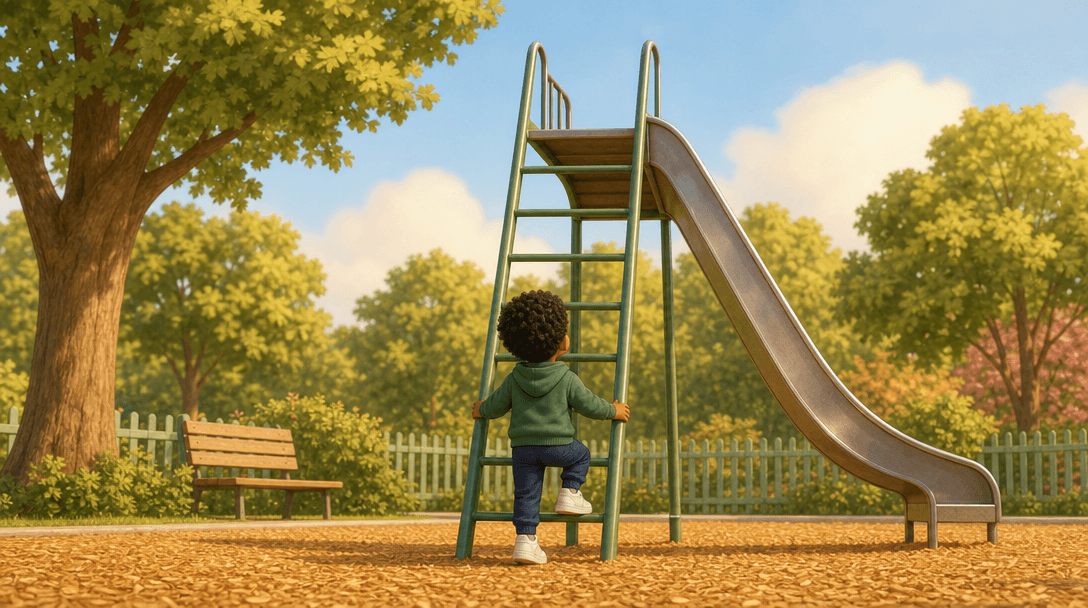
A personalized story for a cautious child: the thing that looks bigger in person, the watching, three steps instead of the whole slide, and going with the fear still there. A 2.5 minute storybook film.
We make it from the details you choose. Your child, by name, in every scene.
Frequently asked questions
- Do babies have nightmares?
Very young babies (under about 6 months) do not have narrative nightmares in the way older kids do; their brains have not yet developed the machinery. Cleveland Clinic and the AAP frame waking crying in infancy as much more likely to be discomfort, hunger, gas, sleep-cycle transitions, or overtiredness. Real nightmares typically appear in toddlerhood (1 to 2) and become more common between about 3 and 6.
- What are night terrors in infants?
Night terrors are technically rare in infants under 12 months and more common in preschool and early school years. They look different from nightmares: they happen in the first third of the night, the child appears awake (eyes open, thrashing, screaming) but is not really awake, and does not remember it in the morning. AAP guidance is to keep the child safe, keep lights dim, and NOT try to wake them. Most kids outgrow them without treatment.
- When do nightmares start in kids?
Real nightmares typically start around ages 1 to 2, become more common through the preschool years, and often peak around 3 to 6, according to AAP and Mayo Clinic guidance. They usually happen in the second half of the night during REM sleep. Frequency naturally decreases as kids get older. A calm, predictable bedtime and skipping scary media in the evening are the two most reliable ways to lower the odds.
- How do I stop nightmares in kids?
You cannot fully stop nightmares (most kids have some), but you can lower the odds. AAP and Mayo Clinic guidance points at the same short list: a calm, predictable bedtime routine, no scary shows or stories in the hour before bed, enough total sleep so your child is not overtired, and a soft, brief reassurance when a nightmare happens. If nightmares are worsening rather than easing over weeks, call your pediatrician.
Sources
- AAP HealthyChildren.org, Nightmares and Night Terrors. Distinction between nightmares and night terrors, sleep-cycle timing, response guidance.
- KidsHealth (Nemours), Nightmares. Age patterns, calm response, when to worry.
- KidsHealth (Nemours), Night Terrors. How to recognize night terrors, safety-first response.
- Cleveland Clinic, Nightmares vs. Night Terrors. Timing, cognition, differentiating the two.
- Mayo Clinic, Nightmare disorder. Peak ages, triggers, when it becomes a disorder.
FableFleet team
Founders & moms, FableFleet
We're a small team of moms building the personalized children's stories we wished existed for our own kids. Everything we publish is rooted in lived experience and cited research.