
How Not to Be Scared of the Dark: The Bedtime Plan That Works
How not to be scared of the dark is a step-by-step calm plan, not a single magic move. Pediatric guidance (KidsHealth, AAP, Zero to Three) converges on the same short list: name the feeling, keep the bedtime routine predictable, add a small nightlight and a favored comfort object, hand your child one thing they control (like a brave-flashlight), talk about the fear during daytime rather than at lights-out, and model calm yourself. Most kids move through the phase in weeks to months. Call your pediatrician if the fear lasts weeks with no easing or blocks sleep.

If you searched "how not to be scared of the dark" tonight, you probably needed the plan and you needed it in the next fifteen minutes. This is that plan. It is drawn from what the pediatric authorities (KidsHealth, AAP, Zero to Three, CHOP) say, translated into normal parent language, and tuned for the moment where your kid is currently in the doorway saying they cannot sleep. My three-year-old is right at the edge of the dark-fear window and the parents I have asked all describe roughly the same set of moves, so this is the version I am planning to run in our house.
How not to be scared of the dark: the honest short answer
Here is the short version, because most people who typed this into a search bar are tired. Take the feeling seriously without confirming an imaginary threat. Keep the bedtime routine predictable. Add one small light and one favored comfort object. Give your kid one tool they control. Say the same short reassurance every night. Do a brief check-in a few minutes after lights out. Do that for two or three weeks.
That is the whole thing, honestly. The rest of this guide is those moves broken down with the exact language most parents I have asked found useful, plus what to skip. If you want the broader "why" of dark-fear (which age, which mechanism), the sibling fear of the dark piece covers the developmental context. This one is the doing part.
The steps that actually work
Here is the plan, in the order I would run it. It is drawn from KidsHealth's Helping Kids Cope with the Dark, the AAP's guidance on anxieties and fears, Zero to Three's routine-anchoring approach, and CHOP's Tackling Irrational Fears piece.
1. Name the feeling out loud. One sentence, said calmly. Something like "I hear you. It is okay to feel scared. I am right here." KidsHealth is specific about not brushing the fear off with "there is nothing to be afraid of," which registers as dismissive. Name it, acknowledge it, then move on.
2. Anchor the bedtime routine. Same sequence every night, roughly the same pace. Bath, book, cuddle, one short reassurance sentence, lights to nightlight. AAP guidance on sleep and anxiety both converge here: predictability is one of the strongest tools you have.
3. Set up one small light. A dim, warm-toned nightlight, in the room or the hallway, whichever your kid prefers. KidsHealth flags nightlights specifically as one of the most reliable dark-fear supports. Not a bright overhead, and not a lamp with a full bulb. Small and warm.
4. Add one favored comfort object. A stuffed animal, a small blanket, a specific pillow. Zero to Three names transitional objects as one of the most useful supports for young children in fearful bedtime moments. If your kid already has one, that is the one to use.
5. Give your child one tool they control. A small brave-flashlight kept under the pillow. A special stuffie who "watches" the room. A specific piece of the routine your kid gets to choose (which book, which stuffie stays out). CHOP's fear guidance is direct: kids who feel one small piece of agency at bedtime move through the fear faster than kids who feel completely powerless.
6. Do a brief check-in a few minutes after lights out. A whispered "you are doing great" from the doorway. No overhead light. This is small but it adds up. Kids learn that a supportive adult is going to reappear briefly, and that reduces the pull to get out of bed.
7. Do the same thing tomorrow, and the next night. Two to three weeks of consistent calm is the pattern most parents I have asked describe as the thing that finally moved the fear. Novelty makes bedtime harder. Consistency makes it easier.
That is the seven-step plan at the lowest possible energy level. Everything else in the parenting literature is a variation on those seven moves.
Comfort tools that pay off
Let me put the tools in one place because I know that is what a lot of parents come here looking for.
Nightlight. Dim, warm-toned. Room or hallway. One is enough.
Brave-flashlight. A small kid-sized flashlight the child controls. Kept where they can reach it. The agency piece is the whole point; do not use it in your hand to sweep the room like a search light.
Favored comfort object. A stuffed animal or a blanket. The one they already like is better than a new one. New "special" gear at the peak of a fear moment often confuses kids more than it comforts them.
Short calm book. Read on the routine. Not a scary story, obviously. A slow gentle one that settles the room.
Sound anchor. A small predictable white-noise machine or a soft playlist. Whatever you already do. The point is sensory continuity; darkness feels smaller when the room is not silent.
Do not go on a shopping trip. Two or three of these is more than enough. More gear usually signals to kids that the fear is a big deal.
Talking about it before bedtime, not at bedtime
Here is the piece the parents I have asked most consistently said helped, and it is not obvious.
Talk about the fear during the day. In the car on the way home from preschool. At a snack. In a bath earlier in the day. The moment for a real conversation about "what is scary about the dark, what helps you feel safer, what is one thing you want to try tonight" is not at 8:04 pm with the lights half off. It is at 4:15 pm when the stakes are lower and your kid can think.
At 8:04 pm, you use the short calm sentence and the routine. You do not litigate the fear. The parents I have asked said the difference between families who moved through this phase in two weeks and families who stayed in it for months was often just this: the daytime version of the conversation was where the actual problem-solving happened.
This is also where you can teach your kid the one-liner they can say to themselves in the dark. "I am safe. My grownup is close." A phrase they have practiced in daylight is a phrase they can grab at 2am.
Modeling calm
If bedtime feels tense to you, it will feel tenser to your child. KidsHealth and Lurie Children's both flag this: kids' nervous systems borrow from the adults in the room.
That does not mean you have to be perfect. It means the calmest, most boring version of you is the one that helps your child settle. If you are stressed, you can name it briefly ("mommy is a little tired tonight but I am okay, and you are okay too") and then go back to the routine. Kids can handle honesty. They cannot handle being told they are silly for being scared.
The parents I have asked who felt like they nailed this phase all said roughly the same thing about themselves: they did not get less tired, they got more predictable. That is the version to aim for.
What if the dark fear lingers
Most dark-fears move within weeks to a few months with the calm plan above. Some do not. Here is when to escalate, drawn from AAP and KidsHealth guidance.
Call your pediatrician if the fear lasts more than a few weeks without any easing. If it blocks sleep for weeks (your child cannot fall asleep, is up multiple times a night, or is exhausted during the day). If it spreads into daytime (refusing to be alone in any room, refusing to go upstairs, refusing to enter certain parts of the house). If it comes with physical symptoms (stomachaches, panic-like breathing, headaches at bedtime). If nightmares are worsening rather than easing.
Pediatricians see this all the time. They can screen for anxiety disorders or specific phobias, and they can refer you to a child psychologist if it is time. The full childhood fears guide covers the wider red-flag map. And the sibling piece on the developmental why, fear of the dark, is where I would send a co-parent who wants the fuller context.
How FableFleet fits
FableFleet is personalized animated stories, video-only, made just for your child. When a personalized story is about your kid, by name, going through a small brave moment at bedtime, and the character like your child ends the day settled with their nightlight, your child gets a rehearsal.
The reason it fits the specific "how not to be scared of the dark" moment is that most of the pediatric-guidance plan is about giving your child a mental picture to hold at 2am. A picture in their own name, of themselves, doing the calm thing, is a durable one. It is not a cure. It is a small piece of practiced language and a familiar image. It goes on the shelf next to the nightlight and the brave-flashlight, not instead of them.
More in Anxiety and Fears
- Childhood Fears: A Calm, Pediatrician-Backed Guide for Parents
Childhood fears are the normal, developmental worries kids move through, from stranger fear as a baby to monsters and the dark in preschool to real-world worries in early school years. Pediatric authorities (AAP, KidsHealth, Lurie Children's) treat most childhood fears as a phase that eases with time, calm routines, and gentle reassurance. What helps most: take the fear seriously, keep bedtime predictable, add small comfort tools (nightlight, comfort object, brave-flashlight), avoid scary media, and skip the mocking or forced exposure. Call your pediatrician if a fear stops sleep, eating, or play, or if it lasts more than a few weeks with no easing.
- Book About Being Brave: The Picks That Actually Land With Scared Kids
Book about being brave: the picks that consistently land are gentle picture books where a character faces a specific fear (dark, monsters, first time doing something hard) and finds their brave. Pediatric sources (KidsHealth, Zero to Three) treat story as one useful piece of the calm bedtime mix, not a cure. What a brave book gives your child is shared vocabulary and a rehearsal for their own moment. What it will not do alone: erase a fear or replace a predictable bedtime routine. Pair the book with the calm plan.
- Fear of the Dark: A Calm, Real Guide for Parents at Bedtime
Fear of the dark is one of the most common childhood fears and typically peaks between ages 3 and 6. Pediatric authorities (KidsHealth, AAP, Lurie Children's) treat it as a normal developmental phase driven by the imagination outpacing the ability to soothe itself. What helps most: take the fear seriously, keep a predictable bedtime routine, add a small nightlight and comfort object, and skip scary media before bed. Call your pediatrician if the fear stops sleep for weeks, spreads to daytime, or comes with physical symptoms like stomachaches or panic-like breathing.
- Infant Bad Dreams: What the Pediatric Sources Actually Say
Infant bad dreams are almost never nightmares in the true sense until around the toddler years. Pediatric authorities (AAP, KidsHealth, Cleveland Clinic, Mayo Clinic) treat waking crying in babies under about 6 months as much more likely to be discomfort, hunger, gas, sleep-cycle transitions, or overtiredness than a bad dream. Real nightmares typically start around 1 to 2 and peak between 3 and 6. Night terrors are different from nightmares and are handled differently. What helps most: a calm predictable bedtime, low-stimulation evenings, and a soft response when your child wakes upset. Call your pediatrician if wakings are worsening or come with concerning symptoms.
- Monsters Under the Bed: A Calm Guide for the Scared Bedtime
Monsters under the bed is one of the most common preschool fears, driven by the same developing imagination that lets a 3 or 4 year old play pretend. Pediatric sources (Lurie Children's, KidsHealth, AAP) treat it as a normal phase most kids move through with calm reassurance, a predictable bedtime routine, and small comfort tools (nightlight, brave-flashlight, a favored stuffed animal). What helps: take the fear seriously without confirming the monster. What backfires: mocking, forcing exposure, or scary media before bed. Call your pediatrician if the fear stops sleep for weeks or spreads to daytime.
The story for this milestone
For the child who wants to and cannot, both at once
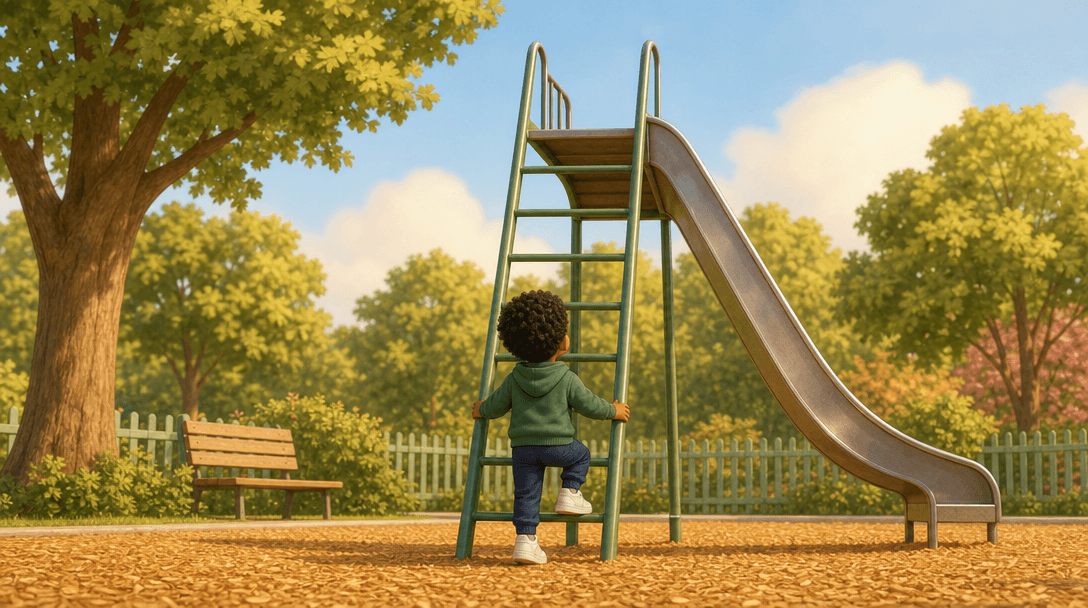
A personalized story for a cautious child: the thing that looks bigger in person, the watching, three steps instead of the whole slide, and going with the fear still there. A 2.5 minute storybook film.
We make it from the details you choose. Your child, by name, in every scene.
Frequently asked questions
- How not to be scared of the dark?
The short pediatric-guidance version: name the feeling out loud once, keep a predictable calm bedtime routine, add a small nightlight and a favored comfort object, hand your child one thing they control (a brave-flashlight or a special stuffie), talk about the fear during the day rather than at lights-out, and stay calm yourself. Do not force lights-off or mock the fear. Most kids move through it in weeks to months with the calm mix.
- How do I help my child not be afraid at bedtime?
Anchor the routine first. Same sequence every night, delivered at roughly the same pace. Add one small comfort tool (nightlight, brave-flashlight, favored stuffed animal). Say one short reassurance sentence at lights-out and use the same one every night. Do a brief check-in a few minutes later. That mix, done consistently for two to three weeks, is what pediatric sources (KidsHealth, AAP, Zero to Three) point at for the vast majority of preschool bedtime fears.
- Do nightlights help kids not be scared of the dark?
For most kids, yes. KidsHealth specifically calls out nightlights and comfort objects as one of the most reliable pieces of the calm mix. Choose a dim, warm-toned nightlight, in the room or the hallway, whichever your child prefers. It is not a cure by itself; it works best as one piece of a predictable calm bedtime routine rather than the single lever.
- What can I say to my child who is afraid of the dark?
One short sentence, said calmly, works better than a long argument. KidsHealth advises against dismissing the fear ('there is nothing to be afraid of') and against confirming the imagined threat. Try 'I hear you. It is okay to feel scared. I am right here.' Use the same sentence every night. Predictability is soothing; novel bedtime speeches usually raise the temperature.
Sources
- KidsHealth (Nemours), Helping Kids Cope with the Dark. Practical dark-fear toolkit, take the fear seriously.
- KidsHealth (Nemours), Childhood Fears and Worries. Modeling, do not force exposure, calm response.
- AAP HealthyChildren.org, Anxieties and Fears. Routine as anchor, when a fear needs a pediatrician.
- Zero to Three, Handling Fears. Toddler-and-preschool transitional object framing.
- CHOP, Tackling Irrational Fears in Children and Teens. Do not force exposure, small steps, agency for the child.
FableFleet team
Founders & moms, FableFleet
We're a small team of moms building the personalized children's stories we wished existed for our own kids. Everything we publish is rooted in lived experience and cited research.