
· Updated
Toddler Biting and Hitting: Why It Happens, What to Say, and When It Stops
By Amanda and Ashley, two moms with four kids between us
Biting and hitting at one, two and three are normal, and they are not a sign of a mean kid. The feeling gets there before the words do. In the moment: stay calm, block the hand or move your child, say one short line the same way every time, then go to the one who got hurt. Teach the instead later, when everyone is calm. It fades as language grows, usually somewhere between two and a half and four.
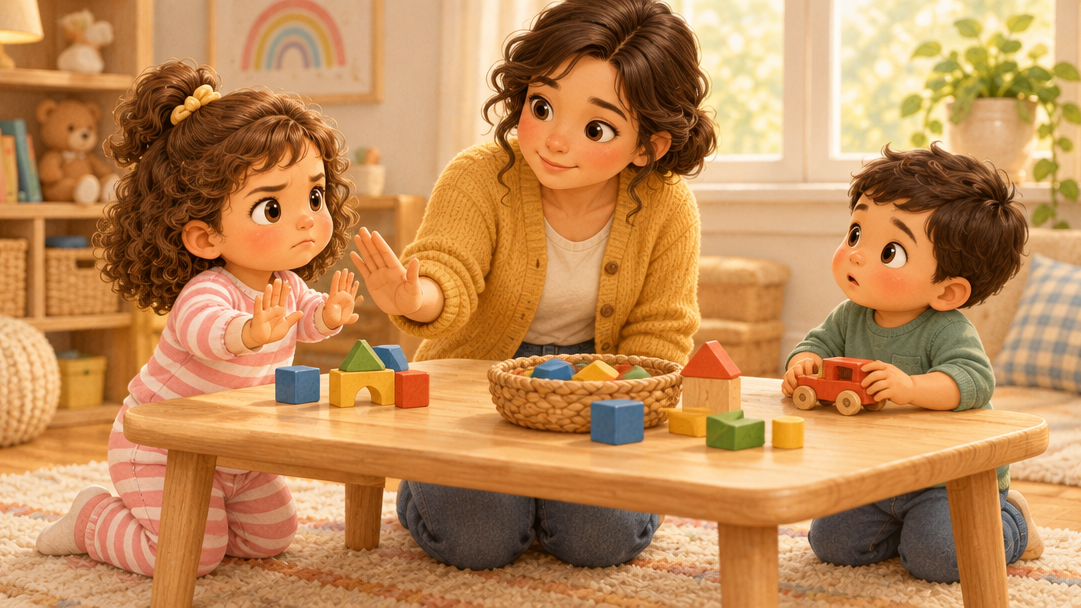
The first time my daughter bit me I was more surprised than hurt. She was not angry, exactly. She was full of something, and it came out through her teeth. We did the same thing each time: we said what had just happened, and we talked about what our teeth are for. It stopped. What I didn't know then, and know now from reading everything I could find, is that this is almost exactly what every pediatric body says to do, and the reason it works has nothing to do with the talking being clever. It was short, calm, the same every time, and nobody got a big reaction.
This is the whole picture of toddler biting and hitting: why it happens, what to say in the moment, the daycare call, the kid who only hits you, the baby, and when it ends.
Coming soon, the story for this moment: Your child and the Biting Feeling, with your child in every scene. Free to print: the same words card, one line for home and daycare with your child's name on it.
Is it normal for a toddler to bite and hit?
Yes, and this is one of the few places where the research is solid rather than opinion. Richard Tremblay has followed thousands of children from birth, and his curve is simple. Most children start hitting between the first and second birthday. It climbs until about two and a half to three and a half, then it falls, steadily, as the words come. The line of his I'd put on the fridge is borrowed from an older psychologist: children never had to learn how to have a tantrum. What they have to learn is "not to use physical aggression."
So hitting and biting are not something your child picked up somewhere. Not hitting is the thing that gets learned, and it gets learned slowly, through hundreds of ordinary moments with other kids, at home and at daycare. Zero to Three puts the peak at around two, when the feelings are very strong and the words are not there yet.
How many kids bite? Nobody official has counted. The numbers you'll see online, that about a third to a half of children bite someone at some point, come from pediatricians' summaries and one parent survey, not from the American Academy of Pediatrics. One pediatrician's reading of the research is that nearly every toddler is physically aggressive at some point, which makes the label useless. I think that's the right way to hold it.
Why do toddlers bite and hit?
Because the feeling gets there first. Zero to Three's line is the one I'd trust: "They can't tell you yet with words that they're excited, angry, tired, mad or overwhelmed." The rest of their list is curiosity about what will happen, teething and the feel of biting down on something, and a child who needs more running around.
The early-childhood center at Vanderbilt adds the two that explain the most confusing bites and hits, the ones with a smile. Cause and effect, because a bite gets a big reaction every single time. And monkey see, monkey do. The pediatricians' version is the shortest: young children have very little self-control yet.
In the family accounts I read, the pattern behind most of it was ordinary: a room move at daycare, a new baby, the end of the day, a crowded corner, one popular toy, a tooth coming in. The child was not plotting. The child was full.
What to say when your toddler bites or hits
Every body says the same sequence, so here it is in Vanderbilt's order, because it is the clearest.
- Calm yourself first. Count to ten, take a breath, do whatever works. The pediatricians' second tip for an aggressive toddler is simply to control yourself. Your calm is the thing your child borrows.
- Remove or block. Quickly and calmly move your child away from the person they bit. If you're close enough, the hand arrives first and nothing lands. That is the whole of both of our stories, the hand that gets there first, and it is also what the daycare staff in the accounts did when it worked: they stayed within arm's reach.
- One short line, the same every time. Vanderbilt's is Stop. No biting. Biting hurts. Zero to Three's is the same without the stop, said in a firm, matter-of-fact voice, not angry, not yelling. The child psychiatrists give one by age: for a one to two year old, No hitting. Hitting hurts. For two to three, I know you are angry, but don't hit. Hitting hurts. The one we use in our stories is I won't let you bite and I won't let you push, because it says what the grown-up will do rather than what the child must not. Pick one. Don't reword it.
- Then the hurt child gets the attention. Most of it. Vanderbilt's reason is the one to remember: even negative attention can keep the biting going. Your child watches you go to the other kid. That is the lesson, and it needs no words.
- Acknowledge the feeling, and teach the instead later. When your child is calm, not in the heat of it, teach the other ways. Zero to Three's warning is that if you stop the behavior and offer nothing in its place, it is more likely to come back. A hand up and stop. A stomp. A chewy. Come find me. One, chosen, practiced when nobody is upset.
And the one thing every body says not to do, in the child psychiatrists' own capitals: "Do NOT bite a child to show how biting feels." Some parents in the accounts did. It changed nothing, and they felt terrible. The pediatricians' own research on spanking found that children spanked more than twice a month at three were more aggressive at five. Hitting back teaches that big people hit.
Skip the forced sorry, too. Vanderbilt says so plainly. In the accounts, the sorry was more attention to the hitter than to the hurt child, and the hit came again five minutes later. Let them help instead: hand back the toy, fetch the cold cloth, rebuild the tower.
What about time-outs?
Here the bodies disagree, so I'll show you all of them rather than pretend. The American Academy of Pediatrics allows a short one, a minute per year of age, and calls it a last resort. The Canadian Paediatric Society says no time-outs at all under three. One children's hospital says a time-out is almost always effective. Zero to Three says a toddler who bites should not lose play time over it, because that may make the problem worse.
What I can tell you from the accounts: for children under three, time-outs, the naughty step and the cot did nothing (one two year old sang in the cot), and I could not find one account of a time-out working at that age. Our line is the one every body agrees on: block, say it, go to the hurt child. The time-out is yours to decide.
Never "biter": the biting is not who your toddler is
Zero to Three says not to call your child a biter, because the label can make the behavior worse and even become part of who they think they are. It is the same axis as naughty and bad. The useful distinction, from the researcher who has spent her career on shame, is this: guilt says I did a bad thing, shame says I am bad, and nothing in the research says shame changes behavior. Say what the teeth did. Don't say what the child is.
When your toddler only hits you (and laughs)
No body has a line on this one, so what follows is what parents report. Many of the accounts were a child who hits one parent only, nearly always mom, sometimes only dad, and many were a child who hits and then laughs. The pattern the parents found, slowly and painfully, was that the reaction was the reward. Walking away as a show, cuddles and questions in the moment, shouting, the cot: more hitting. What worked, in the families where something did, was a calm, sad "that hurt," a step back, and nothing else; or a cushion to hit instead, which in one house became a game about which cushion makes which sound.
One parenting educator's line is the one I'd keep: when your child hits you, their brain is off track. It is not about you. It is that you are the safe one.
Hitting the baby
One parenting psychologist says it plainly: most two year olds will pinch a baby sibling if no adult is around. Plenty of the accounts were a bitten or hit baby, from seven months old, usually once the baby started crawling toward the toddler's toys. Two things worked, and nothing else did. Block before contact: stay between them, move the baby, don't leave the room. And one-to-one time with the older child, which several families called the only thing that ever helped, including a Saturday morning alone with each child. The rest of it, the new baby and the step backwards, is in our new baby guides.
Biting and hitting at daycare
This is where most of it lives. More than half of the families I read were a daycare story: a room move, then a run of bites or hits at the busiest moments of the day, a signed report at pick-up with the other child never named, a shadow or a behavior plan, the parent crying in the car. Some heard that they might be asked to leave. We wrote the whole of that separately, including what to ask, what a good plan looks like, and what to do if they say your child has to go: biting and hitting at daycare.
The one line to take from it is Vanderbilt's: "Try to have all caregivers approach the biting in the same way." The same words at home and at care. That is what the free card below is for: one line, one instead, the top half for your fridge and the bottom half for the teacher.
When does the hitting and biting phase end?
Tremblay's curve falls after about two and a half to three and a half. One pediatrician's summary is that biting drops off sharply by three, and one children's hospital says physical aggression should taper off by about seven. Nobody gives a date for one child. In the accounts it passed somewhere between two and a half and four, and almost every parent said the same thing: they were never sure what did it. The words came, and the hands and teeth stopped doing the talking.
Zero to Three's warning is the one to keep: it takes many, many repetitions, the words together with the actions. Your toddler may bite again. That is not the plan failing.
When to call the pediatrician about biting and hitting
The American Academy of Pediatrics says to consult your pediatrician if your child is unusually aggressive for longer than a few weeks and you cannot cope with it on your own. Their warning signs: injuries to themselves or others, attacks on you or other adults, being sent home or barred from play. Zero to Three adds unprovoked hitting, several bites a week, and a child who starts after a big change or a frightening event.
Two things from the accounts I'd add. Ask for a hearing check and a speech check: more than one biter in the accounts turned out to have hearing loss or a speech delay, and the biting stopped once that was found. And if you are wondering about autism, no body page on biting or hitting names it, so don't try to answer it from a blog. That is a question for your pediatrician, with everything else they know about your child.
Free printable
The same words card, for your fridge and the teacher
One line for biting, pushing or hitting, the same at home and at daycare. The top half goes on the fridge, the bottom half tears off for the teacher. Nothing you type leaves your device.
What they do
The line: “I won't let you bite. Teeth are for food.”
The instead (one thing, practised when nobody is upset)
Who says it at home (tap one or two)
Three sheets: the card (fridge half and tear-off teacher half), a page for you, and My Biting Feeling, a story to read at a calm time. Your answers go into the print page in the address after the #, which your browser never sends to us. Why the same words.
Books about biting and hitting for toddlers
Teeth Are Not for Biting and Hands Are Not for Hitting (Free Spirit board books) are the two that parents and nurseries actually own. They name the triggers and list good things teeth and hands do, and Zero to Three recommends the first by name. The complaints: thin pages, and one reviewer's wish that the book said something about the feelings behind wanting to hit. In the accounts one 2.5 year old laughed at the hitting one and lost interest; twins read the biting one twice a day for weeks and it helped. No Biting! by Karen Katz is a lift-the-flap with a safe alternative under every flap, short and repetitive; it skips the why, and the flaps tear. Little Dinos Don't Bite is funny more than useful, which is fine. Calm-Down Time (Verdick) is a calm-corner book, not a biting one. Llama Llama Mad at Mama is about the feeling, not the hit. Every one of them names the rule in its title. None shows the child feeling it, the other child's face, and the new thing working.
A biting and hitting story with your child in it
The first thing I'd say about social stories is what Carol Gray, who invented them, says: a proper one describes at least four times more than it tells, with one coaching line at most. Most of the no biting sheets online are rule lists with pictures. The second thing is that a story works when everyone uses the same words from it, at home and at daycare, so pick one and keep its line. Our free printed stories are in the biting social story and the hitting social story posts.
And we made two short stories for exactly this, two to four years old, with your child in every scene. The Biting Feeling: the pressing feeling in the jaw, a grown-up's hand that gets there first, I will not let you bite. Teeth are for food. A chewy on its hook, carrot sticks at the table. Gentle Hands: the tower, the little one, the push stopped before it lands, I will not let you push. A flat hand and a stomp, the tower rebuilt. Nothing lands on screen, nobody is called a biter, no time-out, no sorry on command. The one instruction the research gives for any story like this comes from the Daniel Tiger study: the children who got something from it were the ones whose parents talked with them about it afterwards. Watch it together, then say the line. All of our stories are on the stories page.
More in Social Stories
- A Biting Social Story for Toddlers (Free Printable, and What to Say in the Moment)
A biting social story is a short, calm story in your toddler's own voice that names the biting feeling, says it is allowed, and gives one thing to do with it instead. Below is a free one you can print tonight, then why toddlers bite, exactly what to say in the moment, what a story like this does, and when to talk to your pediatrician.
- No Hitting Social Story for Toddlers: Gentle Hands, Free Printable
A no hitting social story is a short, calm story in your toddler's own voice about the big, scrunchy feeling that goes to their hands, what hitting does to other people, and what their hands and words can do instead. Below is a free one you can print with your child's name in it, then why toddlers hit, what to say in the moment, the kid who only hits you, and when to talk to your pediatrician.
- Toddler Biting and Hitting at Daycare: What to Ask, What a Good Plan Looks Like, and the Same Words at Home
When daycare says your toddler is biting or hitting, the most useful thing you can do is get everyone using the same words. Ask what happened just before, who was close, and what the plan is. A good plan is a grown-up within arm's reach at the busy moments, one short line said the same way in both places, the hurt child comforted first, and no punishment. No pediatric body says a child should be expelled for biting; what follows is what the practitioners and a hundred families report.
Coming soon
For the toddler who bites when the feeling gets too big
A personalized story for toddlers who bite: the pressing feeling, a calm grown-up who stops it, words to use instead, and something crunchy that is allowed. A 2.5 minute story for ages 2 to 4.
We’re still making this one. Your child, by name, in every scene.
Frequently asked questions
- Is it normal for a 2 year old to bite and hit?
Yes. The research that followed thousands of children found that physical aggression starts between the first and second birthday, climbs until about two and a half to three and a half, then falls as language grows. Nobody official has counted how many children bite; the estimates from pediatricians are about a third to a half at some point. It is not a sign of a mean child or of bad parenting.
- What should I say when my toddler bites or hits?
One short line, said the same way every time, in a firm, matter-of-fact voice. The early-childhood line is No biting. Biting hurts. The child psychiatrists' line for a one to two year old is No hitting. Hitting hurts. Ours is I won't let you bite, or I won't let you push. Then give most of your attention to the child who got hurt, and teach the alternative later, when everyone is calm.
- Should I bite my child back to show them how it feels?
No. The child psychiatrists say it in capitals: do not bite a child to show how biting feels. The pediatricians' research found children spanked more than twice a month at three were more aggressive at five. In the family accounts we read, biting back changed nothing and the parents felt terrible.
- Why does my toddler hit me but not anyone else?
No pediatric body has a line on this, so this is what parents report. In the accounts, a child who hit one parent only, nearly always mom, was reacting to the reaction: walking away as a show, cuddles and questions in the moment, shouting, all brought more hitting. A calm, sad that hurt, a step back, or a cushion to hit instead worked where the cot and the naughty step did not. When your child hits you, their brain is off track. It is not about you. You are the safe one.
- When does the biting and hitting phase stop?
Most of it fades between about two and a half and four, as the words arrive. The research curve falls after 30 to 42 months; one pediatrician's summary is that biting drops off sharply by three. Nobody gives a date for one child. In the family accounts it passed in its own time, and almost no parent could say what did it.
- When should I worry about my toddler's biting or hitting?
The American Academy of Pediatrics says to consult your pediatrician if your child is unusually aggressive for longer than a few weeks, if there are injuries, attacks on adults, or your child is being sent home or barred from play. Zero to Three adds unprovoked hitting, several bites a week, or aggression that starts after a big change. Ask for a hearing and speech check too: in the accounts, more than one biter turned out to have hearing loss or a speech delay.
Sources
- Tremblay, Development and Prevention of Physical Aggression, Encyclopedia on Early Childhood Development (2022)
- Zero to Three, Toddler Biting: Finding the Right Response
- Zero to Three, Why Do Toddlers Bite?
- Zero to Three, Aggressive Behavior in Toddlers
- CSEFEL (Vanderbilt University), Responding to Your Child's Bite
- American Academy of Pediatrics (HealthyChildren.org), Aggressive Behavior
- American Academy of Pediatrics (HealthyChildren.org), Disciplining Your Child
- American Academy of Pediatrics, Corporal Punishment Policy (2018)
- American Academy of Child and Adolescent Psychiatry, Facts for Families No. 81: Fighting and Biting
- Canadian Paediatric Society, Caring for Kids, Positive discipline for young children
- Nationwide Children's Hospital, Toddler Biting and Hitting
- Cleveland Clinic, Have an Aggressive Toddler? (2024)
- Carol Gray, Social Stories 10.4 Criteria (2023)
- Zhou et al., Social Stories for children aged 2 to 6: a systematic review, IJERPH (2024)
- Texas Tech University, Daniel Tiger's Neighborhood study (2016)
Co-founders and moms, FableFleet
Two moms, four kids between us. We write about the moments we are living through, and we made the bedtime routine and stories our own kids use.