
Why the same words for biting
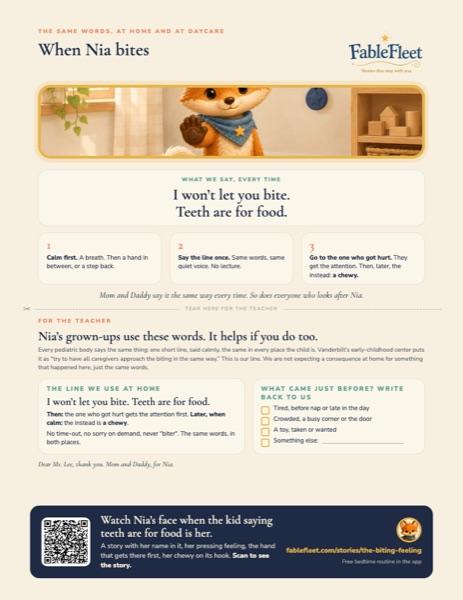
Vanderbilt's early-childhood center, in its guide for parents whose child bites, puts it in one line: “Try to have all caregivers approach the biting in the same way.” The American Academy of Pediatrics says to “keep in close contact with your child's teacher, school and other caregivers.” A two year old learns a line by hearing it exactly the same, over and over, from everyone. They cannot connect a lost toy at six o'clock to a bite at ten in the morning, which is why the early-years consultant Alistair Bryce-Clegg tells nurseries to say to parents that they do not expect a consequence at home. The card does the one thing that helps: it puts the same words in both places.
The line
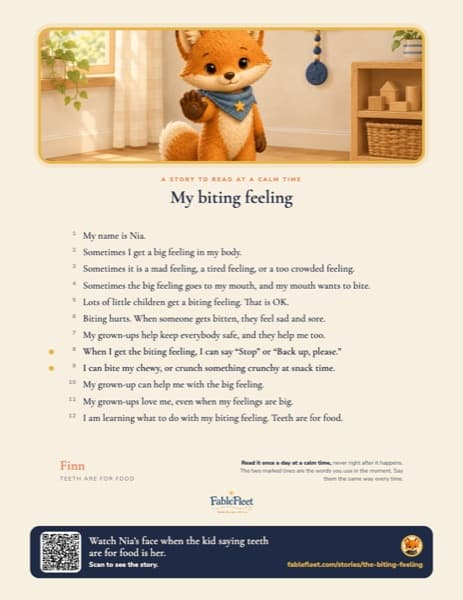
“I won't let you bite. Teeth are for food.” is the line our biting story uses, and it rests on a body's own words. “I won't let you” is the educator Janet Lansbury's, because it says what the grown-up will do rather than what the child must not. “Teeth are for food” is Vanderbilt's “Teeth are for chewing foods, not people.” Zero to Three's version is “No biting. Biting hurts,” said “in a firm, matter-of-fact voice (but not angry or yelling).” If your daycare already uses a line, use theirs on the card. Which line matters less than everyone using the same one.
The three steps
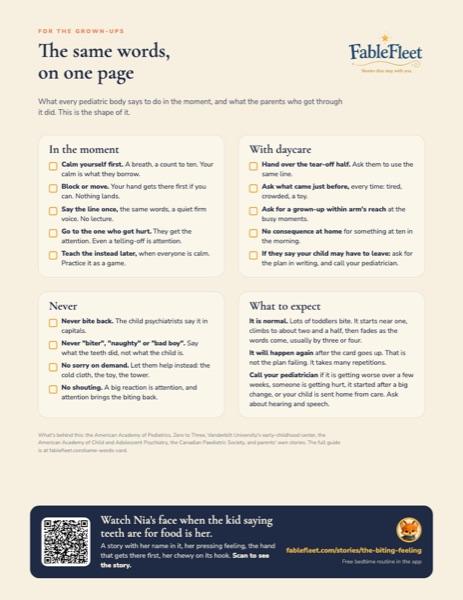
Calm first, because Zero to Three's first instruction is to “calm yourself before you respond.” Say the line once, because a lecture is attention. Then go to the one who got hurt: Vanderbilt's second step is “Focus most of your attention on the child who was bitten,” because “even negative attention can encourage the biting.” The instead is taught later, when everyone is calm, and practised as a game.
What the card never says
No “biter,” because Zero to Three says the label “can intensify the behavior and even instill it as part of their identity.” No sticker chart, no sorry box, no time-out. Nothing on it rates the child. The whole picture, why it happens and when it stops, is in toddler biting and hitting, and the daycare side is in biting and hitting at daycare.
Questions parents ask about biting
- What do you say when a toddler bites?
- One short line, said calmly, the same every time. Zero to Three's is "No biting. Biting hurts." Ours, from our story, is "I won't let you bite. Teeth are for food." Then most of your attention goes to the child who got hurt, and the alternative is taught later, when everyone is calm.
- Why should daycare use the same words as home?
- Because every body says the response has to be consistent, and a toddler cannot connect a consequence at six o'clock to a bite at ten in the morning. Vanderbilt's early-childhood center puts it as "try to have all caregivers approach the biting in the same way." The tear-off half gives the teacher the line you use, the instead, and a place to write back what happened just before.
- Should I punish my toddler at home for something that happened at daycare?
- No. The early-years consultant Alistair Bryce-Clegg tells nurseries to say so to parents: they should not expect a consequence at home. What helps is the same line and the same calm response in both places, and a grown-up within arm's reach at the busy moments.
- What is the instead?
- The one thing your child can do with the feeling. Zero to Three says a limit with no alternative is more likely to continue. For biting, a chewy that lives on a hook or something crunchy at snack, or "stop" and "back up, please" for the child who came too close. Pick one, put it on the card, and practise it as a game when nobody is upset.
- Is it normal for a toddler to bite?
- Yes. The research that followed thousands of children found physical aggression starts between the first and second birthday, climbs until about two and a half to three and a half, then falls as language grows. It is not a sign of a mean child or of bad parenting. Call your pediatrician if it is getting worse over a few weeks, someone is getting hurt, it started after a big change, or your child is sent home from care.
More biting and hitting guides
- Toddler biting and hitting: why it happens, what to say, and when it stops
- Biting and hitting at daycare: what to ask, what a good plan looks like
- A biting social story, free to print
- A hitting social story: gentle hands, free to print
- My Gentle Hands, the gentle hands social story to print
- Everything for biting
Sources
- CSEFEL (Vanderbilt University), “Responding to Your Child's Bite.” csefel.vanderbilt.edu
- Zero to Three, “Toddler Biting: Finding the Right Response.” zerotothree.org
- American Academy of Pediatrics, “Aggressive Behavior.” healthychildren.org
- American Academy of Child and Adolescent Psychiatry, “Fighting and Biting.” aacap.org