
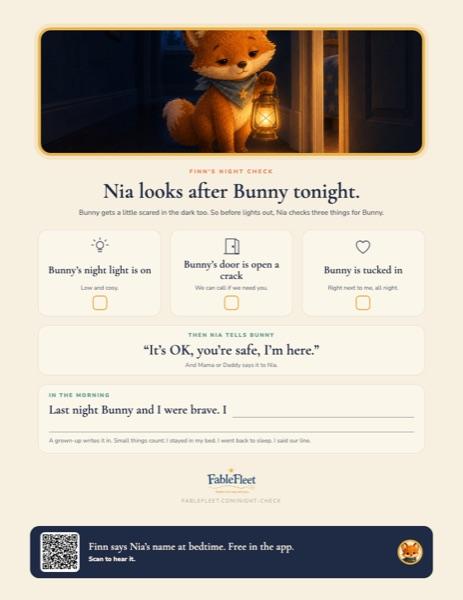
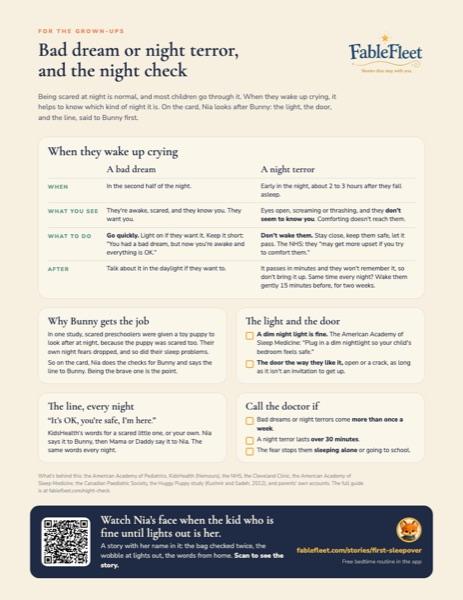
How the night check works
After the story, your child does the three checks, for their cuddly, not for themselves. Is its night light on? Is its door the way it likes it? Is it tucked in, right next to them? They tick each box. Then they tell it the goodnight line, and you say the same line to them. Left blank, the card uses KidsHealth's words for a scared little one: “It's OK, you're safe, I'm here.” In the morning, a grown-up writes in the brave thing. Small things count: I stayed in my bed. I went back to sleep.
Why the cuddly gets the job
It's the one idea about night fears that has been tested in a trial. Preschoolers with real night fears were given a toy puppy to look after, because the puppy was scared too. Their fears dropped, their sleep got better, and six months later it still held. Most children already sleep with something soft, and in a lot of houses, ours included, the 2 a.m. call is for the cuddly that went missing. The night check gives it a job.
Bad dream or night terror
A bad dream wakes your child in the second half of the night, scared and wanting you. Go quickly, put a light on if they want it, and keep it short. KidsHealth's line is a good one: “You had a bad dream, but now you're awake and everything is OK.” Talk about it in the daylight.
A night terror comes early, about 2 to 3 hours after sleep. Their eyes are open, they may scream or thrash, and they don't seem to know you. Don't wake them. Stay close, keep them safe, and let it pass; they won't remember it, so don't bring it up in the morning. The full guide is bad dreams and night terrors.
The light and the door
A dim night light is fine, and the door can be however your child likes it, open or a crack, as long as it isn't an invitation to get up. More on the dark in fear of the dark.
When to call the doctor
KidsHealth says to talk to your doctor if bad dreams or night terrors happen more than once a week, if a night terror lasts more than 30 minutes, or if the fear stops your child sleeping alone or going to school.
Questions parents ask
- Why does my child look after the toy, and not the other way round?
- Because that is the version that was tested. In a study of preschoolers with real night fears, children were given a toy puppy to look after because the puppy was scared too. Their night fears dropped, their sleep problems eased, and it held six months later. A child who is busy keeping someone else safe has a job, and a job is braver than a worry.
- Is a night light OK?
- Yes. Every pediatric body we read allows one, and they all say keep it dim. The American Academy of Sleep Medicine: "Plug in a dim nightlight so your child's bedroom feels safe." Low and away from the bed is the usual advice.
- How do I tell a bad dream from a night terror?
- A bad dream wakes your child, usually in the second half of the night, and they know you and want you. A night terror comes early, about 2 to 3 hours after they fall asleep: eyes open, screaming or thrashing, and they don't seem to know you. After a bad dream they may remember it. After a night terror they won't.
- Should I wake a child having a night terror?
- No. The NHS says do not try to wake them, because they may not recognise you and get more upset. Stay close, keep them safe, and let it pass. If it comes at the same time every night, the NHS suggests waking them gently about 15 minutes before, every night for two weeks.
- Is monster spray a good idea?
- The experts disagree. KidsHealth suggests a dose of pretend monster spray and a check under the bed. The Cleveland Clinic's pediatrician says checking for monsters can tell a child there is something to check for. If your family uses spray, keep it to one spray at lights out, by your child, and don't let it grow into a nightly hunt.
- What age is the night check for?
- About 2 and up, because it puts a soft toy in the bed, which is not advised for babies. It fits best from 3 to 6, the years when the dark, monsters and bad dreams arrive.
More on fears and being brave
- Childhood fears by age
- Fear of the dark
- Bad dreams and night terrors
- Books about being brave
- Everything for fears and being brave
Sources
- Kushnir and Sadeh (2012), “Assessment of brief interventions for nighttime fears in preschool children,” European Journal of Pediatrics. doi.org
- American Academy of Pediatrics, “Nightmares, Night Terrors & Sleepwalking in Children: How Parents Can Help.” healthychildren.org
- KidsHealth (Nemours), “Nightmares” and “Night Terrors.” kidshealth.org, kidshealth.org
- KidsHealth (Nemours), “Childhood Fears and Worries.” kidshealth.org
- NHS, “Nightmares and night terrors.” nhs.uk
- American Academy of Sleep Medicine, “Nightmares.” sleepeducation.org
- Cleveland Clinic, “Is Your Child Afraid of the Dark?” health.clevelandclinic.org