
· Updated
Slow to Warm Up: Helping a Child Who Is Scared to Try New Things
By Amanda and Ashley, two moms with four kids between us
The second time we went back to the play place, our daughter wanted me with her for the first couple of slides. Then she went on her own. Now she just goes. For a child who is slow to warm up and scared to try new things, that is the whole pattern. Let them watch first. Make the step smaller. Stay close, and don't push or rescue. Next time, start where they left off. And when they do it, say what they did.
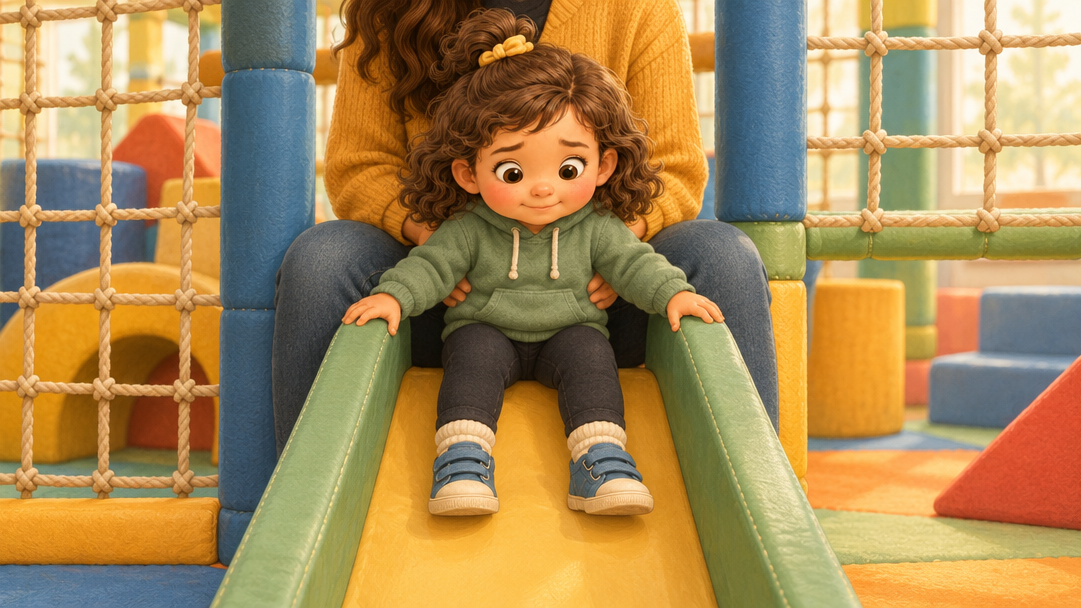
The second time we went back to the play place, my daughter wanted me with her for the first couple of slides. Then she went down on her own. Now, at the same place, she just goes.
The first time was harder. It was a birthday party, and she was scared to go down the slides with me, so I went with her round after round until she watched her friends go and then went down by herself. That whole story is in our guide to childhood fears. This post is about what came after, because the second visit is the part most of us miss. A child who is scared to try new things doesn't get over it in one afternoon. They pick up where they left off.
Coming soon, the story for this moment: Your child and the Big Slide, with your child in every scene. Free to print: Finn's night check, where your child looks after their cuddly at lights out.
Slow to warm up: why some children hold back
Some children run at the slide. Some stand at the bottom of the ladder for a long time. Both are normal. A cautious child isn't broken, and being careful at three is not a problem to fix. There's a name for it: slow to warm up.
What makes it hard is that the child usually wants to. They want the slide and they are scared of it, both at once. Pushing doesn't settle that, and neither does taking the slide away. The American Academy of Pediatrics says it plainly: "Do not try to pressure your child into being brave." It takes time, and the time is the point.
Scared of the slide? When your child is afraid to try
This is what worked at our house, and it is close to what the children's hospitals describe.
- Let them watch. Other kids going down, especially kids their size, is how a child collects proof that it is safe. Don't rush the watching.
- Offer a smaller step. The first couple of rungs and back down. The slide with you. The little slide before the big one. Make it a real offer, not a trick, and let them say no.
- Stay with them at each step. The children's hospital in Philadelphia puts it simply: your child needs your steady presence to get to the next step. Stand at the bottom. Be boring and calm.
- Don't push and don't rescue. Making them go makes it bigger. Carrying them past it keeps it alive, because they never find out they could have done it.
- Start where they left off. Ours was the first couple of slides together. Then she did the rest.
- Say what they did. You watched for a long time. Then you went down by yourself. She was proud of herself, and I made sure to touch on that.
The parents we read who had the hardest time were the ones who tried to make it happen in one go. The ones who went smaller and slower got there, sometimes after weeks, sometimes after months.
How long does it take a child scared to try new things?
Longer than one afternoon, and that is fine. For us it was one party and one more visit. In the parents' stories it ranged from a few days to the better part of a year, and in none of them did pushing make it shorter.
The Canadian pediatricians put the rule simply: "Never force your child to confront a fear before they are ready." Ready often arrives on its own schedule, usually right after a lot of watching.
There is one line worth knowing. They say even a very cautious three year old should settle into a new situation, like daycare, within a few weeks. If a fear is stopping your child from playing, going to daycare or being apart from you for longer than that, mention it to your doctor.
When your child is scared to try new things at a party
A party is a lot at once: noise, new kids, a new place. Plenty of children who love the idea of a party cling to a parent when they arrive.
The parents' stories here have a shape. Most stayed. They did the games with their child at first and slowly became more boring, a safe base rather than the main event. One regretted letting her son hear himself called shy. That word sticks.
One children's hospital suggests starting small: if a big party feels like too much, have a couple of the friends over first, so the faces are familiar when the day comes. And at the party itself, the same steps apply. Let them watch from your side. Let them join one game, not all of them.
Scared of swimming lessons? Afraid of the pool
Swimming lessons are where this goes wrong most often, because there is a class and a schedule and a teacher who wants everyone in.
The parents' accounts are clear on what didn't work: a crying child carried round the deep end, or told to stop crying and sent out. Those are the stories where the pool got worse.
What did work was smaller and slower. A private lesson with a parent allowed in the water. Walking around the shallow end with no lesson at all. Waiting six months or a year and trying again: one boy who hated his first lesson at five was fine six months later. One girl only played in the pool until she was five, then did seven levels in two years.
If your child won't put their face in the water, we made a story for exactly that moment: First Swim Lesson, for ages three to six.
Free printable
Finn's night check, with your child's name on it
Your child looks after their cuddly tonight: its light, its door, tucked in, and the line said to it first. Plus a page for you: bad dream or night terror, side by side, and what to do at 2 a.m. Nothing you type leaves your device.
Who they look after (what goes to bed with them)
The light at night
The door (optional)
Your goodnight line (the same words every night)
Left blank, the card uses KidsHealth's words for a scared little one: “It's OK, you're safe, I'm here.”
Who comes if they call (tap one or two)
Two sheets: the night check for your child, and a page for you. Your answers go into the print page in the address after the #, which your browser never sends to us. How the night check works.
Books for a child scared to try new things
Two picture books get the grown-up right. In Jabari Jumps, a boy climbs the diving board, isn't ready, and his dad tells him being scared is okay and waits, with no push at all. In The Thing Lou Couldn't Do, Lou tries to climb a tree and doesn't make it yet, and that is okay too. More are in our list of books about being brave.
The Big Slide: a story for a child scared to try new things
We made the Big Slide out of exactly this. Your child, by name, stands at the bottom of a slide that looks bigger in person. They watch one child go down, then another, then one exactly their size, who gets to the bottom completely fine. The grown-up offers three steps instead of the whole thing. Nobody pushes and nobody rescues. One hand on the rail, and the deciding happens on the inside, where nobody else can reach it.
They go down still a little scared, which is the point. On the walk home it is just a plain list of what happened: you watched for a long time, you climbed three steps, then you climbed the rest. Your child is in every scene, and Finn hides in three of them. It is for ages three to six.
If the fear is at night instead, start with fear of the dark.
More in Anxiety and Fears
- Childhood Fears by Age 2 to 6: What Helped at Our House
At a birthday party at an indoor play place, our daughter was scared of the slides. So I went down with her, again and again. Near the end she watched some friends go, and then she went down by herself, with me at the bottom. Next time she wanted me for the first couple. Now she just goes. That is most of what the pediatricians say about childhood fears. Stay with them, make the step smaller, and don't push. Most fears come and go with age. Call the doctor if a fear stops sleep, school or play.
- Book About Being Brave: Picture Books for Scared Kids, Sorted by Fear
The best book about being brave for a scared child is one where nobody pushes and nobody laughs at the fear. For a daytime try, start with Jabari Jumps: his dad says it's OK to be scared and waits. For the dark, Can't You Sleep, Little Bear? has a grown-up who comforts and stays. For monsters at two or three, Go Away, Big Green Monster! lets your child send the monster off. Read any new one in the daytime first. A few have surprised parents.
- Can Babies Have Nightmares? Infant Bad Dreams, Baby to 4
When our kids were babies, they would wake up screaming from time to time, and we usually put it down to teething or a growth spurt. Nobody really knows if babies have nightmares. The pediatric sources disagree. Bad dreams a child can tell you about usually start in the preschool years. Night terrors are different, and they are most common around a year and a half. For a bad dream, go to them quickly and keep it short. For a night terror, don't wake them. Stay close, keep them safe and wait.
- Fear of the Dark in Kids: What We Do at Bedtime, and What the Pediatricians Say
Bedtime at our house ends the same way every night. The Gro Clock glows blue and lights the room a tiny bit. The door stays open. Bunny is in the bed. We say goodnight, love you, and she listens to one of our bedtime stories in the app with the phone face down. That is most of what the pediatricians say about fear of the dark. A dim light, the door the way they like it, something soft to hold, the same words, and nothing scary before bed. It often starts between two and four, and it can last into the early school years.
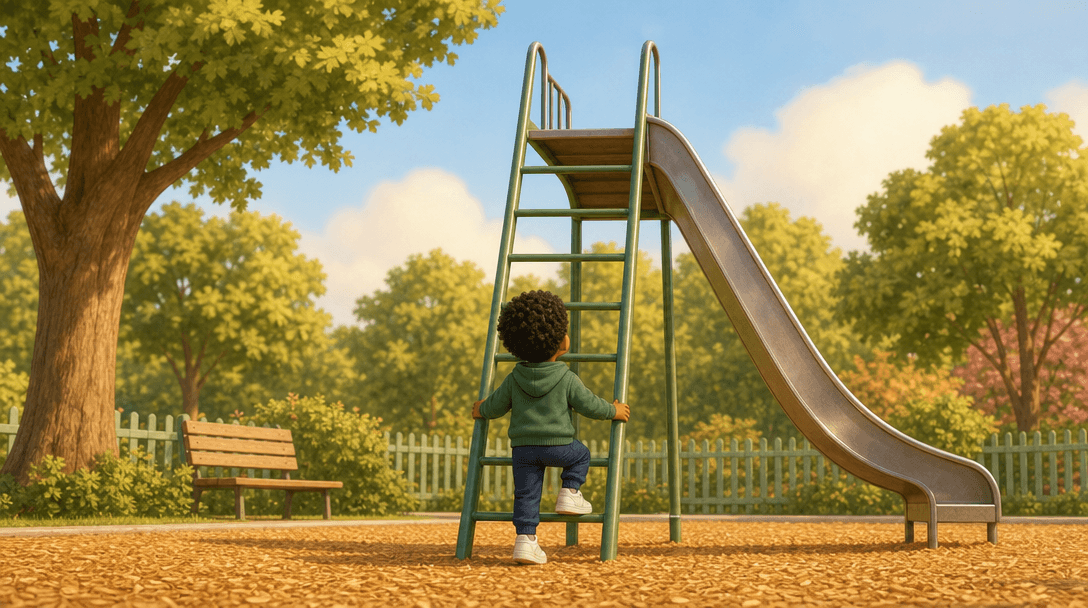
Coming soon
For the child who wants to and cannot, both at once
A personalized story for a cautious child: the thing that looks bigger in person, the watching, three steps instead of the whole slide, and going with the fear still there. A 2.5 minute story.
We’re still making this one. Your child, by name, in every scene.
Frequently asked questions
- Why is my child scared to try new things?
Some children are simply more cautious, and that is normal. Often they want to do the thing and are scared of it at the same time. Watching first, a smaller step and a grown-up who stays close help that settle over time.
- Should I make my child try the slide?
No. The American Academy of Pediatrics says not to pressure a child into being brave, and making them go tends to make the fear bigger. Offer a smaller step instead, like the first couple of rungs or the slide with you, and let them choose.
- Is it OK to let my child just watch?
Yes. Watching other kids, especially kids their own size, is how a child collects proof that it is safe. It is getting ready, not avoiding it. Stay close and don't rush it.
- What should I do if my child is scared of swimming lessons?
Go smaller and slower. Parents who tried a private lesson with a parent allowed in, or just time in the shallow end with no lesson, had better luck than those who kept a crying child in class. Waiting a few months and trying again often works too.
- When should I talk to the doctor about a slow to warm up child?
If a fear stops your child from playing, going to daycare or being apart from you, and doesn't ease within a few weeks, mention it to your doctor. The Canadian Paediatric Society says even a very fearful three year old should settle into a new situation within a few weeks.
Sources
- American Academy of Pediatrics, HealthyChildren.org, Fears & Phobias in Children: How Parents Can Help
- Canadian Paediatric Society, Caring for Kids, Helping children deal with their fears
- Children's Hospital of Philadelphia, Tackling Irrational Fears in Children and Teens
- Children's Health, Childhood fears: What's common and how can you help?
- Child Mind Institute, What to Do (and Not Do) When Children Are Anxious
- Jabari Jumps, Gaia Cornwall
- The Thing Lou Couldn't Do, Ashley Spires
Co-founders and moms, FableFleet
Two moms, four kids between us. We write about the moments we are living through, and we made the bedtime routine and stories our own kids use.