
What the gentle hands social story says
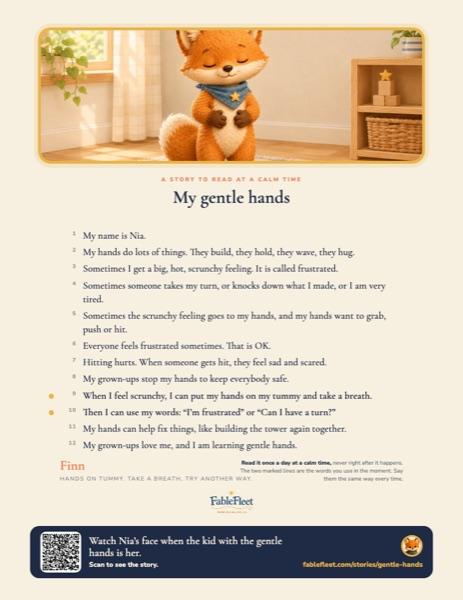
Ten of the twelve lines describe. Your child's hands build, hold, wave and hug. Sometimes a big, hot, scrunchy feeling comes, when someone takes their turn, knocks down what they made, or it has been a long day. It is called frustrated, and everyone feels it sometimes. Hitting hurts, and the grown-ups stop the hands to keep everybody safe. Two lines say what your child can do: put their hands on their tummy and take a breath, then use their words, “I'm frustrated” or “Can I have a turn?” It ends with hands that help build the tower again and grown-ups who love them.
That shape comes from Carol Gray, who created social stories: “Descriptive Sentences appear at least four times as often as Coaching Sentences.” No rough, no naughty, no reward at the end. The story keeps the feeling and the hurting apart, because the feeling is allowed and the hurting is not.
How to use a gentle hands social story at home
Read it once a day at a quiet time, the same way, for a week or two. Never straight after a hit, when it would be a telling-off. Practise hands on tummy and a slow breath as a game when nobody is upset, and the two sentences with it, so they are easy to reach for when somebody is. Zero to Three tells parents to “teach your child strategies to handle frustration such as walking away to take a break, or taking a deep breath.” Hands on tummy gives the hands somewhere to go while the breath happens. If you have the Gentle Hands story, watch it together first: it is the same breath and the same words.
The same words card for hitting at daycare
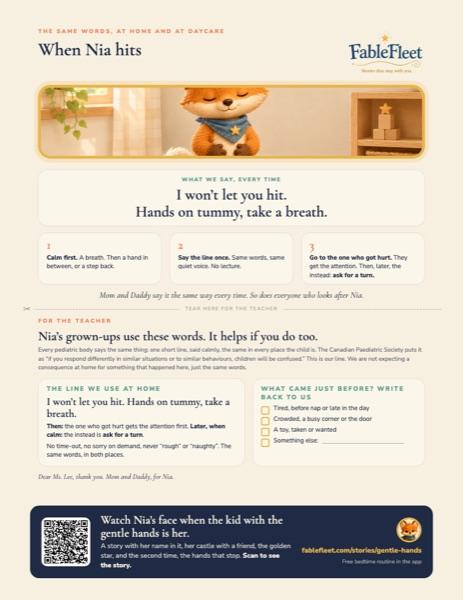
The card puts one line on the fridge and the same line in the teacher's hand: “I won't let you hit. Hands on tummy, take a breath.” Under it go the three steps, calm, the line once, then the child who got hurt, and the one instead you picked. The Canadian Paediatric Society says why it matters: “If you respond differently in similar situations or to similar behaviours, children will be confused.” If your daycare already has a line, put theirs on the card. Which line matters less than everyone saying the same one.
Questions parents ask about hitting
- What is a gentle hands social story?
- A short story in your child's own voice about the big feeling that goes to their hands, what hitting does to other people, and what they can do instead. Most of the lines describe. Only the two "I can" lines tell your child what to do. You read it at a calm time, never as a telling-off.
- What age is a hitting social story for?
- Toddlers and preschoolers, about two to five. Hitting usually peaks around two, when the feelings are big and the words are few, and it fades as the words come, usually by three or four. For a two year old, read it slowly and point to Finn and the hands.
- What do you say when a toddler hits?
- One short line, said calmly, the same every time. Ours, on the card, is "I won't let you hit. Hands on tummy, take a breath." It is the line from our Gentle Hands story, so your child has heard it before. Then go to the child who got hurt, and teach the words later, when everyone is calm.
- What can my child do instead of hitting?
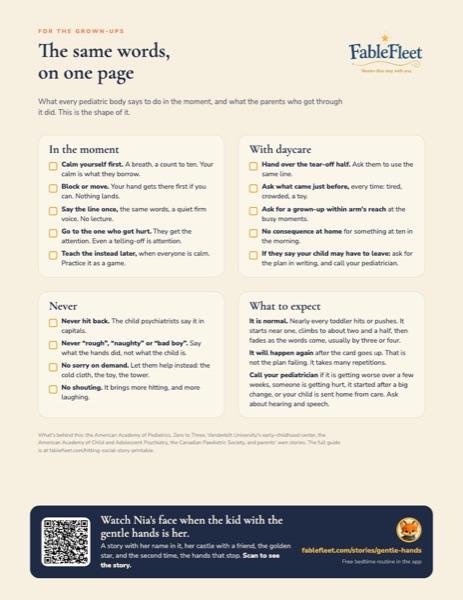
- Hands on tummy and a slow breath first, then the words: "I'm frustrated" or "Can I have a turn?" The pediatricians say toddlers need to learn to "express their feelings through words" instead of hitting. Practise it as a game when nobody is upset, and put it on the card so home and daycare teach the same thing.
- When should I call the doctor about hitting?
- Call your pediatrician if it is getting worse over a few weeks, someone is getting hurt, it started after a big change, or your child is sent home from care.
More on hitting and biting
- A no hitting social story: why toddlers hit and what to say
- Toddler biting and hitting: why it happens, what to say, and when it stops
- Biting and hitting at daycare: what to ask, what a good plan looks like
- The same words card for biting, with My Biting Feeling
- Everything for hitting
Sources
- Carol Gray, “Social Stories 10.4 Criteria.” carolgraysocialstories.com
- Zero to Three, “Aggressive Behavior in Toddlers.” zerotothree.org
- Canadian Paediatric Society, “Positive discipline for young children.” caringforkids.cps.ca
- American Academy of Child and Adolescent Psychiatry, “Fighting and Biting.” aacap.org
- American Academy of Pediatrics, “Aggressive Behavior.” healthychildren.org